
DELAG brochure
The world’s first passenger airline, DELAG (Deutsche Luftschiffahrts-Aktiengesellschaft, or German Airship Transportation Corporation Ltd) was established on November 16, 1909, as an offshoot of the Zeppelin Company. The company provided passenger air service until 1935, when its operations were taken over by the newly-formed Deutsche Zeppelin-Reederei.
While many of the early flights were sightseeing tours, the DELAG airship Bodensee began scheduled service between Berlin and southern Germany in 1919. The flight from Berlin to Friedrichshafen took 4-9 hours, compared to 18-24 hours by rail. Bodensee made 103 flights and carried almost 2,500 passengers, 11,000 lbs of mail, and 6,600 lbs of cargo.
DELAG offered the world’s first transatlantic passenger airline service, using LZ-127 Graf Zeppelin to make regular, scheduled flights between Germany and South America beginning in 1931. Graf Zeppelin crossed the South Atlantic 136 times before being retired after the Hindenburg disaster in 1937.
DELAG also employed the world’s first flight attendant, Heinrich Kubis.
The Origins of DELAG
DELAG’s goal was to commercialize zeppelin travel by providing passenger air service, and to purchase airships built by the Zeppelin Company at a time when support by the military was still uncertain. DELAG was created under the leadership of Zeppelin Company executive Alfred Colsman, who was was married to the daughter of aluminum manufacturer Carl Berg, who supplied aluminum for Count Zeppelin’s airships.

Alfred Colsman (far left) and Count Zeppelin (center, in white yachting cap)

DELAG Before World War I
Between 1910 and the outbreak of World War I in 1914, DELAG zeppelins carried over 34,000 passengers on over 1,500 flights, without a single injury. The majority of the passengers were given free flights to publicize the zeppelin industry (especially members of German royalty, military officers, aristocrats, government officials, and business leaders), but DELAG also carried 10,197 paying passengers before having to cease operations with the beginning of the war.

Passengers aboard a luxurious DELAG zeppelin
DELAG used hangars and landing fields at Frankfurt, Oos (Baden-Baden), Dusseldorf, Lepizig, Postdam, Hamburg, Dresden, Gotha, and elsewhere in Germany (click links for photos), and sold tickets in cooperation with the Hamburg-Amerika steamship line as ticket agent.

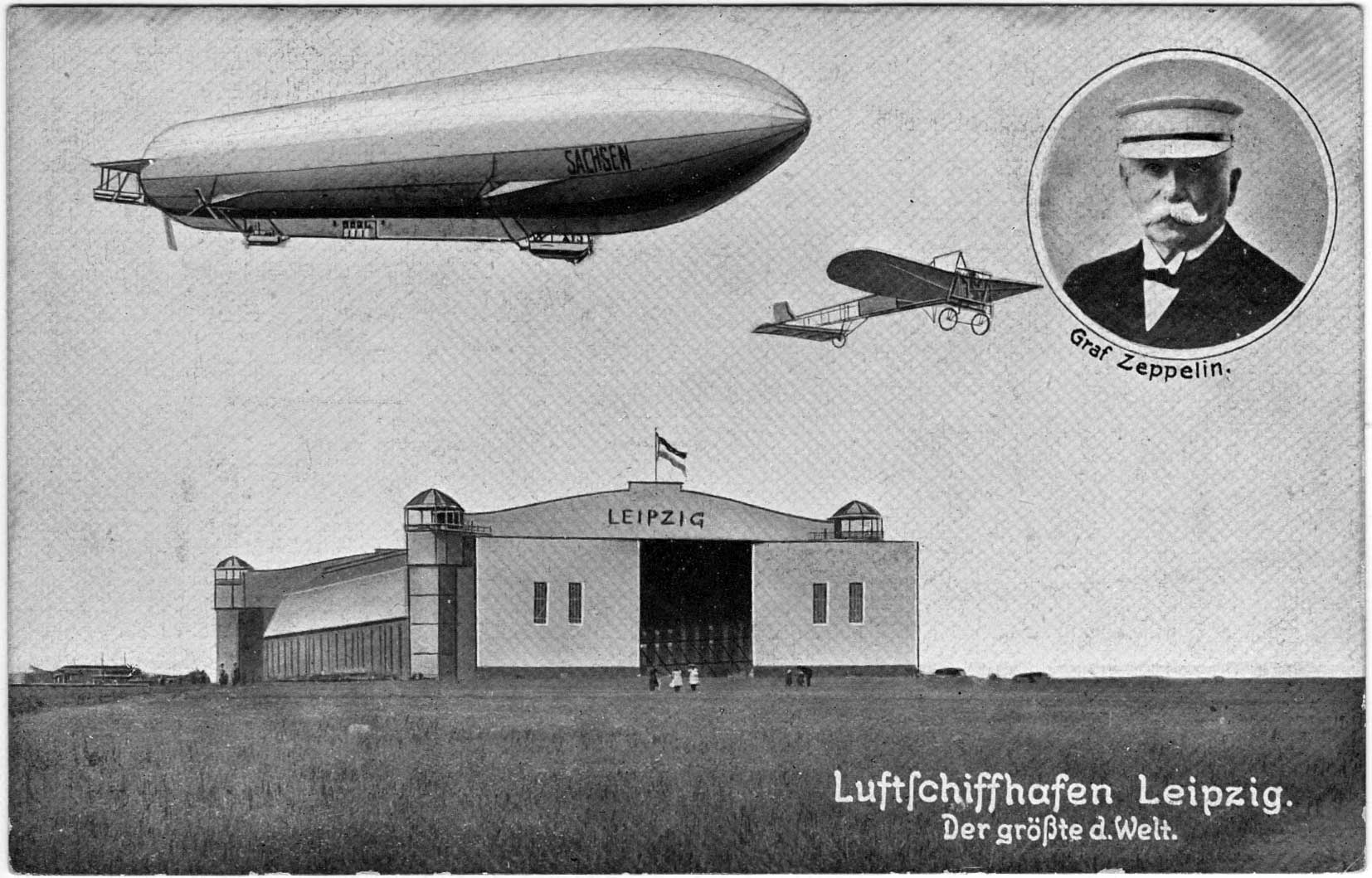
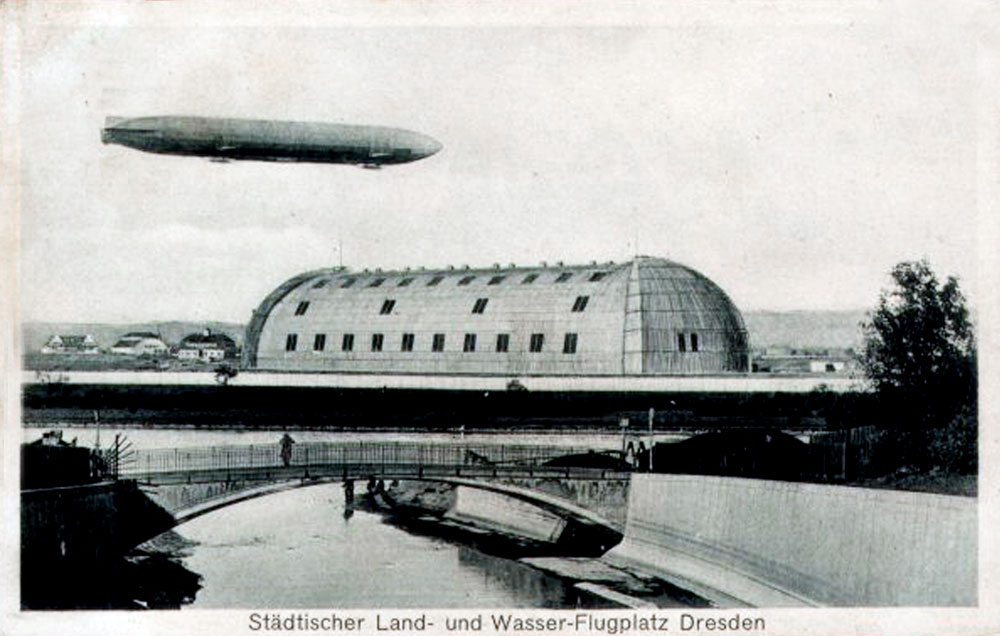
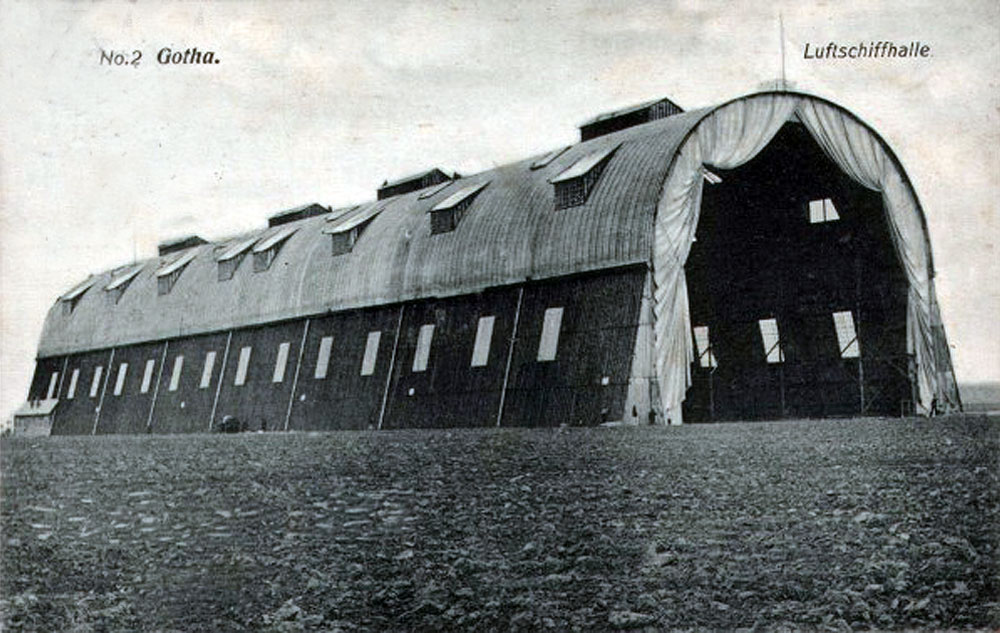
DELAG was not able to fulfill its goal of providing regularly scheduled intercity passenger service before 1914, but its pre-war zeppelins introduced thousands of people to air travel.
DELAG After World War I
The revolutionary design of the airship LZ-120 Bodensee, introduced in 1919, finally allowed DELAG to compete with the railways and offer daily passenger service between Friedrichshafen and Berlin. Beginning August 24, 1919, Bodensee flew northbound to Berlin on odd days of the month, and returned south to Friedrichshafen on even days; the flights included a stop at Munich until October 4, 1919.
DELAG acquired a second ship from the Zeppelin Company in 1920; LZ-121 Nordstern was intended to provide international passenger service between Friedrichshafen, Berlin, and Stockholm, but had not yet gone into service when DELAG was forced to cease operations by the Military Inter-Allied Commission of Control estalished under the Treaty of Versailles. DELAG’s two airships were transferred to the Allies as war reparations: LZ-120 Bodensee was given to Italy, and LZ-121 Nordstern was given to France.
DELAG Airships
- LZ-7 Deutschland
- LZ-8 Deutschland II
- LZ-10 Schwaben
- LZ-11 Viktoria Luise
- LZ-13 Hansa
- LZ-17 Sachsen
- LZ-120 Bodensee
- LZ-121 Nordstern
LZ-7 Deutschland
Deutschland has the distinction of making the first commercial flight of the first commercial aircraft in history, but it was a flight which ended in a crash.

LZ-7 in flight

LZ-7 in flight

Mahogany paneled passenger cabin of LZ-7
LZ-7 departed Dusseldorf on its seventh flight, on June 28, 1910, with Zeppelin Company director Alfred Colsman and a full complement of 23 passengers, mainly journalists covering the flight, enjoying the view from its carpeted, mahogany-paneled, mother-of-pearl-inlayed passenger cabin.
Before long, due to a combination of engine trouble, weather, and the relative inexperience of the ship’s military pilot, LZ-7 crashed into the Teutoburger Forest and was destroyed. Fortunately, there were no serious injuries.

Passenger cabin of LZ-7 (with thanks to Andreas Horn)

Wreckage of LZ-7 at its crash site in the Teutoburger Forest
LZ-8 Deutschland II
LZ-8 was launched March 30, 1911, intended to replace the wrecked LZ-7.

LZ-8 Deutschland II
Unfortunately, LZ-8, also named Deutschland, had a similarly short career. On May 16, 1911, with Hugo Eckener in command of an airship for the first time, LZ-8 had barely left its hangar when it was pulled from its handling crew by a gust of wind and smashed against the roof of the hangar; the passengers and crew were able to escape without injury by climbing down a long fire ladder, but the ship was a total loss.

Wreck of LZ-8 Deutschland II
It has often been said that the almost predictable wreck of LZ-8 — the day’s gusty wind conditions made the flight ill-advised from the start — contributed to Hugo Eckener’s intense caution in the future, and his determination never again to sacrifice safety to pressure from passengers, the public, or any other source.
LZ-10 Schwaben
Schwaben was launched June 26, 1911, and entered passenger service the next month, on July 16, 1911. Frequently commanded by Hugo Eckener, LZ-10 made over 200 flights and carried over 4,300 passengers, mostly on local flights from the hangar at Oos (Baden-Baden), but also from Dusseldorf, Potsdam, and Frankfurt, and occasionally from other cities.

LZ-10 Schwaben in flight
Schwaben was destroyed by a fire and hydrogen explosion at Dusseldorf on June 28, 1912.

Wreck of LZ-10 Schwaben
LZ-11 Viktoria Luise
LZ-11 first flew on February 14, 1912, and was named after Princess Viktoria Luise of Prussia, the only daughter of Kaiser Wilhem II.


LZ-11 Viktoria Luise
The ship made local sightseeing flights, mostly from Frankfurt, but also from Postdam, Oos (Baden-Baden), and a few other cities. LZ-11 made almost 500 flights, carrying almost 10,000 passengers.

LZ-11 Viktoria Luise at Oos (Baden-Baden)

Passenger cabin of LZ-11 Viktoria Luise
Viktoria Luise was transferred to the German Army at the beginning of World War I and used as a training ship for the military.

Relative sizes of LZ-11 Viktoria Luise, LZ-120 Bodensee, LZ-127 Graf Zeppelin. and LZ-129 Hindenburg
LZ-13 Hansa
Hansa made the first international flight by a DELAG ship, traveling from Hamburg to Copenhagen and back on September 19, 1912. Hansa’s first flight was on July 12, 1912, and it carried over 8,200 people on almost 400 flights, mostly from Hamburg and Postdam, but on occassion from other cities such as Leipzig, Gotha, and Berlin. Hansa was last based in Dresden until the outbreak of World War I, when it too was transferred to the Army as a training ship.

Passenger cabin of LZ-13 Hansa
LZ-17 Sachsen
LZ-17 made its first flight on May 13, 1913. Sachsen was the first ship commanded by Ernst Lehmann, who received his airship training in the ship from Hugo Eckener.
During 1913, Sachsen was used mainly for local sightseeing flights at Oos (Baden-Baden) and Leipzig, with occasional flights from Hamburg, Dresden, and other cities.

LZ-17 Sachsen
In 1914 the ship made most of its flights from Hamburg, with additional flights from Potsdam and Leipzig.
Sachsen proved to be an extraordinarily successful ship for DELAG, and carried 9,836 passengers on 419 flights in civilian service.

Sachsen with the zeppelin hangar at Leipzig
With the outbreak of war in August, 1914, Sachsen was transferred to the Army as a training ship, still under the command of Ernst Lehmann, and the leader of the German Navy’s airship service, Peter Strasser, received his training from Eckener and Lehmann aboard Sachsen. Sachsen was later modified to incorporate bomb racks and machine guns and made numerous bombing attacks on targets in Belgium, France, and England. The ship was dismantled in 1916.
LZ-120 Bodensee
The first civilian zeppelin built after the war, LZ-120 was primarily designed to provide fast air transportation between Friedrichshafen and Berlin. Construction was completed within six months, and the ship, named Bodensee, made its first flight on August 20, 1919.

Wind tunnel testing of design for LZ-120 Bodensee
Bodensee’s highly advanced and aerodynamically-determined teardrop shape (which differed greatly from the thin, pencil-like shape of most previous zeppelins) was a great leap forward in zeppelin design, due primarily to the engineering theories of designer Paul Jaray. With its revolutionary design and four 245 hp Maybach MB.IVa engines, LZ-120 Bodensee could reach a speed of 82 MPH.
LZ-120’s shape provided less drag, increased speed, and greater aerodynamic lift, and became the basic model from which LZ-126 Los Angeles, LZ-127 Graf Zeppelin, and LZ-129 Hindenburg were adapted.

LZ-120 Bodensee

LZ-120 Bodensee passenger cabin
A relatively short, small ship, Bodensee carried 706,000 cubic feet of hydrogen (later increased to 796,300 during a refit).
Bodensee traveled the 370 miles between Friedrichshafen and Berlin in 4-9 hours, compared to the 18-24 hours it took by rail. With washrooms and a small kitchen for light meals, Bodensee could carry up to 26 passengers in comfort as well as speed. In the three months after the ship’s launch, LZ-120 made 103 flights (almost all of them between Friedrichshafen and Berlin) and carried almost 2,500 passengers, 11,000 lbs of mail, and 6,600 lbs of cargo.

LZ-120 Bodensee
LZ-120 was taken from DELAG by the Military Inter-Allied Commission of Control and delivered to Italy on July 3, 1921, where it was renamed Esperia.
LZ-121 Nordstern
LZ-121 was built to provide the first international passenger zeppelin service, with plans for scheduled flights between Friedrichshafen, Berlin, and Stockholm. LZ-121 was completed in 1920 and christened Nordstern, but the ship was taken from DELAG by the Military Inter-Allied Commission and delivered to France on June 13, 1921, and renamed Méditerranée.
What was the first passenger airship built for overnight travel? One that offered sleeping accommodations?
Although constructed for the U.S. Navy, LZ-126 was built as a passenger ship with compartments and sleeping berths. The first airship with sleeping berths that actually carried paying commercial passengers was LZ-127.
Great Read! Although I really want to get these old Zeppelins another chance to start over again. I can see it now, a ship like the LZ-126 but would be 790′ instead of 668′ could be rebuilt and used as an alternative for people who get sea sick or don’t… Read more »
Good piece of work, I just like to add that the word ” Luftschiffahrt” is actually spelled like that: ” Luftschifffahrt”. ” Schiff” does mean ship in german and ” Fahrt” does mean ride or journey. 🙂
Using three “f” letters would seem to make sense, but the company did spell its name with two.
Dan, you are right, and “Luftschifffahrt” is only spelled this way since a spelling reform in 1996. Before, the combination of two words into one would reduce the number of consecutive consonants to two when those consonants were followed by a vowel. The reform in its attempt at dumbing down… Read more »
A wonderful and exiting reading about commercial aviation. Its one of my favorites subjects because I work in the industry. I enjoyed reading about the lives of many German pioneers of aviation, they were the heroes of the time and continue to live in our collective memories.
Thank you
Sal Hernandez
I finished designing the Bodenseee and the schematic drawings, juggling that with school and other things it looks more like the LZ 120 Bodensee crossed with the LZ 129 Hindenburg than either specifically. Hopefully it flies…. Still have to buy the aluminum girders, metallized plastic and helium… And the Remote… Read more »
I am planning to build a modified RC Helium Zeppelin this summer, after my trip to Friedrichshafen. It will be a small scale carbon-fiber LZ-120; mine will be designated as the RZ-1 Bodensee (RZ naturally standing for Rigid Zeppelin) and will be the first of 5 of my ZR Project… Read more »
can somebody please help me? how did delag airline influenced the existence or establishment of the diff. airlines?
What a novel and revolutionary design. I believe there was another designer of German zeppelins besides the Count who built a teardrop shaped hull with diagonal girders made of plywood. The efficiency of the hull was proven then too. The Bodensee concept is what I feel is needed now to… Read more »
No, please! Sparks and hydrogen-lofted airships together, bad idea!
I seriously doubt the FAA would certify an airship filled with hydrogen, although considering your average Airbus jet liner is a flying gas can filled with volatile aviation fuel, the hydrogen airship is an even chance. What made them an issue in the 1930’s was the fact the gas cells… Read more »
My original comment was a silly play on words from the earlier post. And yet, it does speak to a valid concern. While, yes, mylar is a fabulous material, it has the notable problem, for this application, that it collects static electricity; the local atoms collect the charge but will… Read more »
Thank you for your reply – a great read! I heard that helium is in very short supply and may not be available as much as before. This will have a huge impact on the LTA industry to date, and the tactics of the USN during the tight years of… Read more »
Hi. But as an ex military meteorologist. I must add. That any gas is very sensitive to temperature and pressure change. That is what destroyed most of the American airships.
Europe had more stable and cooler climate. That is why Germany was so successful to fly them with good safety record.
The name of the other german company was Schütte-Lanz. They pioneered the familiar teadrop shape and cruciform tail.
They had a wooden hull structure in an interesting diagonal girder arrangement that did away with the right angle corners and moment connections.
Reading “Giants in the Sky” which has much on the Shutte-Lanz airships. They were competitors to the Zeppelin products and were headed by a gentleman with as big an ego as the Count had. That being said, he simply chose spruce plywood to build his airships out of simply to… Read more »
The other company was Schütte-Lanz. Johann Schütte was a professor for naval engineering and Karl Lanz the heir to a successful company for farming equipment. The first ship did have a geodesic frame made from plywood, but later designs used the more conventional technique with vertical frames and horizontal stringers.… Read more »
Dan – the writeup read four Maybach engines. I only see three on the Bodensee.
Stu, There are two engines side by side in the rear gondola driving a single prop.
I’m interested in the idea of a ship like Bodensee/Nordstern for trips across the Gulf Coast. New Orleans, Mobile, and Pensacola, for example. Any thoughts?
I can imagine airships taking their place as vacation or luxury cruises in a lot of places. Think about floating over the Grand Canyon, for instance. I took one of those helicopter flights and I’d sure sign up for an airship flight if I could afford it!
Sure, why not? Florida offers flat land with plenty of lakes for mounting floating hangers that can vane in the wind. Florida would make a good place to fly to the Bahamas to the East, and the Gulf to the West. Such flights could be had in 48 hour lengths… Read more »
As a meteorologist. I would not like to fly airships in that part of America. The Gulf is where many tornadoes etc are borne. Western America is notorious for vicious weather changes. Airships are only safe following the contours of stable pressure and temp.
Hi. I am a retired military meteorologist. Sadly in America, the weather conditions in the southern states. Were the reason that all ships were lost due to quick changing weather conditions. gas reacts quickly to temp and pressure changes. Sadly there is no answere to that. I would not consider… Read more »