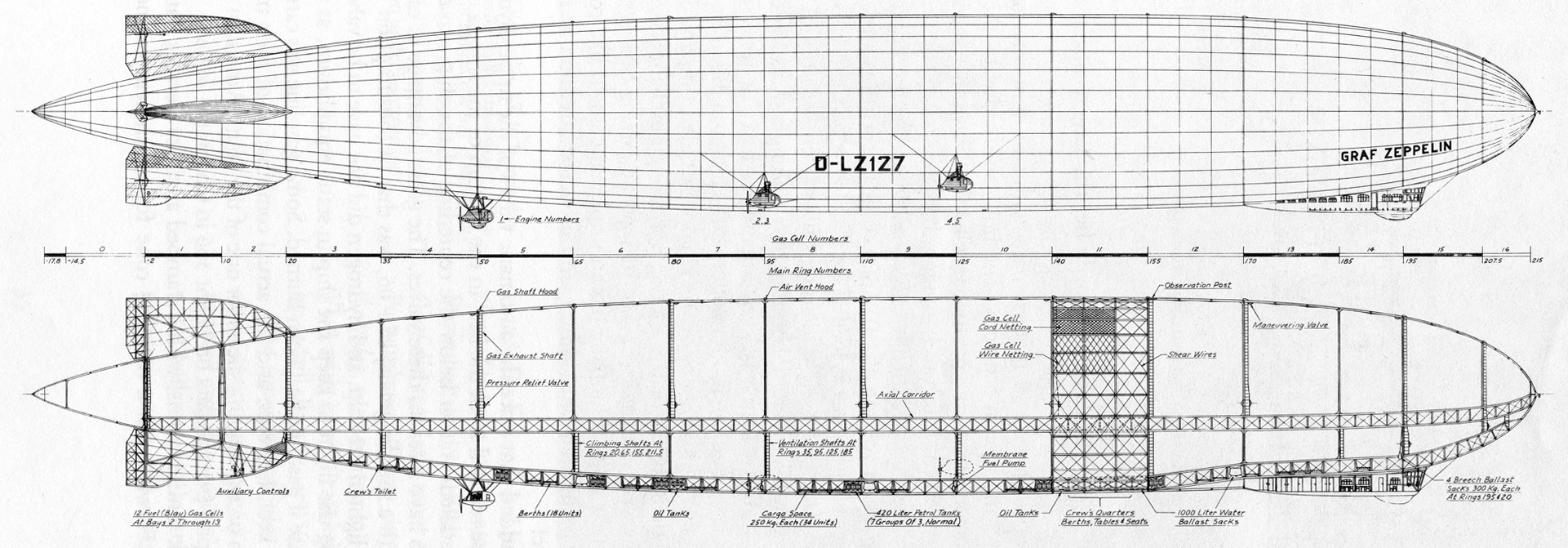
Graf Zeppelin’s Interior: The Gondola
The control room and passenger areas on the Graf Zeppelin were both located within the airship’s 98′ long gondola.
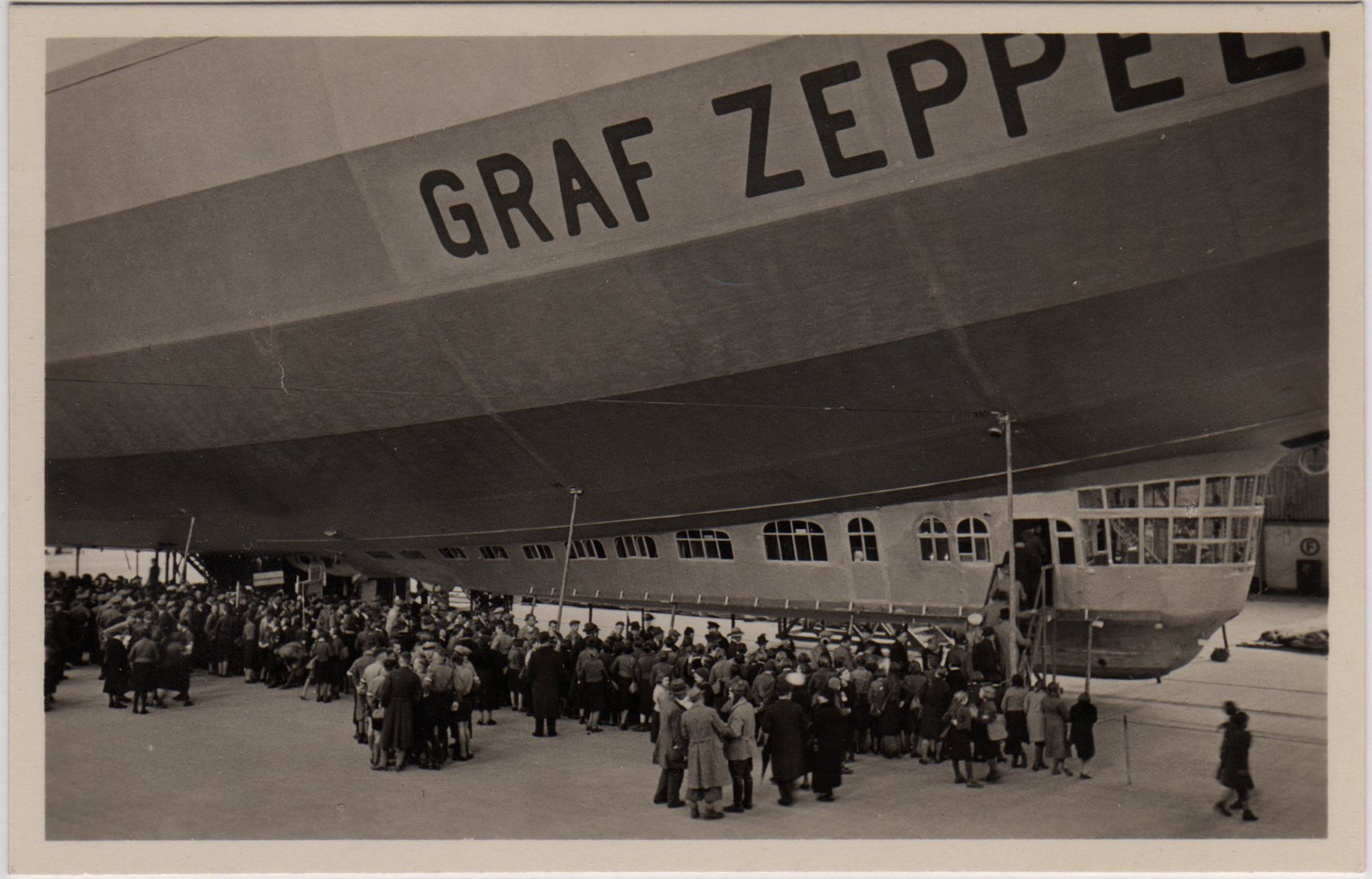
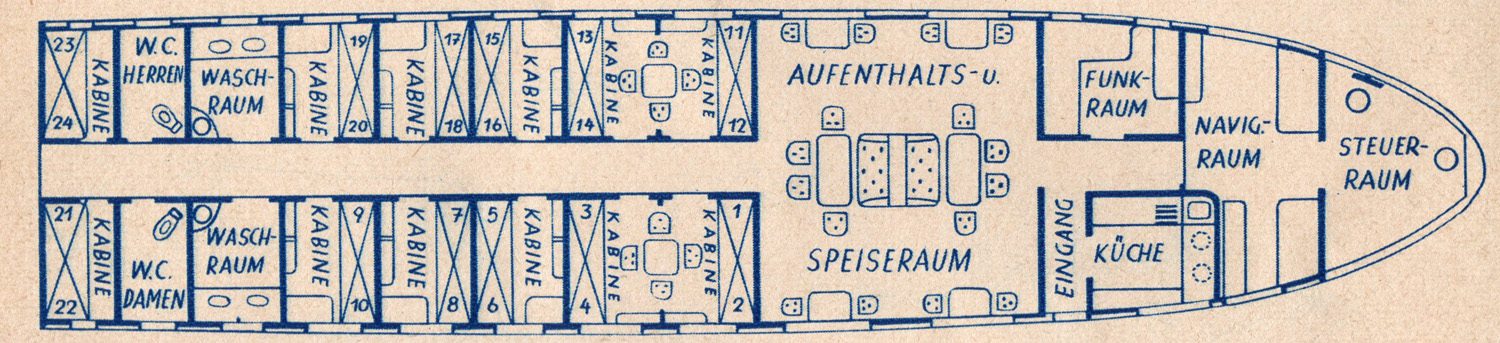
As seen in the deckplan included in this 1934 brochure, the ship’s control room was located at the very bow of the gondola, just ahead of the chart room, radio room, and kitchen.
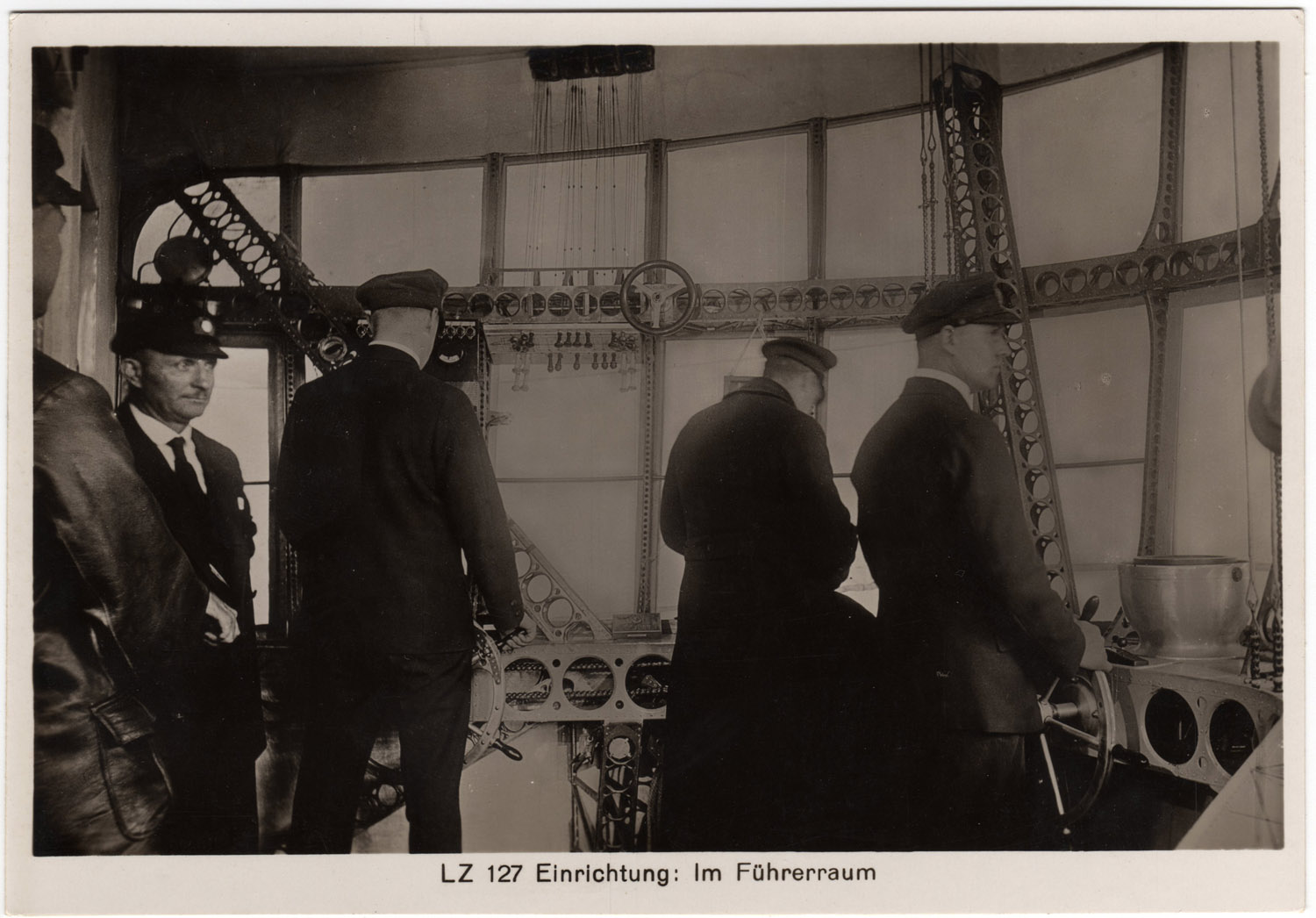
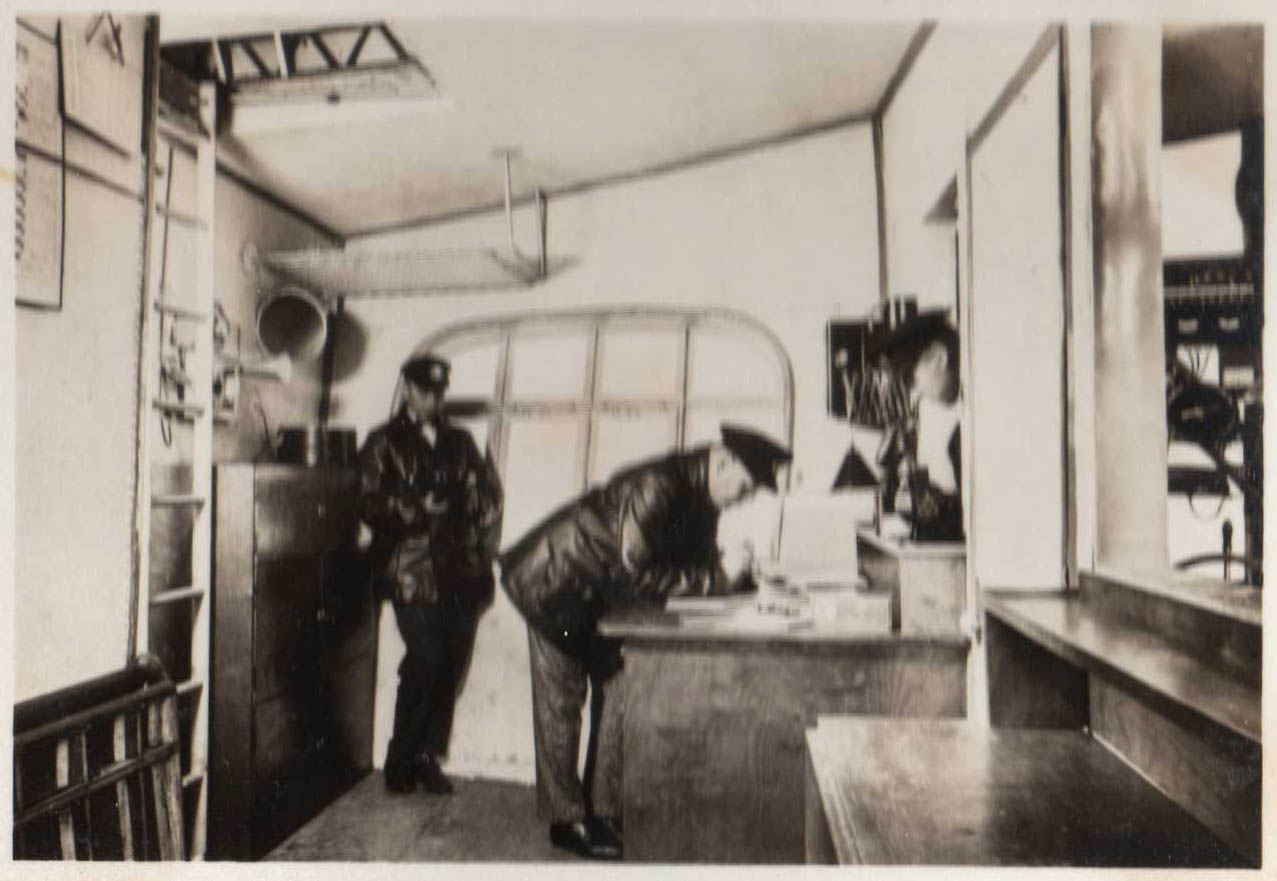
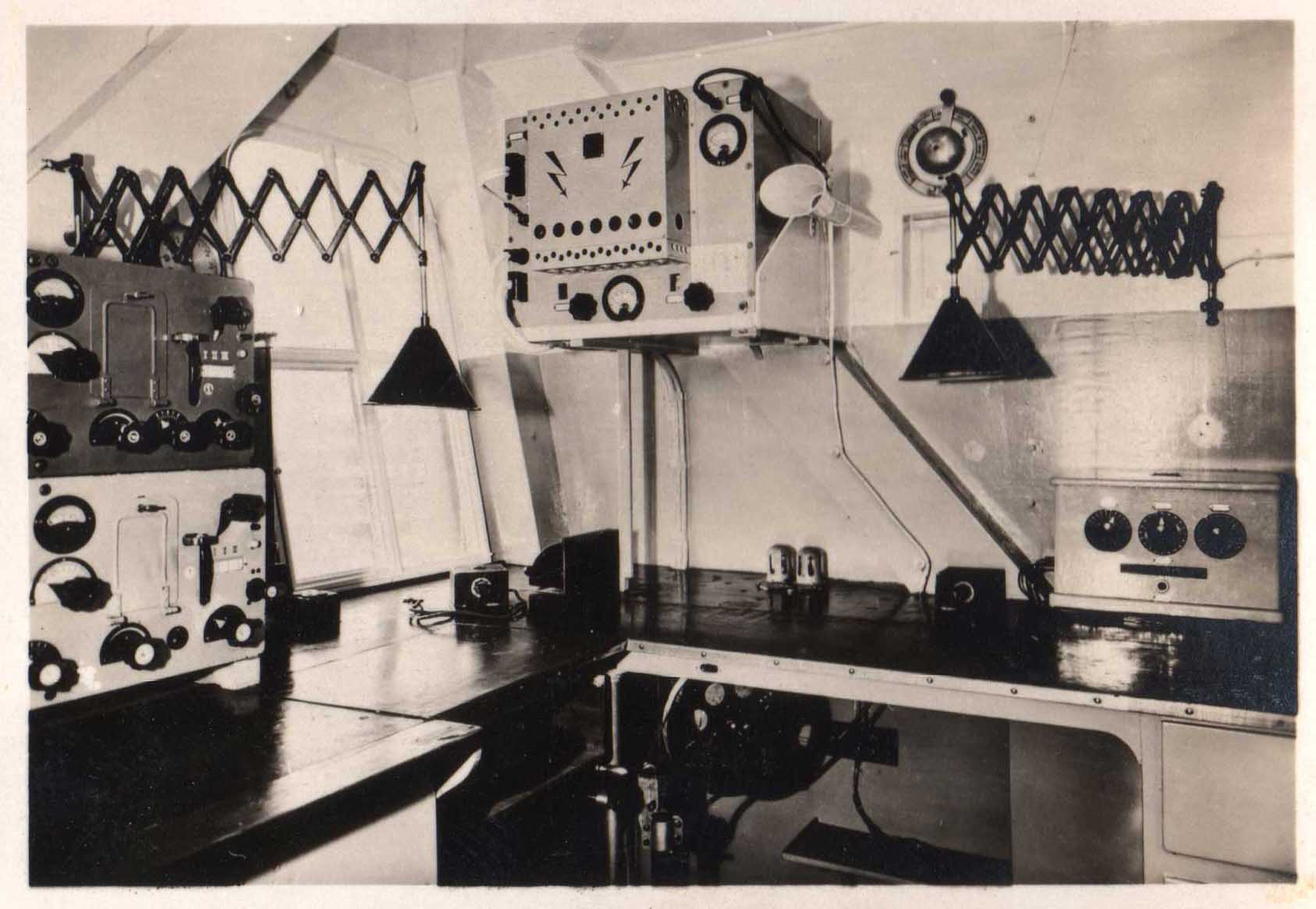
The Control Room, Chart Room, and Radio Room
The control room contained rudder and elevator control wheels, gas and water ballast release controls, engine telegraphs, and flight and navigation instruments.
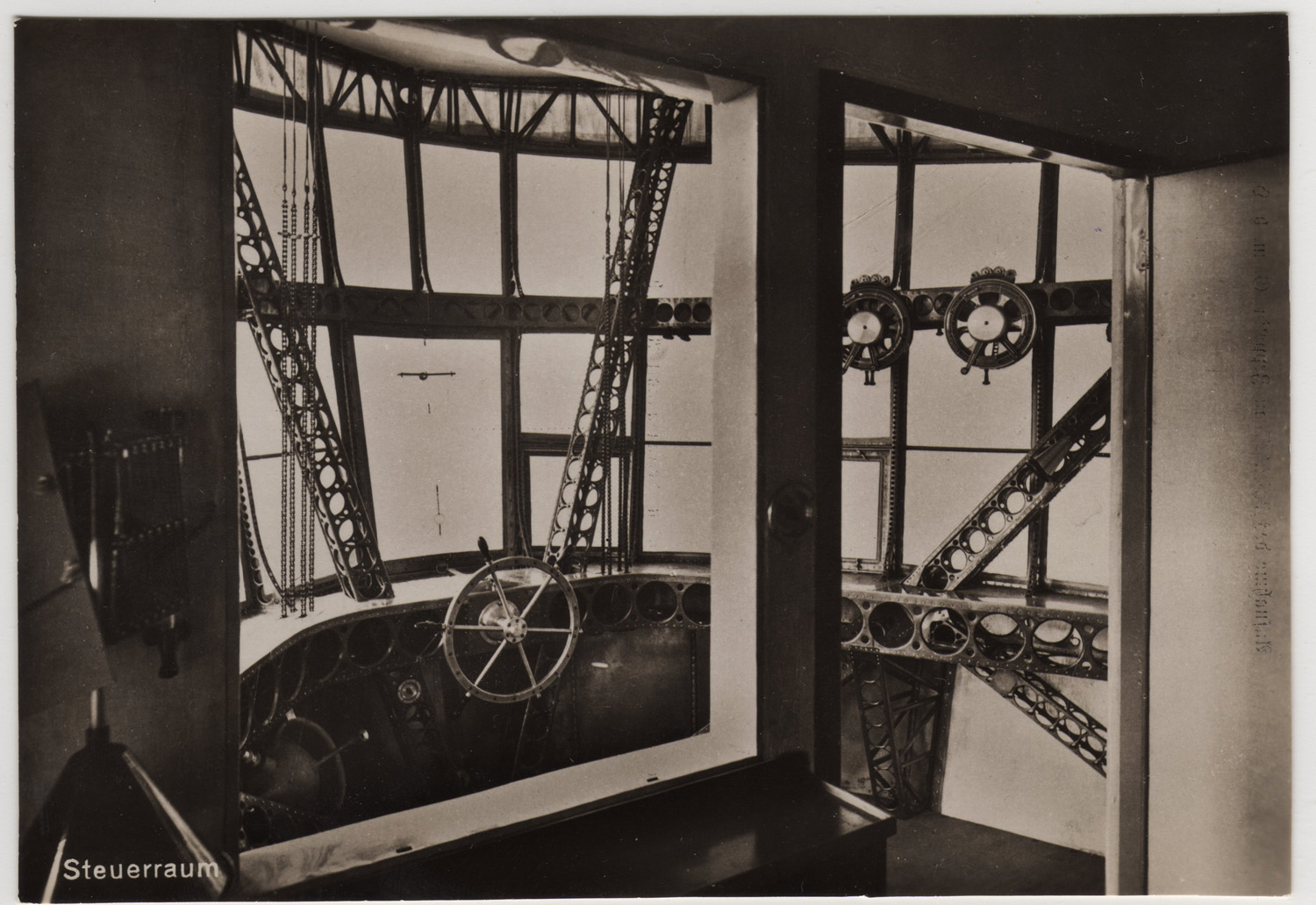
The Kitchen
Across from the radio room was a small kitchen containing electric burners and ovens, an electric water heater, a refrigeration unit, and compact storage and preparation areas. Obviously, no open flames were allowed on the hydrogen-filled airship.

The Passenger Lounge and Dining Room
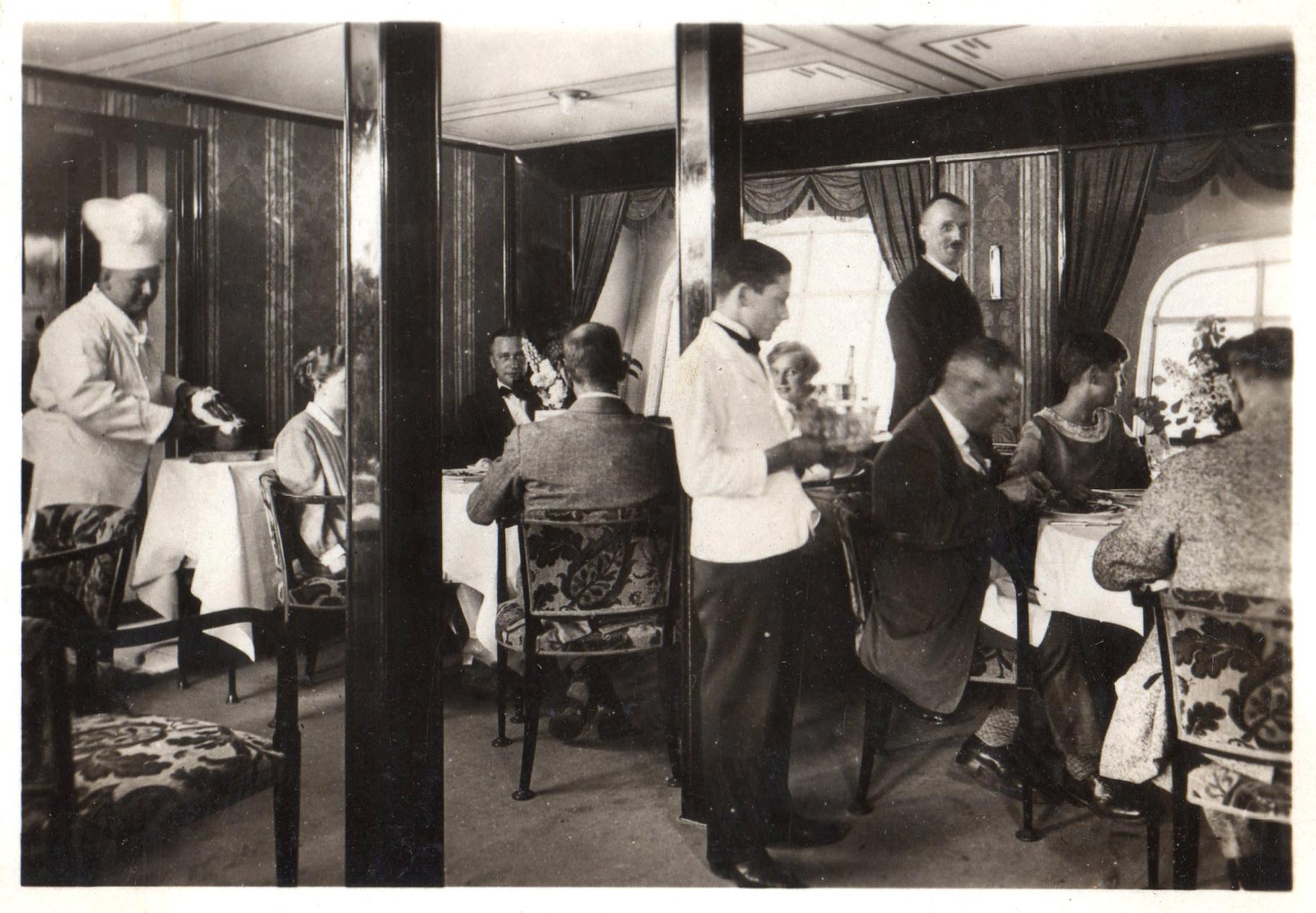
Aft of the kitchen was a combination lounge/dining room, approximately 16′ square, which was the only public passenger space aboard the ship.
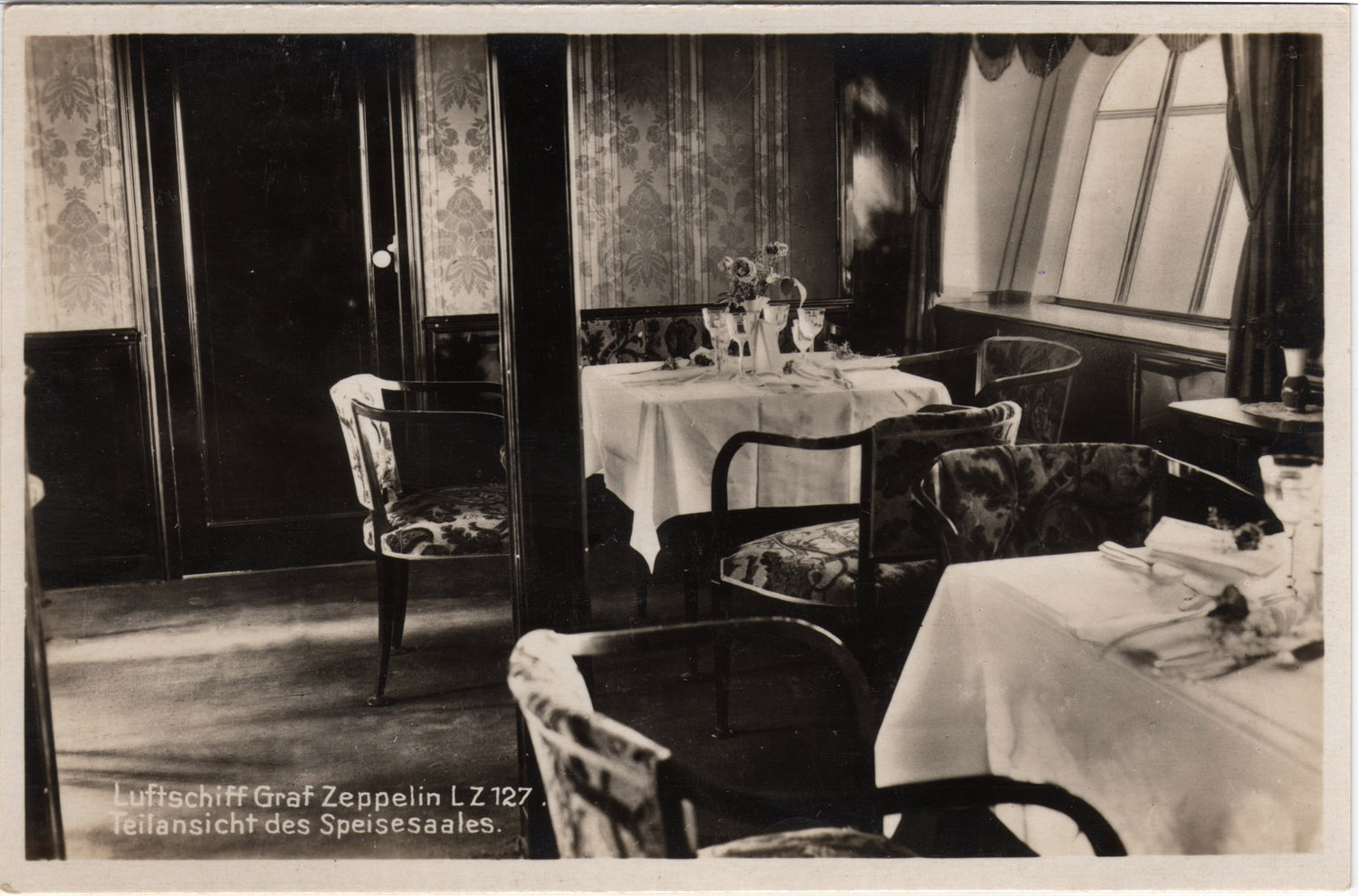
But while the surroundings were luxurious, they were also unheated, and during the winter months, or when the ship flew over the North Atlantic, or during the flight over Siberia as part of the 1929 Round-the-World flight, passengers often spent much of their time wrapped in heavy winter coats or covered by layers of blankets while ice crystals formed on the windows.
As frequent passenger Lady Grace Drummond Hay described it:
We have a million cubic feet of gas but no heat. . . . Merciless cold driving through the canvas walls of this flying tent. … I have visualized myself gracefully draped over a saloon window ledge romantically viewing the moonlit sky. The men . . . have reminded each other not to forget evening jackets and boiled shirts in their baggage. We have drawn ourselves lovely pictures of dining elegantly in mid-air with Commodore Eckener at the head of a flower-decked table . . . but . . . leather coats, woollies and furs will be our evening dress. Hot soup and steaming stew more welcome than cold caviar and chicken salad.

The Passenger Cabins
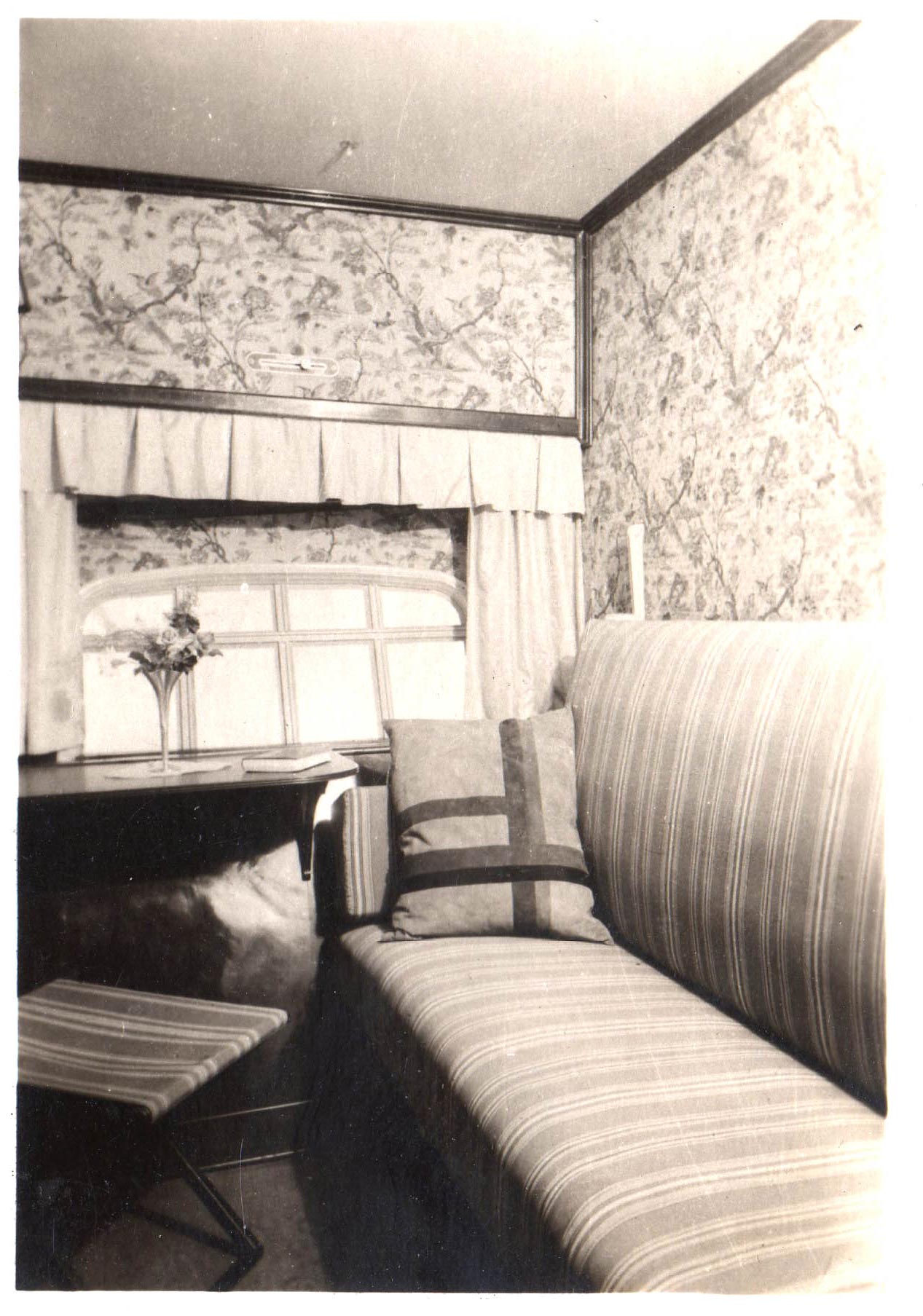
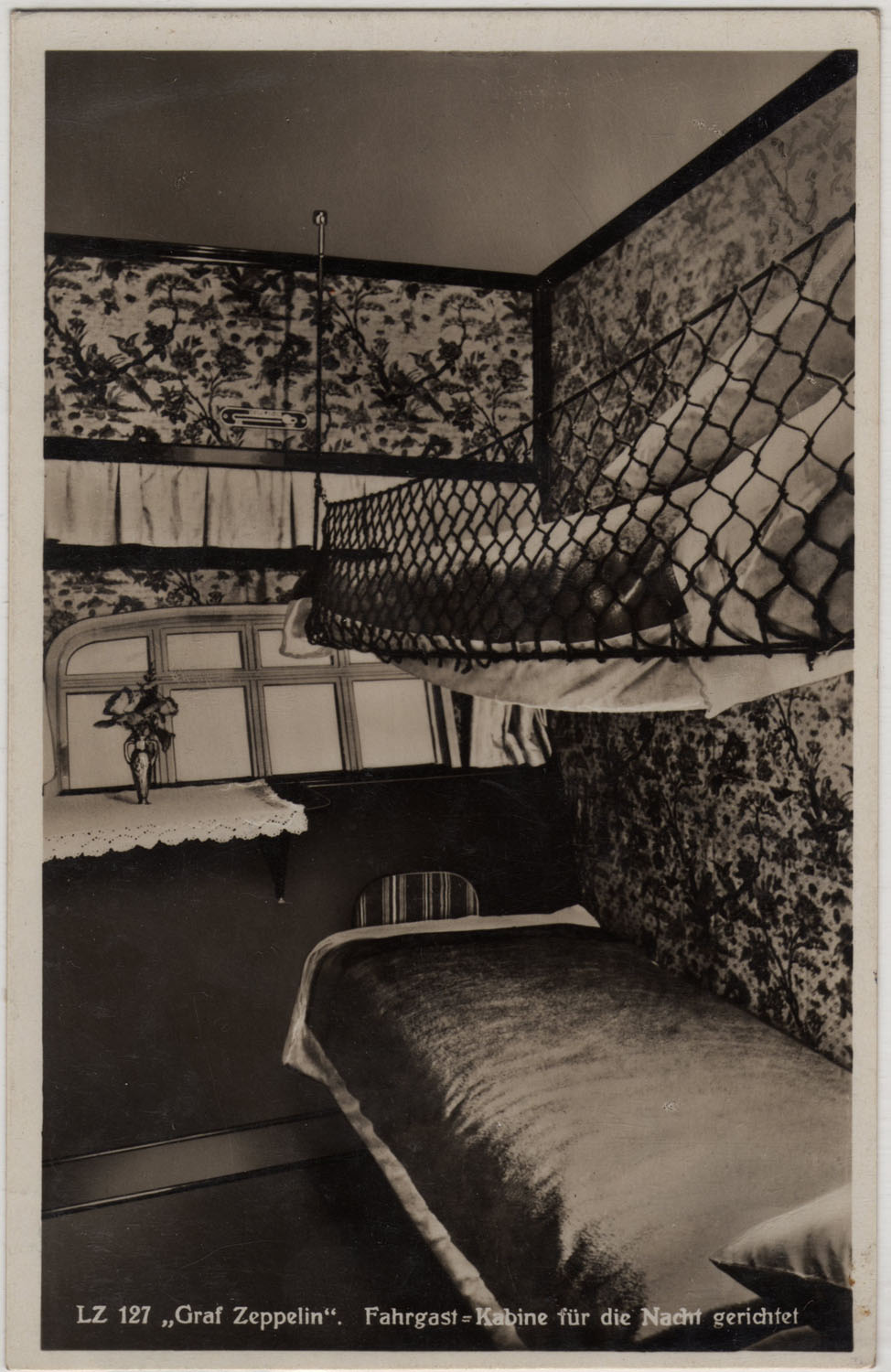
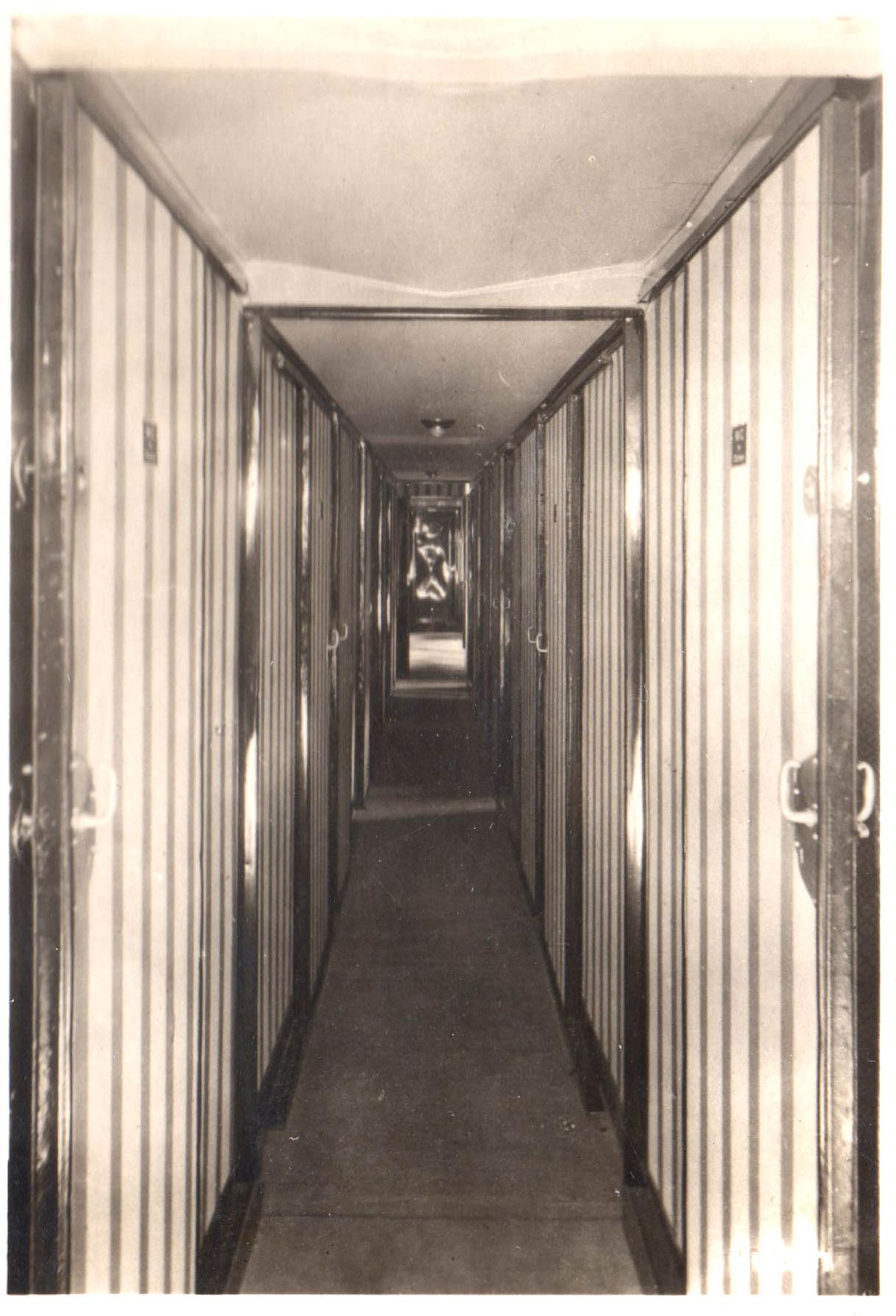
Accommodation for the ship’s twenty passengers was provided in ten small cabins, containing upper and lower berths similar to those aboard a railroad sleeping car, and which could be arranged for daytime or nighttime use. Like the rest of the ship, the cabins were unheated. The cabins were located on a narrow corridor, at the end of which were separate washrooms for men and women.

Steward making up berth



{ 72 comments… read them below or add one }
I am 75 and one of my dreams have been to fly in an airship. A couple of years back MTN brought one to South Africa and my son was able to have a short trip the lucky ****.
Every body talks about using hydrogen or helium but I would have thought with modern materials we should be able to build a vacuum ship,
There was a company that was going to buiil Blimps in S.A Hamelton but it turned out to be a con.
Imagine flying over the game reserves I am very surprised that some multi-millionare has not invested in one .
Happy flying
I don’t mean to be a stickler but I am pointing out the elephant in the room nobody here seems to want to glance up at.
I LOVE the idea of airships being used again and felt sad when I learned about their history just as much as any of you but the problem of outsourcing technologies to countries that hate progress sickens me.
I am really tired right now.
I also wonder if airplane parts like Boeing still get made in the USA or if they are shipped from China too whenever the next generation of airliners gets built.
If it’s not too late already I hope Boeing doesn’t outsource their plant in Seattle.
Man I am very sweaty from typing all this!
I forgot the other big problem besides TSA security theater.
The technology to make these *Green* airships will come from China which uses cheap labor (Slave labor actually) to make products and I will not put my life into their hands which uses the lowest quality materials that will break down after the warranty expires. Thanks but no thanks!!
All our kitchen stuff and electronics that were made either in Japan or the USA lasted us well beyond their lifetime even after extensive use.
Hell we have had and still have a Ford car for over 10 years and have not had any major problems reported any time we bring it in for servicing since it’s made in the USA with high quality parts.
The closest thing was a minor radiator leak we heard hissing but it was caught before any trouble happened.
Here is a little bit of education. (Gasp) Education? No way!
Whenever a country outsources materials that countries GOP always without doubt falls into a recession and unemployment skyrockets where it was just a threat before the outsourcing began.
Their vision for outsourcing is to save money but it’s at the expense of quality and careness you see when workers from home are in charge.
My great grandfather worked on the Graf zeppelin for many years . I believe he
Rioted and did other jobs. I know he traveled on it many times, he could speak seven different languages. My grandmother gave me a letter that her father either sent along with or was on the trip, it was from the Arctic circle and the post office stamped it with a special zeppelin stamp in the corner. It’s one of a kind, although I do not know what something like that would be worth. I also have some newspaper clippings and a photo of my grandfather riveting on a zeppelin. His name is Carl Sauter. He worked for Goodyear after the Graf for 35years! Love family history. Wish I could find more!
What a family treasure that is! I would say that stamped letter is priceless and the story that goes with it should be passed down through generations. Thanks for sharing!
If you want to know more about the menu on board: there is a documentary about it in German TV next sunday:
http://www.hr-online.de/website/fernsehen/sendungen/index.jsp?rubrik=2462
I love the interior photos.
Were any of the crew teenagers or were they all professionals and officers.
Thank you
The Cabin Boys were probably of younger age. Perhaps some of the riggers or engineers were in their low twenties if they were trainees or plebes. The crew in the control room were mainly officers with some experience.
Given the advances in non-conductive plastics and spun carbon structures, as well as recent advances in flexible polymer solar power generation, I wonder if it would be feasible (and safe) to build a hydrogen lift craft that’s electrically powered? Yes, I know that hydrogen is flammable, but I feel constrained to point out that the fuel carried by jet liners is equally dangerous . . . I can think of several methods of reducing the risk of ignition to negligible levels, and a nonconductive hull would eliminate the static charges which represent the greatest danger.
Since water is carried for ballast, and there is a huge amount of electrical energy available from sunlight, hydrogen could be cracked for lift from the ballast, and oxygen collected for cabin enrichment, which would permit operations at somewhat higher altitudes (12 – 18,000 feet). You would use electric motors for propulsion powered by the solar panels, and at night, combine the hydrogen & oxygen in fuel cells to generate the power to run the motors. If you need ballast (which also equates to your lift gas), drop a hose into any lake or river to replenish . . .
To all intents and purposes, you would have a ship with literally unlimited range and duration – like a nuclear sub, you would only have to land to replenish food supplies and change out crews. Fossil fuels would not be needed, so it would be a purely green technology. And even at 9% efficiency, when you have 50 – 65,000 square feet of surface, the energy budget available would be slightly stupendous. You could actually heat the crew spaces . . .
If you had a ship roughly the size of the Hindenburg, with the advances in materials technology and engineering, you could easily cut the dead weight by a third, if not by half. If you have a dead weight of 50 tons, you would have a lift capacity of an equal amount and then some. Given a 90 knot cruise, you could make a very nice profit carrying perishable goods (especially those requiring refrigeration given the temps at cruising altitude) across oceans in addition to passenger service. Your only cost is debt service on the craft and crew costs (and insurance . . .). Admittedly, the initial cost of the solar panels would be high, but given the amount required needed, you could get a huge quantity discount. And compared to the cost of a wide body jumbo, hmmm . . .
I would love to see someone with more knowledge of the economics involved to run some numbers, but given that operating costs are negligible, I think there’s a great opportunity there.
Yes, w/ so many advances in material & technology it should be possible to create large airships again — however, one nagging fact remains: they don’t stand up well in bad weather. But just as the ocean liner became the cruise ship, so it might be possible to make zeppelins air borne cruise ships.
Where to find the investors for such a project though?
Well, given that bad weather passes relatively quickly and weather forecasting technology has improved significantly in the 80 someodd years since the Hindenburg debacle, weather shouldn’t be as much of an issue as it was then. Given that the whole idea behind airship travel is that it’s leisurely, a few hours delay in landing shouldn’t be that much of an issue. Especially when compared to the prospect of sitting for hours on a tarmac waiting for a gate to clear.
The difference in customer base would be subtle but significant – you would have travelers rather than commuters. Travelers get there when they get there. Commuters need to be at Point B at a specific time to stay on schedule. A delay in landing or a detour with an airship simply allows the passengers more time to look down from above and enjoy the flight. Sort of like telling a space tourist that they’ll have to remain in orbit for another few hours. Awwwwww . . .
If you want to get there in a hurry, then be prepared to be treated like a terrorist diseased sheep. If you want to get there, then you can be treated like royalty (relatively speaking) instead. Personally, I refuse to fly commercial anymore (I’ll rent a goddamned plane and fly myself, cost be damned, rather than endure an anal probing from the TSA grays).
As for investors, it’s the same as anything else . . . some people are visionaries, some buy hog belly futures . . .
Your ideas are truly visionary.
I believe they are do-able. Though I may not live to see it, I believe the return of the Great Airship, utilizing cheap, safe, and abundant hydrogen, is yet to come.
Also, may I point out that such passenger ships could recoup a great deal of the operating costs in the form of gambling proceeds, similar to most cruise ships today.
It seems the big debate is ‘could we do it now with hydrogen for lift?’ My question is, to serve what need? I think it would be utterly fascinating to ride on an airship, but from what I’ve read, top speeds are what, 60 or 70 miles per hour? Who, these days, can afford a week for an Atlantic crossing? I can’t see a use beyond nostalgia and small niche applications for airships of this type.
“Where to find the investors for such a project though?”
Arab countries like Qatar, Kuwait, and United Arab Emirates!
You write a very interesting proposal there. I wish to address some of the topics you raised;
1. Hydrogen is cheaper and easier to come by as it can be manufactured from water. It also has greater lifting capacity to helium. Given today’s synthetic films and linings, gas cells in an airship can be made virtually gas impermeable, making them virtually oxygen free, and thereby safe so long as they aren’t cut or torn. Then you’ll have the same issue that doomed the R-101 on a very low speed impact into the ground in France on a rainy night. Yes, airliners are filled with flammable fuel, however the flash point of jet fuel versus hydrogen may make certifying it for use in commercial passenger carrying aircraft difficult. It’s one thing to spill some gas, and another to suddenly find yourself in a explosive hydrogen / air mixture.
2. Solar panels, thermal equipment that split water atoms to make hydrogen, pumps and tanks to store hydrogen under pressure, pumps, tanks and filters to process water into hydrogen, in addition to propulsion systems, electrical battery storage units, living environmental equipment, and crew and passenger accommodations would be too heavy for a passenger carrying, revenue producing vehicle. The physics of lift necessitate a simple, lightweight approach to every system on an airship. The Graf Zeppelin was the only airship that had a dual mode fuel system, but had a limited passenger capacity, and no heat in the cabins.
3. Airships are green even if they burn regular aviation gas in standard internal combustion engines when compared to jet liners. They burn a fraction of the fuel jets do and are quieter, don’t leave contrails, and leave less pollution than gas turbines which burn a heavier fuel than gasoline. And with efficiencies in fuel injection and exhaust gas cleansing systems used in automobiles, gasoline engines can be very clean as can “blue” technology diesels. Airships can be green simply by their innate ability to float without using power. Their helium gas may not be “green” as it is a non-reusable resource, and harvested from the ground from oil drilling – a politically dark topic.
4. The passenger carrying airship is a potential in today’s market as I have outlined in other responses I made on this site. The traveler looking for alternatives to the long lines, the searches, the poor service, the delays, tiny toilets, ridiculous food service, cramped and uncomfortable seating, and being herded around like a cow in a slaughterhouse, would be perfectly willing to to trade a day or more and the price of a first class ticket for a bed to sleep in, a table to eat a meal at and a comfortable chair to relax in, all with one hell of a view. It would not appeal to every traveler, but think about it, if one out of every hundred or more wanted an alternative to flying, that would be a great deal of potential clients. The Concorde made a profit when it raised ticket prices to astronomical levels to fly across the Atlantic in two hours. It was able to succeed with the snob appeal of flying in something entirely different that celebrated the adventure of flying.
5. I think the impetus to finance an airship will come from several sources in the travel / entertainment industry, perhaps as a adjunct to a cruise line. It certainly won’t come from airline firms, although the loss in business they face with airships would be infinitesimal.
6. Airships can happen – the initial costs would be immense as we would have to create an infrastructure (landing fields, hangers, etc) that no longer exist or are usable. It would take much to start it, but once the first one flies and makes regular flights, you won’t be able to make them fast enough for a eager world market looking to rediscover the romance and style in flying.
Thanks for your ideas! We can do this. Please share any ideas with others and start the discussion!
Also it seems that whenever there is a terrorist attack the government officials try to make everyone to be a terrorist then the actual terrorist themselves and the Liberals are too busy focusing on fighting to stop it.
They claim they want to but always fall apart at the seams.
The journey is the destination. Enjoy the ride!
Great ideas but their is only one major problem…………..TSA!
Their are so many horrible experiences from so many people that I no longer believe it’s made up. Maybe exaggerated by some just for attention because of a delay that messed up their flight but not totally made up.
I’ll look forward to air technology when people start using common sense and their gut instinct instead of labeling everybody but Muslims a criminal.
Did you know TSA actually has Muslims in charge of screening at some places so they won’t get accused of being *racist? Makes you feel safe doesn’t it?
Now lets pull over Grandma with her knitting kit and let the Muslim walk by to not offend him.
Le vin de la Moselle allemande était servi a bord. Je suis a la recherche du menu présente a bord. Merci d’avance.
My aunt, the famous opera singer Lily Pons, star of the Metropolitan Opera of New York, flew aboard the Graf Zeppelin in 1938. Today I have a cup, saucer and plate from this airship as well as a picture of her in front of the Graf Zeppeling as it landed in Rio de Janeiro; in that picture she is all dressed up and ready to board the airship for the long trip. I can’t recall what she had told me about the trip, except that it was a long, around the world flight, although, if I remember well, she did not fly for the entire trip. This is a great site, congratualtions!
Thank you for sharing this valuable, extremely historic nostalgia. I am 94 years of age and certainly do remember Lily Pons. My father took the family out to Mines Field, now LAX, in the middle of the night, to see it take off during its round the world flight
Dale Berkihiser
The only around the world flight the Graf made had only one female passenger, Lady Grace Drummond Hay. I am not sure the Graf was still making long distance flights in 1938 as the political scene in Germany was going strongly towards the Nazi Party and airships were used for local propaganda flights.
I also have a Graf Zeppelin cup and saucer that I inherited. My father-in-law also had a plate in this set but he smashed that in a fit of late Parkinsons disease.
Is your china also marked with a 1928 firing date?
My step-father used to play his collection of 78 records of Lily Pons on my Hi-Fi when he could sneak in and replace my folk songs. Impressive voice!
On the question of the future of the dirigible, here is a real-world academic exercise for those who feel it is viable.
I am a grad student in Hawaii, where travel between islands is an expensive proposition due to the cost of air travel and the lack of maritime options. A few years back, we thought we had a solution with the Hawaii Superferry, which was to include one vessel going to/from Honolulu and Maui and then to/from Honolulu and Kauai. Another vessel was to go to/from Honolulu and the Big Island (Hawaii Island).
Owing to a successful legal challenge regarding the lack of a proper environmental impact assessment, the Hawaii Superferry was suddenly shut down and the boat owners went elsewhere. Now, other than airplanes, we have no alternatives.
So, this is the “exercise”: Would it be viable, affordable, and practical to operate dirigible service between Honolulu and Maui, and/or Honolulu and the Big Island (Kauai residents generally were unwilling to have Superferry service, so let’s forget about that). Let’s say Kahului on Maui and Kailua-Kona on the Big Island.
For comparison, the Superferry took about two hours between Honolulu and Kahului on Maui (95 miles), and I believe it would have taken three hours between Honolulu and Kailua-Kona (175 miles). The passenger fare was $60 to $70. Automobiles were also allowed ($70?), but I’m guessing that’s not feasible with a dirigible (is it?). About 200 people could ride at one time, since the short trips did not require sleeper cars or any accommodation like that.
It would seem that if the dirigibles could offer something comparable, they would be advantageous over a maritime ferry because (a) they are cheaper to accommodate than what is required for a ferry dock, and (b) they don’t impact sea life. It would seem they are also more flexible in terms of docking.
So, what do you think?
I can’t speak to the economics of your proposal but I do have one practical reservation: weather. Dirigibles are easily grounded by strong winds. How would that impact your plan?
Greg, thanks for your reply. Even though I think I didn’t mention it, I was wondering myself about how wind would affect things.
What would be wind speeds where they would need to be grounded? It might be best to determine that and then see how often that would make an interisland route infeasible or not.
I don’t know. You’d have to ask someone w/ technical expertise. Maybe someone @ Goodyear could help. One variable to consider would be the ground handling equipment. A ship secured both fore & aft & able to be rotated into the wind would be able to operate more effectively in windy weather.
Landing & ground handling equipment would also be an expense feasability factor: while the ship’s engines could be directionally adjustable for better manuverability, there’s still the issue of how many people would be needed for a ground crew. What kind of mast would be used for landing? A high mast is easier of course, but then you have to be able to lower the ship to the ground.
Lot’s of issues to deal w/…
Weather would be definitely an issue. But think about how a line of storms in Chicago screws up the entire network of incoming and outgoing domestic flights. Ever sit in a airport in perfectly lovely weather delayed for hours because of fog or weather at your destination? How many delays are there from “congestion” in the skies now. Given the number of bad days, and the advancement of digital, real time weather data available to aircraft today, I’d pit an airship annual on-time percentage against a jetliner any day.
Interesting that the WC is separated from the Wash basins. Quite different then today. Not important but interesting.
More of an european way. Here in Europe this setup is quite common still.
I agree fully with David Maurice that the Dirigible has future.
This is not only based on a nostalgic wish. I think it has a few very interesting advantages that are becoming more and more important.
For example: i’ve just read an article about future airtraffic and the most important problem will be the airports, especialy the runways. Expected is that traffic wil be doubled in 2035 but airports defenately will not. That means that the common way of landing (runways) will become more and more inappropriate.
Increasing delay in landing procedures will surrpass a decreased airspeed during the trip and so on.
Another thing is that in fact the dirigible was very successfull. Especialy the 127.
so it still is a strange fenomena that we still cruise after the Titanic, we still fly 747 after Lockerbie, but we dont sail dirigibles after the Hindenburg.
The demise of airships after the Hindenburg was already happening due to the events of the time. The US Navy, and England abandoned their lighter than air ventures after spectacular crashes and heavy loss of life long before the Hindenburg went down. The German airship program was slowly dying off due to the looming warlike footing of the German Nazi government who saw no use for airships in their plans of world domination.
The remaining passenger airships flown by Germany were the Concorde’s of their time, featuring luxury and speed versus the only other way to cross the oceans then, the steamship liner. The Hindenburg was the toy of the elite, and to fly on her was like flying on the Concorde when they first came out.
Also competing with the Hindenburg was the winged passenger airplane. By the time the Hindenburg went down, the DC-3 was in the process of establishing regular, safe and comfortable air travel at costs lower than and faster than airships.
You’re right – there is a market for airships today. They would fill a niche for folks who are sick and tired of squeezing into cramped seats, drinking soda pop from a 4 ounce cup, and dining on a minuscule bag of peanuts. But make no mistake, the jet aircraft is still the most efficient way to move masses of people quickly and safely.
The airship will fill the need for folks who aren’t flying to get there, but want to fly to enjoy the flight and see the Earth from somewhere lower than 35,000 feet. It’ll be the older folks who don’t like getting fondled by TSA, or the adventurous traveler who wants to do something different. It won’t be cheap either, in fact, it will be probably as costly as the Concorde was initially. But picture this scene;
You’re dining on a gourmet meal, sipping a fine glass of wine, while sitting comfortably at table with a fine linen tablecloth, fine china, having a conversation with someone without having to shout over the din of jet engines and hull turbulence. Your table is on the deck of a ship that is cruising along the West coast at sunset, which lights the interior of the dining room with color through large windows. You’re flying and your table, along with many others in that room have hell of a view. Folks will pay lots just to be able to have that experience, that kind of romantic, nostalgic moment in the air. It’s the anti-establishment angle that will attract the airship passenger of 2011. A return to basics, to civility, to actually enjoy flying again.
Don’t look for airships to compete with airlines for passenger carrying dollars. With the impersonal treatment by airlines today, who basically herd us here and there like flying cattle, the slow pace of the airship might just be the ultimate vacation while on your way to a vacation. Who cares if it takes me two days to get to the Bahamas from NY?
Indeed you are right about the demise. The time was not right either i guess.
Ofcourse traveling by winged aircraft is far more economical today and because the economic factor still is the most important one, we probably will be flying that way for a time. However as time learns, humans has the tendency to trap themselfs in their ever lasting developments.
I realy think airtravel will change significantly in time. The crowded skies, polution, improving technologies for virtual conferencing etc. are factors that probably will make that change.
And we are accelerating this change because more people are flying because its cheap and not because they have to. For exampel: In europe we see completely stuffed cheap flights with people flying from London to go to the pub in Amsterdam.
As time also learns, new improvements and inventions remarkably look like old concepts.
With new techonologies and reaching some hard limits, i therefore think the airship(principle) migth realy have a chance.
Hi Stu -
Awh, come on now – you’re just saying that because it’s true!!
Your writing , the way you presented the facts, sure made me laugh. Thanks.
Dale
Dan, excellent site.
Do you have some details about so-called Balkan Flight in October 1929.
I have some cuttings from old Serbian newspapers showing zeppelin over Belgrade, Serbia in October 16, 1929.
Excellent site Dan, and useful to me as I’m currently writing a novel involving an airship.
I noted a couple of things on this page and hoped you might clarify them. Firstly, the plan of the gondola shows accommodation for 24 passengers in 12 cabins, every other reference I’ve seen records 20 passengers in 10 cabins. It is also the only plan I’ve seen that shows the ability to convert the front cabins to 4 berth. Was this layout ever used?
Secondly, the access to the gondola is (always) shown as the short passage between the galley and the dining room. However, the lead photograph shows the passengers embarking through a door into the captain’s quarters at the back of the control room. Was that normal?
Fascinating escape back to the era of airships. I am among the those convinced that given our technological advances, safe and reliable dirigible transportation is well within our grasp. We could only stand to benefit from another option to choose in air travel.
I lived in zepplinheim 1966to 1969 # 8 ludwig durr strassa. owner was navigator for the graf she was secrertary to capt of hindenburg nice people
I purchased a crew member’s badge from the Graf Zeppelin last year at an antique shop, and it came along with a post card showing just the airship itself. I was trying to find out when the badge was from or which crew members might have worn it, but so far I haven’t found any information. It’s apparently very early, perhaps 1929. The badge has a picture of the Graf flying over water surrounded by the name of the airship framed in green. I don’t know if the green means anything or not. Not sure if you could help, but if you know anything that would be great. Thanks.
-John
Hi John from the UK! I now have 3 of the known 4 versions of this wonderful badge. The colours that I have are mid-yellow, a dark brown, the same mid-green one that you acquired, and I’m now chasing the final, light blue one! I’m told there were 2 different manufacturers, but all my badges bear the ‘FLL’ logo on the back – This is for Friedrich Linden, of Ludenscheid, a city north of Koln, (Cologne). My research is not vast so far, but I’ve talked to UK dealers who say that neither they, nor their suppliers in Germany, know what, if any, significance applies in the colours used. I’ll keep digging too! Best Regards!
Does anyone have any information about a dinner that was given in Los Angeles in honor of the Graf’s visit to the city?
Dear Amy there has now been info on a ZEP DINNER on the site enjoy
HI I have what I believe is an original canvass oil painted advertisement of a Graf Zeppelin ” it reads Nach Sudamerika in 3 Tagen!” and has LZ HAPAG emblem. I bought it in a french junk shop because my husband loves airships I wondered if these were rare or if it is worth anything it has hung on our wall a long time.
Es famoso aqui en Buenos Aires y Montevideo el viaje del Zeppelin a estos lugares, tambien lo son las fotografias tomadas con él y el Palacio Salvo en Uruguay y con el Palacio Barolo en Argentina.
Me imagino que desde el dirigible, sus pasajeros deben haber tomado una infinidad de fotografias, ¿alguien sabe de alguna?
Trabajo para el Barolo y seria un sueño encontrar una foto aerea del mismo tomada en esa epoca
Los dirigibles tipo Zeppelin demostraron, a pesar de sus entonces primitivos medios de navegación y pilotaje, que eran unas excelentes aeronaves con grán futuro en la aviación.Saludos.
Luis
A fascinating documentary very well put together although some of the shots, perhaps, of doubtful provenance. The cameraman wearing straw boater on the skyscraper shot;may be genuine, or may not, as I can’t remember the full scenario of the Buster Keaton film ‘The camera man’. However, people in those days did have a devil may care view of safety us cosseted moderns may find hard to believe. Look at the shot of the rigger crawling along the top of Graf Zeppelin with just a slack rope to hold onto to stop him tumbling to his death. Or the guys who climbed down into the engine cars-no safety harness’s then!
One question I have about Graf Zeppelin-where did the crew sleep or eat off duty?
Crew quarters were along the keel, inside the hull.
to reply to those who wonderedwhy not build new airships? They ane. Google airship images and you’ll see the plans and progjected images for new airship by Aeros. Very cool looking.
Hi there, I have just purchased an ashtray,possibly aluminium,with a Zepellin on it as well as a postcard with Graf von Zeppelin and on the reverse-”Official postcard for the ZeppelinEckener Spende den deutschen Volkes”.
The reverse of the ashtray has the number 890 stamped in.
Would you be able to tell me what airship this item came out of? I am led to believe it could have been the LZ129?
I have seen the exact ashtray on a website-thevintageaviator.co.nz. It is the oblong sized one with the Zepellin on the top of the ashtray.
Your help would be most appreciated!
I note that
Have you by chance any idea of the menu? What exactly was cooked in the kitchen and served in the lovely dinner hall?
Thanks for posting these pictures and the narrative. I have always wondered about the interior of the Graf Zeppelin and was never able to find much information. This is great! Good website.
I also find it unfortunate that someone has not built a large passenger-carrying airship of the modern era. The current zeppelin-NT airships provide over-priced excursion flights that really do not come close to reflecting the true passenger carrying abilities of airship travel.
I wait for the day when a 700+ foot passenger airship, called the America, flies scheduled flights between Los Angeles and the San Francisco bay area… with select cross-country flights across America for all to enjoy.
The best of airship history lies in the future. Someday such a wonderful aircraft will take to the skies and the world will again enjoy the spectacle of travel by airship.
Dennis M. Zermeno
Gilroy, Ca
I agree. Sit and relax [in a proper chair],have a decent meal and enjoy the scenery and not the tops of the clouds.
I concur. Airships have stayed with an unfair image for too long. With the technology of fabrics, metal, polymers and computers, this design of flying machine it’s far better in terms of passenger accomodations and luxury. This pics make a first class jet accommodation look cheap and undesirable. Hopefully open fresh minds will embrace the Airship and try to reach a new limit, and these days there is no limits to human ingenuity. Maybe in some near future we will get on board a airship and wonder how did we ever travel in the steel tubes so comfortable…not to mention the airports line. Kudos for a so well prepared and maintained site.
I Have a photo of the Graf Zeppelin flying over Seville (Spain). Could you tell me the date or dates that the ship flew to Sevilla?
Thanks
LZ-127 flew over Seville (Sevilla) on numerous occasions, including many of the ship’s South American crossings.
my mother ethel webster was a 14 year old when she saw the first zepperlin brought down by capt robinson in 1916 she liveed with her mother @ father at 84 bertram road enfield the whole street turned out to se it crash in flames in near by cuffley …..my mother moved south to littlehampton and in 1940 watched the battle of britton taking place overhead my father sergent sidney knight served in the controlroom at tangmere fighter station he had a narrow escape when stukas attacked the aredome my mother never saw the end of the war she died in in 1943 …..jon at jedbells sussex
This is self-advertisement, I am afraid, but at least it is relevant to the subject of the site!
I am just in the process of publishing a novel that involves a fictional airship – the Bismarck, built by the Zeppelin company. The Bismarck includes some features of the Graf Zeppelin I(the crew sleep in the hull, for example), some from the Hindenburg (the passenger accommodation is aft of the separated control nacelle), and some from the British R101 (the passengers board through a gangway in the nose).
If this is of interest to you, please feel free to visit the book site at http://www.beneath grayskies.com – and order a book (details on the site) – downloadable as a PDF if you don’t want paper.
Dear Dan,
I am in the midst of reading a novel, The Reserve” by Russell Banks. The Hindenburg is part of the plot.
Ruthy Rosen
Hi Dan,
I need some information on when the Graf Zeppelin flew over Scotland, specifically Edinburgh or close to that. I am complileing a scrapbook for my father in law who will be 90 in October and he saw this airship fly over and has never forgotten it. Are you able to help?
Thanks
Cathie
Graf Zeppelin toured Britain on August 18-19, 1931, on a flight which began and ended at Cardington in Bedford.
I hope this helps, and best of luck with your scrapbook!
Dan
Where did the crew sleep?
The crew quarters were in the hull of the ship, along the keel. You can see the location of the crew berths on the profile drawing at the Graf Zeppelin Design & Technology page.
There is also a plan view and photographs of the crew quarters on Hindenburg on the Hindenburg Interiors page.
the main keel extending from bow to stern was used as a passage way and storage area, an innovative feature-an axial gangway- enabled crewmen to reach and service the gas cells. the crews mess and bunks were also situated there
There were no crew bunks nor crew mess along the axial corridor, and in fact the riggers were the only members of the crew allowed to access that area.
My grandmother’s cousin flew on one of the trips to Brazil. I have the vinyl (?) bound book passengers were given and if you’re interested, I’ll find the passenger names and send them to you. You might want to start a collection of them for folks like Myriam L. Russo.
Paul
These are absolutely incredible photographs!
I found a picture of the GRAF Zeppelin in my mothers old album. It was taken in 1928 in Lakehurst, New Jersey. I think the two men in the picture are the captain and maybe my family’s close friend, Harry Lawrenson, who was a photographer with Fox Movie Tone News.
Thanks for your comment!
If you would like to send me a scan of the photo, I can try to identify the ship’s officer. And if you like, with your permission, I would be happy to post the picture here for other people to see as well.
My father, Antonio Fernandes Lima traveled on the Zeppelin when it was traveling from the north of Brazil to Rio de Janeiro.
I would like to find out if there is a list of passenger from that time, so I can find out the actual date of his trip.
I remember him telling us how wonderful the trip was and how steady the Zeppelin fligh was, whem he even balance a pencil on its end on a table…
Could you, help me, please?
Thank you, Myriam Russo
Unfortunately I don’t have any Graf Zeppelin passengers lists. (I have lists from most of the Hindenburg’s Atlantic crossings, but not Graf Zeppelin.) I am sorry I can’t help, but thanks for your comment!