The Zeppelin NT is a 75.1 m (246 ft) semi-rigid airship inflated with helium. NT stands for Neue Technologie, or “New Technology” in English.
The ship made its first flight on September 18, 1997, and when configured for sightseeing and tourism it can accommodate up to 12-14 passengers and two pilots.
The famed Goodyear Blimps are now being replaced with Zeppelin NT airships.

Zeppelin NT (photo: ZLT Zeppelin Luftschifftechnik GmbH)

Passenger cabin of Zeppelin NT (photo: ZLT Zeppelin Luftschifftechnik GmbH)
Structure and Framework
The semi-rigid Zeppelin NT is built around a framework of high-strength, lightweight carbon-fiber and aluminum.

Zeppelin NT Structure (image: ZLT Zeppelin Luftschifftechnik GmbH)
The framework consists of 12 vertical triangular carbon-fiber crossbeams, connected to three longitudinal girders of welded aluminum, with aramid cables bracing the structure and giving it additional rigidity.
All the ship’s major components — cabin, engines, and tail assembly — are mounted on the rigid structure to provide safe and stable flight performance, and also a quiet and comfortable ride for the passengers.

Airships.net author Dan Grossman holding lightweight carbon-fiber section with two fingers.
The Zeppelin NT is longer than a Boeing 747 airliner but its primary structure weighs only about 1,000 kg (2,200 lbs).

Zeppelin NT Size Comparison
Lifting Gas and Envelope
Zeppelin NT’s basic variant (N07-100) has an envelope volume of 8,450 cubic meters (298,409 cubic feet) according to its European Aviation Safety Agency Type Certificate. The envelope itself is a high-strength multilayer laminate.
Similar to a blimp, the Zeppelin NT uses ballonets of air to maintain a constant interior pressure and a taut envelope at all flight altitudes.
Engines and Propellers
The Zeppelin NT is driven by three gasoline-powered, 4-cylinder, 197 hp Textron-Lycoming IO-360-C1G6 piston engines. The Lycoming IO-360 has proven its reliability in decades of use in small aircraft.
The ship’s three engines power four propellers; three vectored thrust (swiveling) Hoffmann 2.7 m three-bladed propellers, and one lateral thrust Hoffmann 2.2 m three-bladed propeller.

Side propellers of Zeppelin NT. (photo: ZLT Zeppelin Luftschifftechnik GmbH)

Aft propellers of Zeppelin NT. (photo: ZLT Zeppelin Luftschifftechnik GmbH)
The aft engine drives a pushing propeller that can be turned 90° downward if needed, and a steering propeller that can directed from side-to-side to function like the bow thruster of a ship. The two side propellers generally provide forward thrust but can swivel through 120 degrees.
The ship’s vectored thrust propellers allow the Zeppelin NT to perform vertical take-offs, stable hovering, and even backward flight.
The ship has a maximum speed of about 125 km/h or 78 mph (VNE is 130 km/h) but usually cruises at about half that speed when used for sightseeing and tourism.
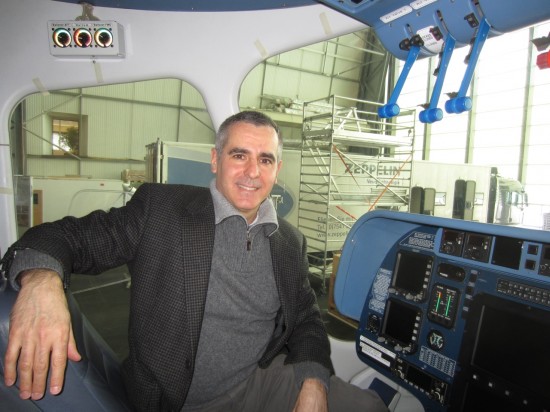
Airships.net author Dan Grossman on the flight deck of Zeppelin NT
Zeppelin NT Dimensions and Performance
- Crew: 1-2 pilots (certified for single pilot operation)
- Passengers: 15
- Envelope volume (N07-101): 8,425 m³ (297,526 cu ft)
- Envelope volume (N07-100): 8,450 m³ (298,409 cu ft)
- Length: 75 m (246 ft)
- Maximum Width: 19.5 m (64 ft)
- Maximum Envelope Width: 46.45 ft.
- Overall Height: 19.4 m (64 ft)
- Maximum weight: 19,780 lb
- Engines: 3 Textron-Lycoming IO-360-C1G6 (197 hp) 4-cylinder gasoline piston engines
- Propellers: 3 vectored thrust Hoffmann 2.7 m three-bladed; 1 lateral thrust Hoffmann 2.2 m three-bladed
- Fuel capacity: 306 gal. (5 tanks), right 49 gal. (48 gal. usable), left 44 gal. (43 gal. usable), reserve 49 gal. (48 gal. usable), 2 external auxiliary 82 gal. each (80 gal. usable).
- Maximum speed: 125 km/h (78 mph)
- Endurance: 24 hours
- Static Lift: 2,940 pounds
- Maximum Dynamic Lift: 1,102 pounds (500 kg)
- Maximum static heaviness, take-off/landing: 400 kg
- Maximum static heaviness, inflight: 500 kg
- Maximum static lightness : -200 kg
- Payload: 2,350 kg (5,181 lbs)
- Max. flight altitude: 10,000′ (3,048 m)
Source: European Aviation Safety Agency Type Certificate EASA.AS.001 and ZLT Zeppelin Luftschifftechnik
The New Goodyear Airship
In 2011 Goodyear announced that it would be replacing its fleet of advertising blimps with Zeppelin NT airships and the first new Goodyear zeppelin flew in 2014.
The Goodyear ship is a slightly modified variant known as LZ N07-101.

The new Goodyear airship. (photo: Goodyear)
i would fuel my design rigid airship entirely with hho! the system would power ducted props(contra-rotating),generators to power pumps and cooking,shower,etc.! an archimedes type screw pump (electric) would power the water ballast and return lines to the water(fuel!) tanks! i have already successfully run my lawn mower on water only… Read more »
i have a question:
Could a zeppelin fly over a large scale fire?
Could it lift a large tank filmes with water?
I think a zeppelin would be the ultimate fire combat aircraft but maybe it cant be done?
I read an article in (I believe Science Today or Pop Mechanics) a magazine that several companies where looking into doing this. The ride would be very bumpy due to thermals but sprayers could be used to direct water instead of just dumping and hoping.
I’m currently writing a science fiction where fossile fuels are spent and all travel and transport in the future is done by zeppelin (solar or hydrogen powered thrusters) Keeping in mind this is a science fiction, what would the difference in lift be between a helium filled envelope and a… Read more »
https://www.airships.net/helium-hydrogen-airships/
I’m interested in purchasing one is it possible???? and where
Start saving up, Michael. They’re not cheap. They go for at least $10 million.
Would like to take my wife for a ride on an airship for her Birthday, do you offer rides to the public
How wonderful . Can you advise cost
If the structure only weighs 2,200 pounds – the same weight as a mid-late 1990s GT1 class FIA GT car – how much does the airship weigh with everything else added?
With the new technology of the present and helium lifting gas it would seem possible to replace the wonderful flying Hotels of the past; the Graf, Hindenburg and Graf Two for luxury travel in the utmost in comfort with private staterooms, gourmet dining and live entertainment. Not as fast as… Read more »
False dichotomy. For the same price of a Graf Zeppelin or Hindenburg ticket (about 12,000$ a ticket in today terms) you can buy yourself a very comfortable first class ticket on a regular Jet airliner, in which you’ll get the best service and beds. Economy class tickets opened up air… Read more »
A crossing on Cunard’s Queen Mary 2 (and other repositioning voyages can be delightful
My fater-in-law is a WWII vet who flew in blimps. He is turning 90 next week and told us he would love to ride in a blimp again. Is there a way I can make this happen?
Thank you, Brenda Du Charme
925-862-2994
I don’t know of any airships giving rides to the public in the U.S. The Zeppelin company offers public flights in Germany: http://zeppelin-nt.de/en/homepage.html
Brenda Du Charme: If you explain the situation, perhaps they may make a special accomodation for your father in law, providing he’s still around. It never hurts to ask! http://www.goodyearblimp.com/passenger-guide/;
Here’s another good resource:
http://traveltips.usatoday.com/ride-blimp-103148.html. GOOD LUCK!
I’ve always dreamed of owning one airship as I live in a mountainous area. Anyone knows how much it can cost and operating cost (example, how much fuel consumption to travel 100 km, maintenance cost)?? Please kindly share if you know. I’m not an engineer just an enthusiast and entrepreneur.… Read more »
I went on an NT flight in Friedrichshafen in 2006. Sitting on the bench seat at the back of the gondola and being able to see the shadow of the Zeppelin on the ground below and being able to open the window was unreal. When we reached the end of… Read more »