
USS Akron
An operational history of USS Akron.
[Read about Akron and Macon as “flying aircraft carriers” and about their structural design and technology.]Construction and Test Flights of USS Akron
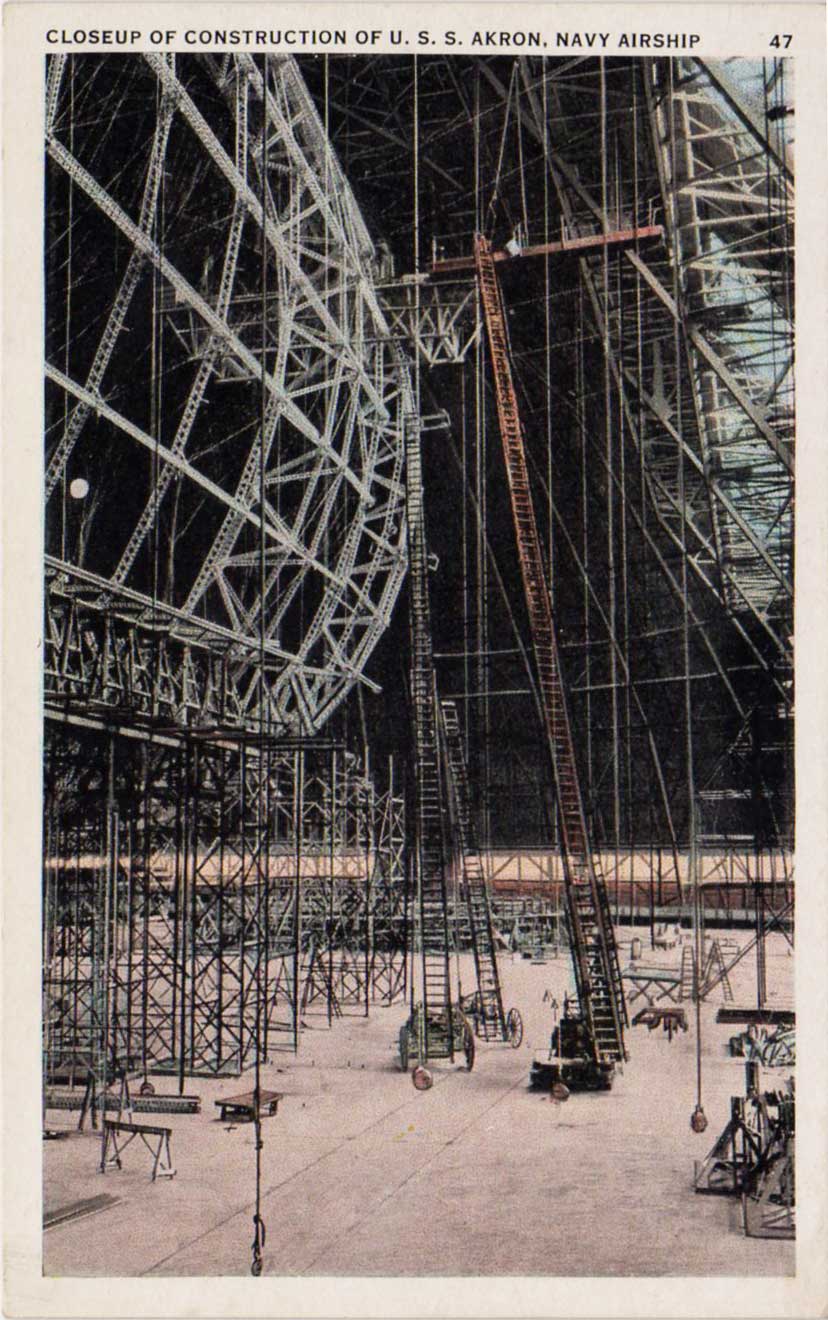
USS Akron under construction
Construction of USS Akron began in November, 1929 at the newly completed Goodyear-Zeppelin Airdock in Akron, Ohio.
The design of USS Akron, and its sister ship USS Macon, were based on plans prepared by Goodyear-Zeppelin engineer Karl Arnstein which differed radically from the design of previous rigid airships.
The ship was christened by First Lady Lou Hoover, the wife of United States President Herbert Hoover, on August 8, 1931, and made its first flight on September 23, 1931, under the command of Charles Rosendahl.
Rosendahl conducted a series of test flights over the next month, and then flew the new ship to the Naval Air Station at Lakehurst, New Jersey, where it was commissioned as a vessel in the United States Navy.

USS Akron under construction (click all photos to enlarge)
USS Akron’s Operational Career
USS Akron conducted its first naval exercise in January, 1932. While the ship’s range was impressive (it was able to stay aloft for several days and fly thousands of miles before returning to base), it performed poorly as a scouting aircraft, largely because it was not yet equipped with its squadron of fixed-wing aircraft, which would not become operational until the summer of 1932.

Damage on February 22, 1932
On February 22, 1932, Akron suffered an embarrassing ground handling accident at Lakehurst, in front of a group of congressman waiting to board the ship for a demonstration flight, when the ship broke away from its handlers and smashed its lower fin into the ground.
After two months of repairs, Akron spent most of the remainder of 1932 conducting trial flights, including operations with its fixed-wing squadron, and making goodwill and demonstration flights to show the airship to the American public and to congressional and other government VIPs.
In one of its most impressive demonstration flights, in May and June of 1932, Akron made a cross-country flight from its base at Lakehurst to a new airship facility being constructed at Sunnyvale, California.
 It was during this cross-country flight, at a stop in Camp Kearny near San Diego, that Akron was involved in a tragic and very public accident on May 11, 1932. Three sailors on the ground crew were carried aloft by the ship’s mooring lines when the ship climbed unexpectedly, and two of the men fell to their deaths in an event that was captured on film and shown in newsreels throughout America.
Akron participated in a very disappointing scouting exercise with the fleet off the west coast on June 1-4, 1932. Akron was able to locate the ships it was sent to discover, but still without its heavier-than-air squadron, Akron was required to stay close to the ships it was scouting, and seaplanes launched from those ships were easily able to score mock “kills” against the large, vulnerable airship.
Akron’s squadron of F9C-2 Curtiss Sparrowhawk biplanes became operational in July, 1932, and the ship spent the remaining months of 1932 in training operations with its airplanes.
During the first months of 1933, Akron continued to refine operations with its fixed-winged aircraft, and made several long distance flights including trips to Cuba and the Panama Canal Zone. Akron also made several shorter publicity-oriented flights, including an appearance at the inauguration of President Franklin Roosevelt on March 4, 1933.
 Crash of the USS Akron

USS Akron departed NAS Lakehurst on the evening of April 3, 1933 on a mission to calibrate radio direction finding equipment along the northeastern coast of the United States. The ship was under the command of Frank C. McCord, and among the 76 persons on board were VIPs including Rear Admiral William Moffett, Chief of the Navy’s Bureau of Aeronautics, and Cmdr. Frederick T. Berry, commanding officer of NAS Lakehurst.
[See: U.S.S. Akron Crash: Officers and Crew]
Admiral William A. Moffett, killed in the crash of USS Akron
Shortly after midnight, in the early minutes of April 4, the ship was hit by a series of strong updrafts and downdrafts off the New Jersey coast. Akron rose and fell in the strong winds, and while attempting to climb, the ship’s tail struck the water. With its control surfaces destroyed, Akron was lost, and the ship crashed into the ocean.
The cause of the crash is generally attributed to poor decisions on the part of the ship’s commander. It is likely that McCord relied on incorrect altitude readings given by the ship’s altimeter, which had been rendered inaccurate by the low pressure in the storm. Captain McCord may have thought his ship was higher than it really was, but as an aviator and aircraft commander, McCord should have been thoroughly familiar with the operation of a barometric altimeter and should have taken this into account.
In addition, while it is possible that Akron was driven into the sea by a strong downdraft, it is equally possibly, and even likely, that McCord simply flew his ship’s tail into the water, having not taken into account the ship’s great length while attempting to climb out of a downdraft. With the nose of the ship raised sharply to climb, Akron’s tail, almost 800-feet farther back, may have simply been pivoted into the ocean as the result of poor handling.
Executive Officer Herbert V. Wiley describes crash of the Akron
The crash of the Akron caused an appalling loss of life, and of the 76 persons on the ship only three survived; two sailors and the ship’s executive officer, Herbert Wiley. The rest of the ship’s passengers and crew died in the ocean from exposure to the frigid water, compounded by the lack of any lifejackets to keep survivors afloat.
ZRS-4 USS Akron statistics:
- Length: 785 feet
- Gas capacity: 6,850,000 cubic feet
- Useful lift: 152,644 lbs
- Maximum speed: 69 knots
- Crew: 60 officers and men
- First flight: September 25, 1931
- Final flight: April 3-4, 1933
- Total flight hours: 1,700
- Total flights: 74
CDR Berry’s name was Fred Thomas Berry. Not Frederick. His official title when he died was actually CAPT (sel) Fred Thomas Berry. He was my grandfather. I have so much Akron memorabilia from my father and uncle that is priceless. He was an amazing man.
It seems like many people are interested is seeing memorabilia from the USS Akron. My brother has a museum in Warren, OH that has one of the wooden propellers from that airship. It is in the Ernie Hall Aviation Museum at Sloas Airfield. You can find out more information by visiting the website erniehallaviationmuseum.org
Hope you get to visit the museum and see it.
I thought I would submit a comment today concerning the USS Akron. I find these stories on the lighter than air airships really interesting and just read today the story of the tragedy concerning the May 11, 1932 incident near San Diego. Today is the 81st anniversary of the two sailors falling to their deaths after losing their grip on the mooring lines when the airship unexpectedly lifted from the ground. I do remember seeing old newsreels of this incident many years ago, probably back in the 50’s or 60’s.
I just retired from a large industrial contractor as a Safety Administrator and I find it amazing when I look back on the fatalities associated with America’s endeavors of the twentieth century. US Steel averaged nearly 1-fatility a week at its now long gone South Chicago Works. The Hoover Dam had an official recorded number of 96 fatalities during its construction. It’s amazing to think that large construction projects use to “factor in†a given number of fatalities during their planning. The loss of life in the non-combat use of Dirigibles follows this pattern. Compare this, for example, to the $3-4 billion dollar project I just came off of at a nearby refinery employing as high as 15,000+ construction workers at one time which has not experienced a single fatality to date. I guess we can thank OSHA and the insurance companies for this systemic change.
Although my involvement with dirigibles is basically nonexistent, I find it amazing reading the various stories submitted from all the contributors out there on the history of something that occurred generally prior to the 40’s. God bless those who survived the various incidents, including those who lost earlier family members from accidents, and also the few out there old enough to witness seeing the dirigibles in action or the aftermath of an unfortunate incident. Finally, I salute the Resident Expert Dan (at Airship.Net) for his knowledge and for putting together this amazing site for all to enjoy.
My father’s brother, Lewis O. Hulting (age 33) was a crewman on the Akron. Uncle Lew wasn’t scheduled to fly but volunteed to take a friend’s place whose wife was expecting the birth of their child. My father, his brother Raymond “Tubby” Hulting, and brother-in-law Irv Ball drove from Illinois to Lakehurst, NJ to “pressure” the Navy to recover bodies of crew from the wreckage. The Navy said the wreckage site was too dangerous for divers to work. Our family has telegraphs from the Navy concerning the crash, front page headlines from our local newspaper, Peoria Journal Star, Uncle Lew’s diary, and other Akron memorabilia. There is a memorial plaque with the Akron’s crew names on it in the chapel at the Lakehurst Naval Air Station.
Less than a year later, Dad’s brother “Tubby” (age 30) died from complications after surgery. My father, and his two sisters always spoke so fondly of their “departed” brothers.
May God Bless the crew of the USS Akron and their families…….
Hello. My uncle benjamin Charles mclellan was on the Akron when
It crashed my dad told stories about his older brother. I have the telegram
The navy sent my grandmother notifying her of her sons death. Thanks for your information here about the Akron…very nice
Hi Tom,
I am the grandson of Smith, Charles’ brother. I would love to see that telegram. Do you have any other items related to the Akron? My grandpa had a few things like a piston from one of the engines and a piece of fabric, but after he died it disappeared. I had thought about creating a memorial page on Facebook for Charles. Andrew Wolgamott
Hi there. If anyone knows of a good picture of the J class bimp (J-3) that also went down during the Akron rescue I would appreciate it. Turns out that a friend of mine has the USN star from the side of it that his uncle salvage from it before it sank (his uncle was on a coast guard rescue ship that assisted the survivors and cut it from the sinking blimp with a knife).
Hi Doug,
As a long-time collector of lighter-than-air photos, I do have some decent photos of J-3. However, they are not for sale. But if interested, I can email scans to you.
By the by, the star you mentioned was positioned on top of the envelope with another underneath on the forward portion of the envelope. These were the only two stars on the blimp. No stars on the side. None of my photos show the star on top of the J-3. But I have a nice top view of the J-4 which clearly shows the top star.
Yours,
Thomas Norris
I am a life-long resident of Lakewood, graduate the class of ’40……one year before Bob Bedell. (Your grandfather?) I knew your great grandparents. I am presently the chairman of the Lakewood Heritage Commission We are currently seeking whatever information you can provide about your great uncle, “Ted” Bedell. You can reach me at my email address.
If you would send me you telephone number I woul like to speak with you.
Tell me the best time(s) to call you.
Thank you.
Wonderful site, and a true tribute to these rare vehicles. I grew up in San Pedro, California and remember the very subtle hum of one the Goodyear Blimps floating over my house more than a few times. Never failed to take my breath away; thank you again for the site.
Definitely. I am quite obsessed with airships myself. I wish I had one though. Just a small one you could use to live and fly around in, with almost complete freedom. Apart from licenses and regulations and health and safety and such.
Hey there, Chris… noting your wish for your personal airship, have you read up on, or watched the PBS documentary on Alberto Santos-Dumont (Wings of Madness)? He invented a number of “personal” airships he’d power with pedals geared to a propeller while sitting comfortably under the gasbag. He was known to fly from cafe to cafe in Paris, c 1895-1901, tying up at the roofs of same, climb a rope ladder to the street, drink/dine/hold court and then cycle away through the sky… now THAT was living!!! Good articles all over the internet. Great photos over on earlyaviators dot com.
Thanks for the interesting info, that is exactly what I would love to do! It would look pretty cool too, cycling around in the air, landing whenever you needed a tea break etc. Definitely what I would call living! (As long as you had a house and hangar too, of course)
Our grandfather use to work on those back in the day.
I just saw something on TV about past Navy Airships and decided to do a little research again on the Akron & viewed this site for the first time and loved it. Was also drawn to it because I have spent the past 2 weekends with my father Vernon and we were reminiscing about his childhood because his father, my grandfather, Harold Lamkin (who he never knew) was a Seaman 1st Class on the Akron & perished on that dreadful morning of April 4th, 1933.
Can anyone tell me if the hanger at Lakehurst, NJ is still there as a memorial to this arirship and it’s crew and is it open to the public? I would love to take my father and visit for myself?
Thanks and God Bless America & all our past , present & future men / women of the military!
Hanger One is still at Lakehurst. I had the pleasure of going inside back in the late 80’s. They had the control gondola from the movie “Hindenburg”. The Navy also had a mock up flight deck of a carrier built inside for training purposes. It was an amazing structure, and had a soul to it. I’ll never forget the experience and the privilege of sharing a room that once housed the Shenandoah, Los Angeles, Akron, Graf Zeppelin and the Hindenburg.