Dozens of hydrogen airships exploded or burned in the years before before the Hindenburg disaster finally convinced the world that hydrogen is not an acceptable lifting-gas for airships carrying people.
The following is a partial list of hydrogen-inflated airships that were destroyed by fire from accidental causes (the list does not include ships shot down in combat operations):
- LZ-4 (August 5, 1908)
- LZ-6 (September 14, 1910)
- LZ-12/Z-III (June 17, 1912)
- LZ-10 Schwaben (June 28, 1912)
- Akron (July 2, 1912)
- LZ-18/L-2 (October 17, 1913)
- LZ-30/Z-XI (May 20, 1915)
- LZ-40/L-10 (September 3, 1915)
- SL-6 (November 10, 1915)
- LZ-52/L-18 (November 17, 1915)
- LZ-31/L-6 and LZ-36/L-9 (September 16, 1916)
- LZ-53/L-17 and LZ-69/L-24 (December 28, 1916)
- SL-9 (March 30, 1917)
- LZ-102/L-57 (October 7, 1917)
- LZ-87/LZ-117, LZ-94/L-46, LZ-97/L-51, and LZ-105/L-58 (January 5, 1918)
- LZ-104/L-59 (April 7, 1918)
- Wingfoot Air Express (July 21, 1919)
- R-38/ZR-II (August 23, 1921)
- Roma (February 21, 1922)
- Dixmude (December 21, 1923)
- R101 (October 5, 1930)
- LZ-129 Hindenburg (May 6, 1937)
Description of the Accidents
LZ-4 (August 5, 1908)
After an emergency landing near Echterdingen, Germany, LZ-4 was was torn from its temporary mooring by a gust of wind and ignited after hitting a stand of trees.
Burned wreckage of LZ-4 near Echterdingen
LZ-6 (September 14, 1910)
LZ-6, owned by the world’s first passenger airline, DELAG, was destroyed at Baden-Oos by a hydrogen fire which began when a mechanic used petrol to clean the ship’s gondola.
LZ-12/Z-III (June 17, 1912)
LZ-12 ignited and burned in its hangar at Friedrichshafen while being deflated.
LZ-10 Schwaben (June 28, 1912)
The passenger airship Schwaben was destroyed by fire at the airship field at Dusseldorf when its hydrogen was ignited by static electricity from the ship’s rubberized fabric gas cells.

Wreck of LZ-10 Schwaben at Dusseldorf
Akron (July 2, 1912)
Melvin Vaniman’s airship Akron exploded 15 minutes after departing Atlantic City, New Jersey, during an attempt to cross the Atlantic.
LZ-18/L-2 (October 17, 1913)
An in-flight engine fire ignited the ship’s hydrogen, killing all aboard.
LZ-30/Z-XI (May 20, 1915)
The ship broke away from its ground crew after being damaged during removal from its hangar; it crashed nearby and was destroyed when its hydrogen ignited.
LZ-40/L-10 (September 3, 1915)
L-10 was destroyed by a hydrogen fire during a thunderstorm near Cuxhaven as it was returning to its base at Nordholz. It is likely the ship rose in an updraft and released hydrogen which was ignited by the atmospheric conditions. All 19 members of the crew were killed.
SL-6 (November 10, 1915)
SL-6 exploded and burned on takeoff, killing all aboard.
LZ-52/L-18 (November 17, 1915)
The ship caught fire and was destroyed while being refilled with hydrogen at the zeppelin base at Tønder.
LZ-31/L-6 and LZ-36/L-9 (September 16, 1916)
Both ships were destroyed by fire in their hangar at Fuhlsbuttel when hydrogen was ignited during refilling operations.
LZ-53/L-17 and LZ-69/L-24 (December 28, 1916)
While L-24 was being returned to the shed it shared with L-17 at Tønder, a gust of wind lifted the ship into the roof of the shed; a light bulb ignited a hydrogen fire which destroyed both ships.
SL-9 (March 30, 1917)
SL-9 burned after being struck by lightning in flight over the Baltic, killing all 23 persons aboard.
LZ-102/L-57 (October 7, 1917)
L-57 burned in its shed at the airship base of Niedergörsdorf”“Juterbog after being damaged by high winds during docking operations.
LZ-87/LZ-117, LZ-94/L-46, LZ-97/L-51, and LZ-105/L-58 (January 5, 1918)
An explosion at the zeppelin base at Ahlhorn ignited the hydrogen of all four ships.
LZ-104/L-59 (April 7, 1918)
L-59 exploded in flight and crashed at sea near Malta, killing all 21 members of the crew. L-59 was the famous “Africa Ship” which proved the feasibility of intercontinental zeppelin travel by carrying 15 tons of cargo and 22 persons on a record-breaking 4,225 mile flight during a military relief mission to German East Africa in November, 1917.
Wingfoot Air Express (July 21, 1919)
Goodyear’s Wingfoot Air Express ignited in mid-air and crashed through the skylight of the Illinois Trust & Savings Building in Chicago, Illinois, killing three persons on the ship and ten bank employees and injuring another 27 people. All subsequent Goodyear airships were inflated with helium.
R-38/ZR-II (August 23, 1921)
The British-built R-38 (intended to serve as the United State Navy airship ZR-II) suffered in-flight structural failure over the city of Hull, England and crashed into the River Humber where it ignited, killing 44 of the 49 men aboard.
Roma (February 21, 1922)
The United States Army airship Roma (built by Umberto Nobile) ignited when it hit high-tension electrical wires near Langley Field at Hampton Roads, Virginia, killing 34 of the ship’s 45 crew members. After the Roma disaster the United States government decided never again to inflate an airship with hydrogen.

Dixmude (December 21, 1923)
The French-operated Dixmude was destroyed over the Mediterranean Sea near the coast of Sicily by a hydrogen explosion visible from miles away. Dixmude’s gas cells had apparently been contaminated with air, creating an explosive mixture, and the ship may have been lifted by updrafts in a thunderstorm, causing hydrogen to be vented and then ignited by the electrically charged atmosphere.
R101 (October 5, 1930)
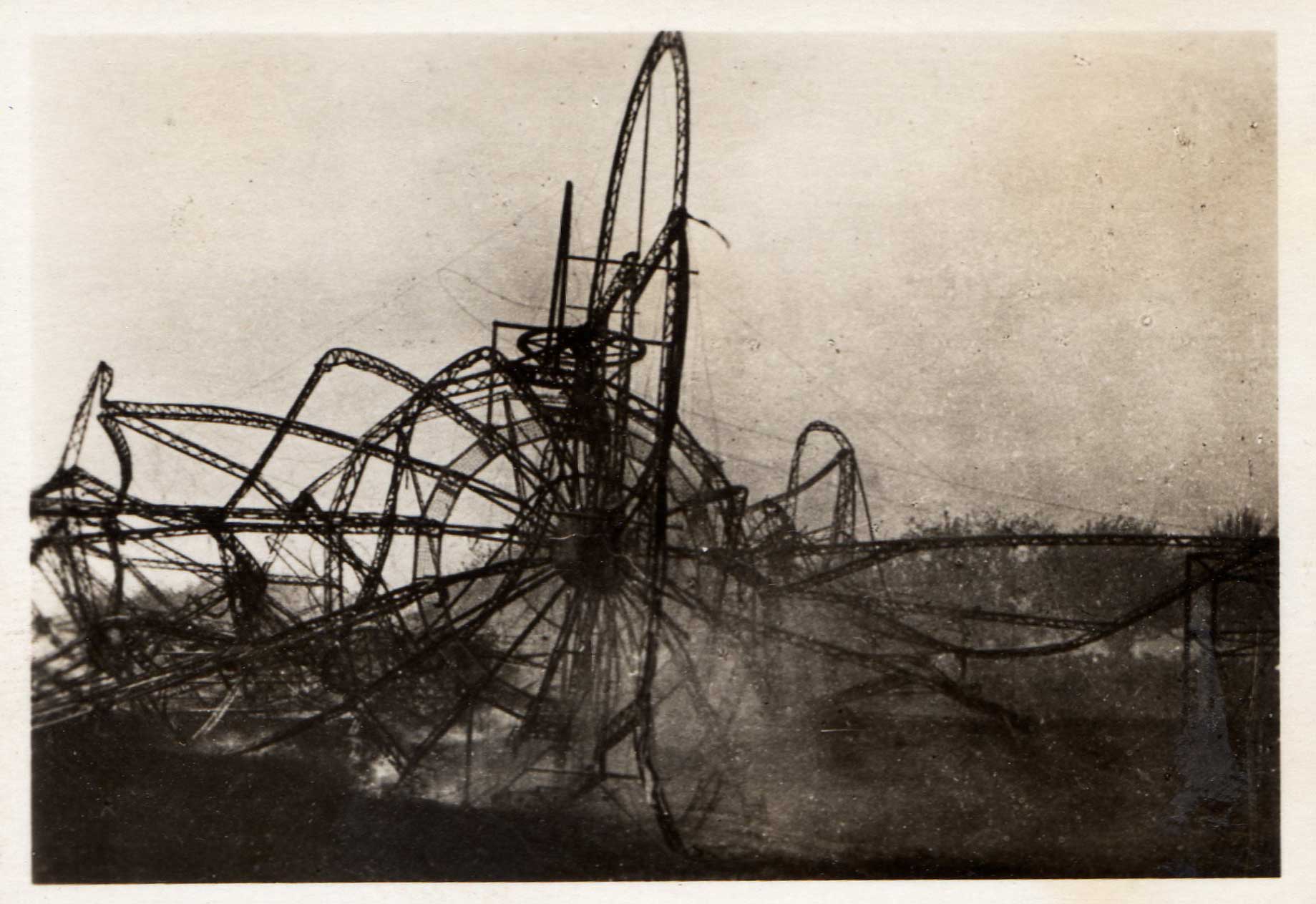
The poorly-designed British R101 lost altitude and sank into a hillside near Beauvais, France. The impact was slight and caused few if any injuries, but the ship’s hydrogen ignited and the ensuing inferno killed 48 of the 55 passengers and crew.

Wreckage of R101
LZ-129 Hindenburg (May 6, 1937)
Hindenburg was destroyed by a hydrogen fire at the Lakehurst Naval Air Station.

Hindenburg Burning at Lakehurst, New Jersey
I suspect also:
-Baumgartner-Wolfert
I do not know, whether these fires have been of hydrogen or another origin. But likely so.
I have researched automobile alternative fuels and found hydrogen an environmentally sound choice. Some disadvantages include cost and availability. This article begins its second paragraph commenting on hydrogen’s abundance. I assume that keeping an airship full versus a fill up at the gas station makes a big difference. Is there a hydrogen fuel savvy expert “here” somewhere?
You see how many car accidents there are already, imagine now with a highly explosive gas under massive amounts if pressure, which would be needed to keep hydrogen in a liquid form to make it feasible for long distance travel.
My Grandmother and her sisters/friends encountered the Roma as it flew over Hampton Roads area of Virginia. Less then 1 hour later it crashed near Langley Field in Virginia. My Grandmother and her sisters/friends were very surprised to hear that the victims that died in the disaster were the same ones that only minutes before had been waiving and telling them hello from the Roma as it flew by above them.
I will never fly on a helium inflated airship since the worst airship disaster ever was because the helium in the USS Akron did not support the ship’s Weight in a Atlantic storm and the airship crashed into the Atlantic so i will only fly on a Hydrogen filled airship
Ok so one tragedy has you willing to risk this whoke list of tragedies? Could you at least pretend to be serious?
It’s not ALL about H2 or He. Let’s not forget CH4, methane. Half as buoyant as He and a third more buoyant than hot air, it is the champion of the middle ground of airship lift gas.
It’s flammable but much less so the H2. Its flammability range is one third of H2.
Plus, the lesser permeability of its large molecule will enable the use of a cheaper plastic film for containment. Cost of a multi layered container is a huge drawback to using H2 for personal airships.
So, its an all around winner for airship lift gas I believe.
Has anyone tried using CH4?
It is about 16x the weight of H2 and also flammable, so what is the advantage?
I’m guessing not enough of an advantage for anyone to actually attempt to use it.
Latest Zeppellins used Blau Gas, basically propane. Same density as air, simply replaced it in tank.
Blau Gas was used only one airship, LZ-127 Graf Zeppelin. It was used as fuel for the engines, and was carried in the lower portion of the ship’s gas bag assembly, labelled here as Kraftgaszelle (power gas cell, or fuel gas cell), not in tanks.
I am also doing a report on the Roma and the US military zeppelin program for my 8th grade independent study because of my great great grandfather.
I am trying to locate info on the flight crew of the Roma. I very close friend of ours, Alberto Flores was one of the few who survived the crash. he died in 1988 at the age of 91.
Judie,
My wife is currently writing a book on ROMA, she would be more than happy to share any information that she has (which is quite extensive). She is having some difficulty with information regarding Alberto Flores after the crash so if you have any personal stories etc… I know that she would be eternally grateful. If anything, I know that she would be very interested in speaking with you about ROMA.
Best,
Joshua D. Sheppard
My great, great grandfather William O’loughlin was a civilian engineer working on the Roma’s six liberty engines when she went down. My family and I still regard him as a hero.
And the rest of the world regards him as an idiot.
This comment is insensitive and uncalled for.
I agree. The comment was totally uncalled for.
This is someones gggrandfather. Who are you to judge him? This man was part of history. What have you done in your lifetime that will be written about 100 years later? NOTHING I’M SURE…..be a man and remove this. Or continue being a pos and leave it up….maybe that can be your life legacy you moron.
I just noticed Fred’s comment and was tempted to delete it, but Antony and Sandra did such a good job with it that I will leave it up; maybe it will make Fred think twice about posting things like this in future.
I commend you for doing so. My pet peeve is moderator/censors. The huge majority of them are capricious in the extreme.
Trolls on websites merely display their own stupidities. By troll, I do NOT mean someone who merely disagrees with the status quo, as some do.
It wasn’t the engines that caused it to catch fire dumbass
As you are without a doubt.
Hello Wesley,
I hope this reply reaches you, over two years after you posted your comment! My name is Nancy E. Sheppard and I am a historian who has devoted the last three years of my professional work to the study and research of ROMA and her crew. Recently, I have accepted a contract to bring ROMA’s story to publication and it is due for release early next year. I would love to hear from you regarding your great great grandfather, William O’Loughlin. I have had a great deal of trouble locating information regarding the civilian engineers from McCook Field that were on board ROMA. I would love to know more about your great great grandfather and any stories you might have heard.
I would also like to apologize for the insensitive comment left regarding your great great grandfather. The truth is, very few people actually know terribly much about the ROMA disaster and it can only be insinuated as to the cause(s) of the crash. The engineers from McCook were brilliant men who understood airships perhaps better than those higher up in the military LTA community at the time. I would love to share with you the little I’ve been able to gleam about your great great grandfather.
My email address is: [email protected]. Please send me an email and I’d love to connect with you!
Very best,
Nancy E. Sheppard
Mr.Carvallo you’re a jackass
Akron was not inflated with hydrogen
i think it was filled with hydrogen
The Akron was inflated with helium
The Akron referred to here is the airship Melvin Vaniman flew in 1912.
Different Akron…the first one blew up in 1912. The second one, the USS Akron, helium filled, has the dubious distinction of having the worst loss of life of any airship when it was lost in a storm off New Jersey in 1933.
Hydrogen is in a flammabilty class by itself. Jet fuel, which is less easily ignited than gasoline, is practically inert when compared to hydrogen.
And, besides, the hindenberg blew up after hitting an iceberg. It was the Titanic that burned at Lakehurst. Do try to get the facts right.
You are just trying to be funny, right? We all know that the Titanic was an ocean going passenger ship. No one has ever thought otherwise. If you are in fact serious, you desperately need help.
You’re crazy, how could the Titanic even have got to Lakehurst if it was an ocean going ship (as you claim)?
Lakehurst isn’t on the sea.