What is an Airship?
An airship is any powered, steerable aircraft that it is inflated with a gas that is lighter than air.
What is a Dirigible?
“Airship” and “dirigible” are synonyms; a dirigible is any lighter-than-air craft that is powered and steerable, as opposed to free floating like a balloon.
The word “dirigible” is often associated with rigid airships but the term does not come from the word “rigid” but from the French verb diriger (“to steer”).
Dirigibles include rigid airships (like the Hindenburg), semi-rigid airships (like the Zeppelin NT), and blimps (like the Goodyear blimp).
A blimp (technically a “pressure airship”) is a powered, steerable, lighter-than-air vehicle whose shape is maintained by the pressure of the gases within its envelope.
A blimp has no rigid internal structure: If a blimp deflates, it loses its shape.
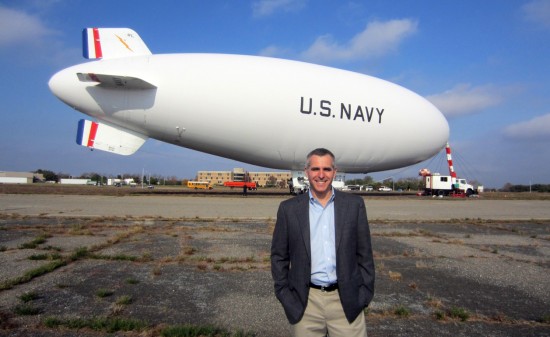
Airships.net author Dan Grossman with the U.S. Navy blimp MZ-3A. (Photo: JB-MDL Public Affairs)
Today, blimps are best known as advertising vehicles — Goodyear began using blimps to advertise their brand in 1925 — but blimps have also played an important role in the armed forces of many countries; the U.S. Navy’s lighter-than-air program made extensive use of blimps, primarily in anti-submarine and reconnaissance roles, from the 1920s through the 1950s.
Was the Hindenburg a Blimp?
No, the Hindenburg is often called “blimp” but that is not correct; Hindenburg was a rigid airship that maintained its shape by means of a metal framework.
What is a Rigid Airship?
A rigid airship has a framework surrounding one or more individual gas cells, and maintains its shape by virtue of the framework and not from the pressure of its lifting gas.
This photograph of the U.S. Navy airship Shenandoah under construction illustrates the ship’s metal framework, a partially inflated gas cell, and the fabric outer covering that protected the gas cells and provided aerodynamic streamlining:

USS Shenandoah under construction, showing rigid framework, individual gas cells, and fabric covering
This drawing of U.S.S. Shenandoah illustrates the various parts of a rigid airship:

Drawing of U.S.S. Shenandoah from the January 1925 issue of The National Geographic Magazine.
What is a Zeppelin?
A zeppelin is a rigid airship manufactured by a particular company, the Luftschiffbau Zeppelin of Germany (the “Zeppelin Airship Construction Company”), founded by Count Ferdinand von Zeppelin.
Ferdinand von Zeppelin is considered the father of the rigid airship, but not all rigid airships are “zeppelins,” just as not all photocopiers are “Xerox” machines.

German Navy Zeppelin L-13 (LZ-45). Drawing by Norbert Andrup.
The term zeppelin is often associated with the German airships that conducted bombing raids during World War I, but while most of these ships were built by the Zeppelin Company, not all German WWI airships were zeppelins; the German military also used rigid airships of very different design built by the Schutte-Lanz and Parseval companies.
One of history’s most famous zeppelins was LZ-129 Hindenburg. (“LZ” stands for “Luftschiff Zeppelin” and “129” indicates that Hindenburg was the 129th airship designed by the Zeppelin Company.) Because the American naval ships USS Akron and USS Macon were built by a Goodyear-Zeppelin joint venture, they are sometimes referred to as zeppelins as well.
Zeppelins still fly today; in fact the new Goodyear airship is a not a blimp but a zeppelin, built by a descendant of the same company that built Graf Zeppelin and Hindenburg.
What is a Semi-Rigid Airship?
A semi-rigid airship, like a blimp, maintains its aerodynamic shape from internal gas pressure, but it has a partial rigid frame, usually in the form of a keel, which supports and distributes loads and provides structural integrity during maneuvering.

Semi-rigid airship Norge
Famous semi-rigid airships include Norge of polar explorer Roald Amundsen and Italia of Umberto Nobile. The modern Zeppelin NT is also a semi-rigid airship.

Goodyear’s newest airship, a Zeppelin NT, lifts off for its first flight on March 17, 2014. (photo: Goodyear Tire & Rubber Company)
A question; semi-rigids seems to be more solid than blimps with a slight weight penalty, why had they fallen out of favor in the 20s versus rigids and for long afterwards with blimps?
My thoughts are that while blimps are cheaper to build and seem to be safer in adverse weather than rigids, they do not seem to be easy to scale up, and full rigids cost an arm and a leg to build, despite their impressive lifting abilities (the Akron and Macon come to mind). It just seems odd that there is so little info on what seems to be a great middle ground airship. The Roma, for example, at 410 feet long, had a useful lift with hydrogen of 42,000 pounds.
I rode in a Zeppelin NT and it was wonderful.
I understand much of the problems of shipping grain out of Russia is due to the lack of roads; modern airships could solve this problem. Are there any dirigibles being made now that could be used that way? Trading around Russia’s central government could get us out of the nasty mess we are in just now
Right now we cannot build airships big enough to effectively haul bulk cargo.
This is actually something being looked into by a number of businesses, more as an in-between for overseas transport (with planes being fast but expensive, and boats being slow but cheap, airships could offer a good middle ground) however one of the big issues being faced is if you are dropping a ton of cargo, you now have an extra ton of lift. There are a number of innovative solutions that have been proposed, such as an airship which uses gas to lift itself, but uses forward thrust to generate the lift for it’s cargo. This seems like one of the best ideas at the moment, and is certainly better than just venting the extra gas, but it’s not perfect. Airships for use in disaster relief is also something being looked at,given that arterial roads are often damaged during natural disasters, and supply trucks with food, water and medicine can’t access the area. It has been proposed that airships could drop off pre-fabricated building, such as hospitals and generators, as well as being a route for supplies, and potentially even service as a phone ‘tower’. However in all cases, the extra lifting gas is an issue, and given that most modern airships use helium, which is rare and expensive, venting air is not an economic or environmental option. My personal suggestion would be to use a rigid-body airship, where each gas cell is tethered to the cargo, so the ship could drop off and pick up cargo easily, and ground crew could compress the air at a more practical pace. I’m sure there would be a whole host of design and structural challenges with this, but at present no good and scale-able solution has been developed as far as I’m aware. (My information is a few years old so I can’t stand over all these facts, but the basic idea should be there)
why dont they use airships for cargo?
Right now we cannot build airships big enough to effectively handle bulk cargo.
Interesting.i love to watch the Good Year blimp fly over. thanks nice article.
I think you mean the Goodyear airship… 🙂
No….BLIMP.
I got to watch the Goodyear Blimp land once. I was under the impression that the blimp was venting off helium, but I was told by a ground handler that they were pumping air into the air bladders to land and pumpiing it out to rise. The Helium has to be added asd it is lost, but the air supply is what actually makes it hevier or lighter.
The main purpose of a blimp’s ballonets it to maintain the shape of the envelope and assist with trim, but to the extent air added to a blimp’s ballonets makes the ship as a whole heavier it is not from the weight of the air itself (which has the same weight as the ambient atmosphere and thus no effect on buoyancy) but from slightly compressing the helium, which makes it denser and thus heavier.
This was really fascinating. I’ll have to tell my older brother about this because he loves planes and vehicles.
There were at least one dirigible with a Dish or flying saucer shape. It was in the 1970s and if I remember well was named Skyship. Do you hace any info about that type of dirigibles?
I believe you are thinking of Aereon, “the Deltoid Pumpkin Seed.”
I can’t recall where I got this notion, but maybe someone can verify or deny… I always thought that the term airship referred strictly only to rigid lighter than air steerable craft, and that dirigible was the catch-all term for all LTA craft whether or not rigid. Kind of makes sense, as dirigible refers simply to the steerable nature of the vessel, whereas airSHIP implies a rigid structure, like a naval ship would have (and not a rubber dinghy;-). I note that the definition on this web page “devalues” airship as merely a synonym of dirigible. I also note that after some research, all of the “common” sources – various dictionaries – similarly equate the two terms. But here I am asking the experts! Terminology matters!
While terminology does matter, dirigible and airship are interchangeable. The use of dirigible is also somewhat archaic, much like horseless carriage is to car.
The true distinction of an airship is not in the term “airship” vs “dirigible”, but rather in an LTA vessel’s classification: Non-rigid, Semi-rigid, or Rigid. That is where the specificity lies, given that the classification describes exactly what manner of LTA craft one is dealing with. Although I rather suspect someone in 1910 or there about wouldn’t have had much challenge in seeing the difference without knowing the terminology, ha ha.
I have seen some articles make the silly mistake of saying “dirigible airship”, which is somewhat redundant as non-steerable craft are usually referred to simply as balloons.
What was the difference between blimps and zeppelins and why couldn’t the British make zeppelins to sink German submarines instead of blimps?
If you actually read the article you would see that has Zeppelin is made by a specific company the Zeppelin company. Also blimps are big balloons with fins basically and all Zeppelins are rigid or semi rigid inform.
Furthermore the British could not build Zeppelin’s to bomb German submarines because Zeppelin’s are all all made in Germany by a German company.
THE British needed something quick and dirty, time was of the ESSENSE. THE game was to get war materials from America to England, avoiding or keeping to a minimum the torpedoing of the ship convoys, trying to keep England supplied. Building a Zeppelin, or more took too much time.
Excellent article, Dan. Last year I received my grandfather’s military service jacket and found that he was present in Lakehurst, New Jersey, when the ZR-1 first lifted off on Aug 16, 1923 (christened the USS Shenandoah that fall by the wife of President Coolidge). Your facts and drawings of the rigid airship are helping me in one section of a book I’m writing on my grandfather’s life. Thanks.