The design and construction of Graf Zeppelin were essentially conservative, based on tried-and-true technology developed over the Zeppelin Company’s decades of experience, and the ship was constructed of triangular Duralumin girders, with frames (or “rings”) spaced 15 meters apart.
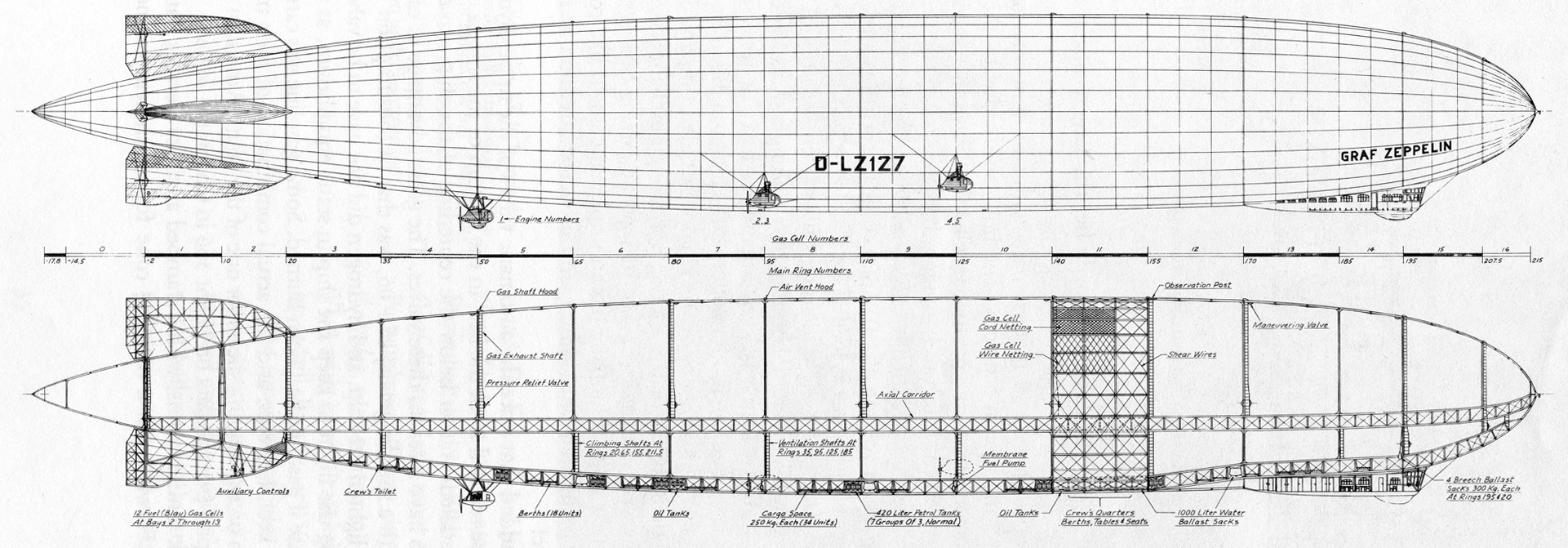
Graf Zeppelin profile, showing rings, gas cells, and major elements. (click all photos to enlarge)
The Limited Shape and Size of Graf Zeppelin
The shape and size of Graf Zeppelin was not ideal aerodynamically (in terms of performance), structurally (in terms of strength), or economically (in terms of payload).
The design of the ship was determined — and limited — by the size of the construction shed at Friedrichshafen, which had inner dimensions of 787 feet in length and 115 feet in height.

Since greater size meant greater efficiency in long distance operation, the challenge for Ludwig Dürr and his design team was to create a ship with the largest possible gas capacity that could be built within the confines of the construction shed:

The Graf Zeppelin’s hull was the largest shape that could be built within the rectangular limits of the Friedrichshafen construction shed. The ship was designed to have the maximum gas-carrying capacity that could be built with the limits of the shed.
The ship they designed was a long, thin cylinder, 776 feet long and 100 feet in diameter, with a gondola situated far forward, so that it could be slung under the hull where it began to rise toward the bow. The height of the ship from the bottom of the gondola to the top of the hull was 110 feet, just barely clearing the arches of the shed.
LZ-127’s long, slim hull was not the most aerodynamically efficient shape (which was a lesson learned from the efficient teardrop design of Bodensee and Nordstern); it was not the most structurally effective shape (since the thin hull was vulnerable to bending stresses); and it was not the most economically practical design (since its relatively small size limited payload on long flights), but it was the best that could be achieved within the limitations of the hangar at Friedrichshafen.

Keel of Graf Zeppelin, showing traditional triangular girder construction. (click all photos to enlarge.)

Graf Zeppelin under construction, showing Duralumin frames, 15 meters apart.
The Use of Blau Gas
But Graf Zeppelin did incorporate one especially notable innovation, in the use of Blau gas fuel for its five engines. One of the challenges of lighter-than-air powered flight has always been the need to account for the loss of weight as fuel is burned by the ship’s engines. As gasoline or diesel fuel is consumed during flight, the ship becomes lighter, and without a means to compensate for this change, lifting gas must be vented to maintain the ship’s equilibrium. The Zeppelin Company’s innovative solution to this issue with Graf Zeppelin was the use of a gaseous fuel, similar to propane, named Blau gas after its inventor, Dr Hermann Blau. Since Blau gas is similar in weight to air, its consumption during flight did not significantly change the aerostatic balance of the ship, and so it was not necessary to valve lifting gas to compensate for Blau gas burned by the engines.
Blau gas was also more efficient to carry than gasoline, and extended the ship’s range by over 30 hours of flying time; the approximately one million cubic feet of Blau gas carried by Graf Zeppelin could power the ship for over one hundred hours, but if that million cubic feet of Blau gas had been replaced by hydrogen, the additional hydrogen could have lifted only enough gasoline to power the ship for 70 hours or less.

Cross-section of LZ-127 Graf Zeppelin
The Blau gas was carried in 12 cells (Kraftgaszelle, or “power gas cells”), in the lower section of 12 of the ship’s 17 gas cell bays, beneath the hydrogen cells (Traggaszelle, or “lift gas cells”). Of Graf Zeppelin’s total gas capacity of 3,707,550 cubic feet, 1,059.300 cubic feet was available for Blau gas. The ship did also carry a supply of gasoline, so that if the ship were heavy, the engines could burn gasoline instead of Blau gas, lightening the ship without the need to drop ballast.
The use of Blau gas was quite hazardous, and many people believe Graf Zeppelin’s Blau gas presented a greater danger to safety than the ship’s hydrogen. The gas cells of that era were not impermeable and always leaked to some extent, and small tears and other minor leaks were also common. Since Blau gas has a similar density to air, escaping Blau gas did not rise like hydrogen but rather settled to the bottom of the hull, including the keel and into the gondola itself, and could even flow out toward the engines. This was an even bigger problem when the ship was on the ground, especially inside an enclosed hangar, since there was no flow of air to carry the gas away.
It should always be remembered that Graf Zeppelin was basically an experimental “proof of concept” design, and that the design of ship was limited by practical considerations such as the size of the construction shed at Friedrichshafen. While a clever response to these limitations in some ways, Blau gas had never before been used in a zeppelin, and it would never be used again.
Water Ballast
When it did become necessary to drop ballast to maintain equilibrium, Graf Zeppelin could look to the 17,640 lbs of water it carried as trim ballast, as well as up to 5,280 lbs of water as emergency ballast, and 3,520 lbs of water carried for drinking, cooking, and washing (which was kept on board after use).

LZ-127 Graf Zeppelin dropping water ballast during landing.
Graf Zeppelin was powered by five Maybach VL-2 12-cylinder engines, which could develop 550hp at maximum revolutions, and 450 hp at 1400 RPM in cruise.

One of Graf Zeppelin’s two port engine gondolas, under construction.

Graf Zeppelin’s five engine gondolas under construction.
Typical Speed and Altitude
The ship typically cruised at 72 MPH, at an altitude of 650 feet above ground level, but it also flew as high as 6,000 feet on occasion (for example, when crossing the Stanovoy mountain range in far eastern Russia during its Round-the-World flight). Graf Zeppelin also cruised well below 650 feet when necessary, as it was German practice to reduce the stress of vertical gusts by flying low to the ground during storms when possible.

Graf Zeppelin under construction.

Graf Zeppelin under construction.

Graf Zeppelin under construction, showing the keel at bottom of photograph, and the axial corridor above, which ran down the center of the ship.
i bet someone is going to make a rigid airship in the next hundred years. why? because they produce less co2 and alot of people are afraid for the climate
i bet someone is going to recreate the graf zeppelin or make another rigid airship. in the next hundred years too.
Wonderfull. I love the graf zeppelin!
Did the engine gondolas need to be maned 24/7 as I assume the control gondola needed to be?
Yes. A minimum of 21 Mechanics were on each flight, which allowed for a three watch rotation in each of the five engine gondolas, plus three floaters for the Trim Watch rotation. Mechanics were on duty for 2 hours during the day and 3 hours at night.
I have a technical question. I have been fascinated by Airships / Zeppelins since my childhood. Did the Graf Zeppelin DLZ have any EXTERIOR lighting (such as beacon lights or search lights 1. at the nose of the ship or close to the cockpit and 2. At the tail / fins) at the end? If so, I would be interested to know, if they were clear plain white light or a red ones. I am currently buidling the Hawk 1/245th scale Graf Zeppelin DLZ 127 model. I can’t find any specific mention of this in research materials such as in Rick Archbold’s “Reliving the Era of Great Airships: Hindenburg” nor in Harold G. Dick’s work “The Golden Age of the Great Passenger Airships Graf Zeppelin & Hindenburg”. If anyone would have details regarding this aspect, I would be immensely grateful! On a side note / personal trivia; Prior to WWII, when my grandparents were young, they both saw the Graf Zeppelin and Hindenburg over Essen, in the Ruhr region, during the ‘propaganda tours’ across Germany. They noted it was SPECTACULAR to see them in flight together. Congratulations! This is a great website. I enjoy the information, photos and many posts. Greetings from Canada.
idk i wish i knew i just realized what they were and i’m now SO facinated in them.
i would design my rigid airship to utilize an hho electrolyzer system to not only supply the gas bags, but to power the engines as well! the ‘water'(h2o) that would be the hydrogen source would also be utilized as ‘ballast’ (controllable) and would power the electrical generator(s?) as well for cooking, pumps to power the ‘trim’ controls and showers, radio, etc.! ([email protected])
Problem with that is that a electrolysis requires energy input. Even if the hydrogen in the gas cells was utilized as a power source, you’d likely have ballast issues, since it would add weight while in flight.
The problem with that is that electrolysis requires energy input. Even if you utilized the hydrogen as a power source, you would likely run into ballast issues, as the ship would add weight while in flight.
I would suggest mylar for gas cell material! For skin, anything that looks nice and is light. Perhaps mylar as well. It is heat sealable and very light.
Zeppelins 100th anniversary of passing!! Long live LTA!
Did the cabin layout change in the Graf over the years? There are photos out there on the internet from that time showing the starboard side of the gondola, towards the front. One photo shows the entry door where most of us recall – abaft the galley and before the salon. However, another photo clearly shows the entry door just aft the forward control room and ahead of the galley. Did DELAG alter the design of the ship? I was unable to paste the images on this posting unfortunately.
Lets see,,,,
3520 pounds of potable water is about 422 gallons of water.
That’s not much for 24 passengers and crew on a three day jaunt across the “pond” to America, or a four to five day run down to Rio.
13 liters per person each day
Hello! I can’t thank people like you anymore for keeping these sites going and giving lighter-than-air fans and hobbyists a chance to read and discover more about the thing they love. I’ve had an obsession with all sorts of lighter-than-air craft for a while now and am trying to build an 8 foot, long laser cut zeppelin with a rigid frame made from balsa wood. I’m currently trying to talk with people at hobby shops about how to get an RC system into my craft, but I would love to talk to other people about any problems found in my design. I don’t even know if the craft has to be aerodynamic! I made it mostly from scratch and I am hoping to find some way to refine it. I may be able to put the link for my model into the comments section later, since I need to upgrade to a later version of SketchUp in order to put my model on the workshop.
Instead of using would wood you should consider carbon fiber struts or aluminum struts for the rigidity of the airship. I have found that using wood causes a major weight increase which leads to a rather odd shaped design; not very aerodynamic.