The internet is filled with claims that the Hindenburg’s “flammable covering” was the main reason the ship was destroyed by fire in less than a minute. In fact, the Hindenburg was only the last in a long line of hydrogen airships destroyed by fire as a result of their highly flammable lifting gas, and scientific studies show that the Hindenburg’s covering might not have been flammable at all.
For a detailed historical and technical analysis, visit Rocket Fuel, Thermite, and Hydrogen: Myths about the Hindenburg Crash. But perhaps the most obvious and compelling evidence is found in the films and photographs of the disaster: Even as the hydrogen flames roared around the covering, the covering itself did not burn right away.
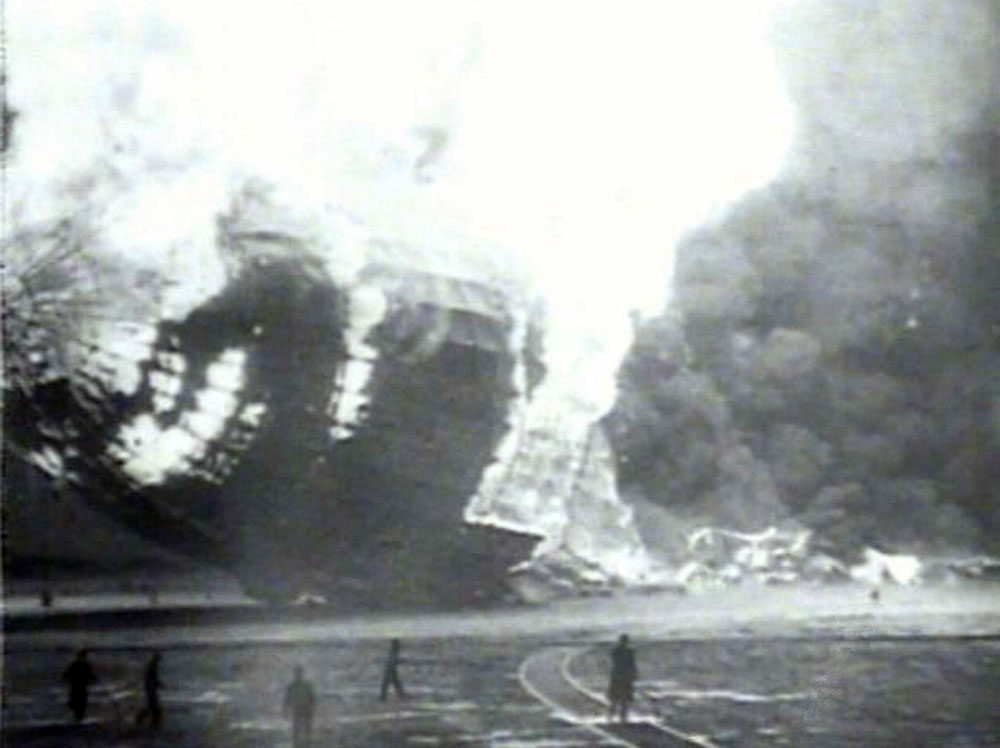
(click to enlarge)
Even with flames right behind the covering, the fabric itself did not not immediately ignite. Instead, the fabric burned from behind, where the hydrogen fire was roaring.
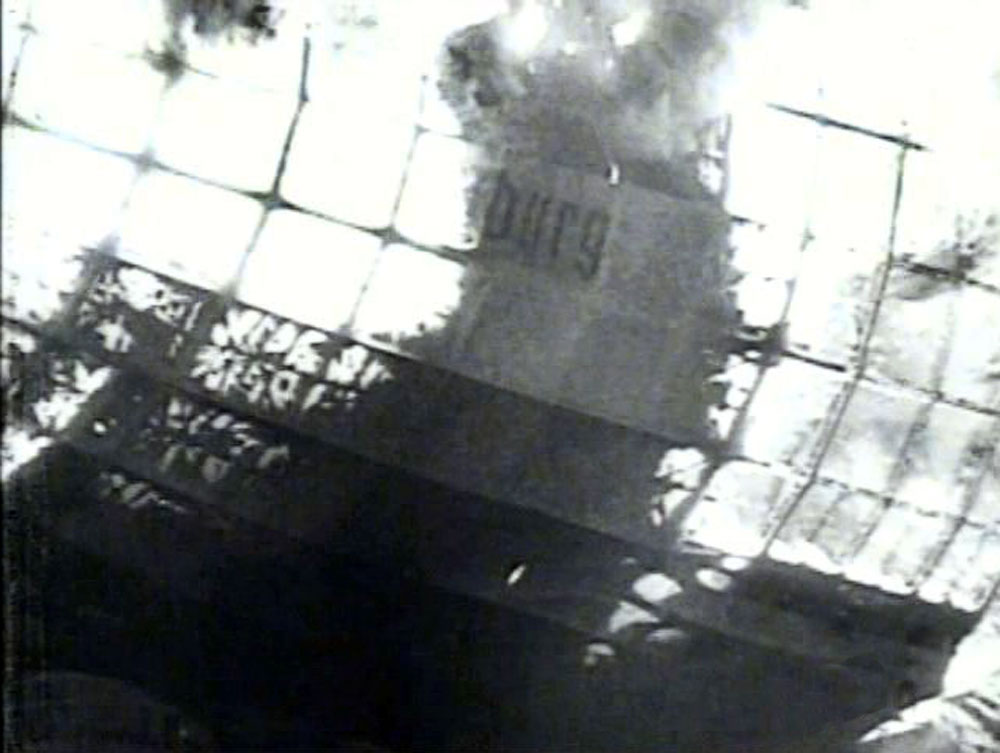
(click to enlarge)
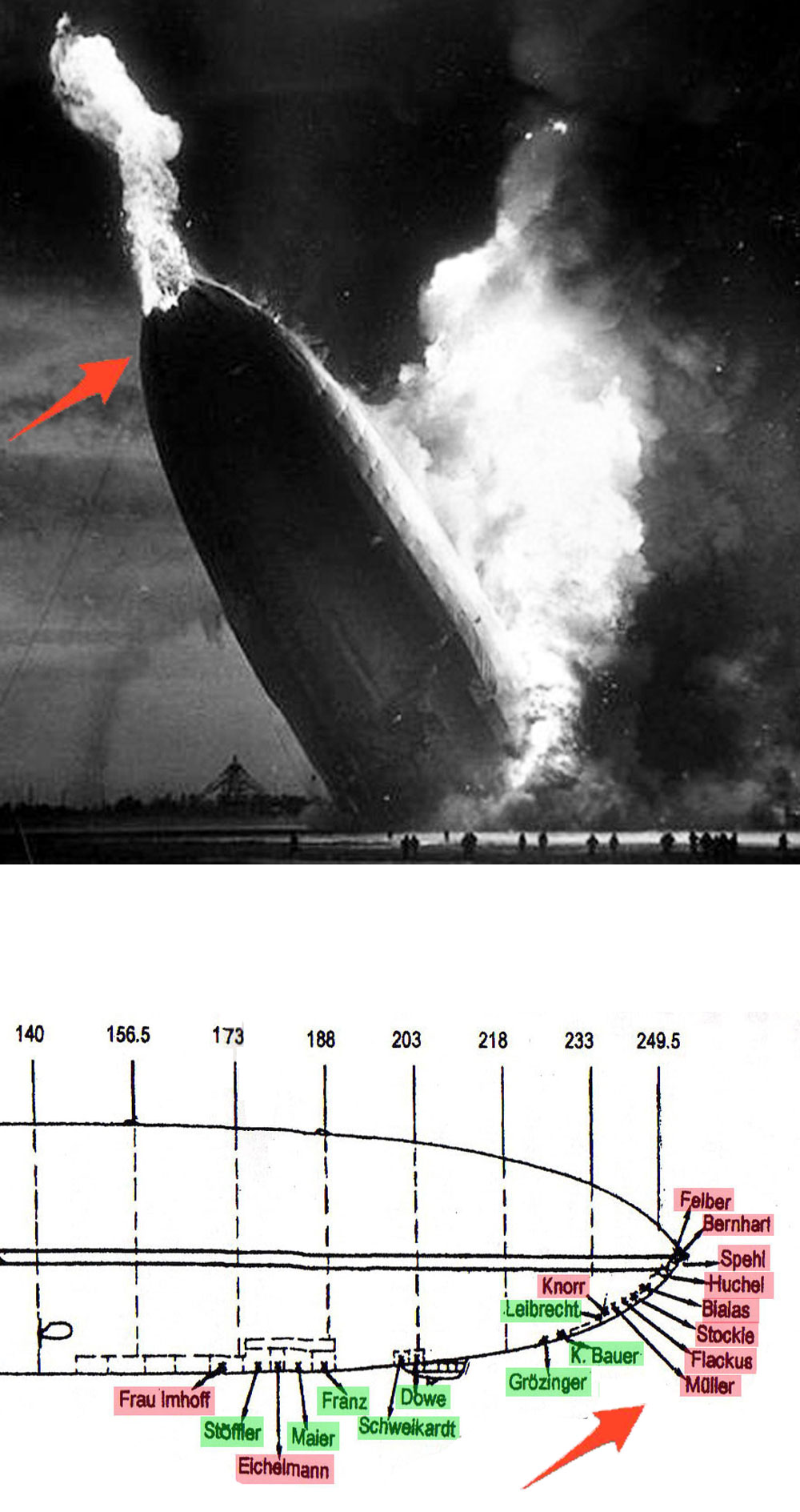
And even as the zeppelin crashed to the ground, with flames erupting from its nose like a blow torch, the covering had not yet burned: Flames fueled by hydrogen reached the airship’s nose, killing the crewmen stationed in the bow [see diagram], long before the covering on the hull caught on fire.
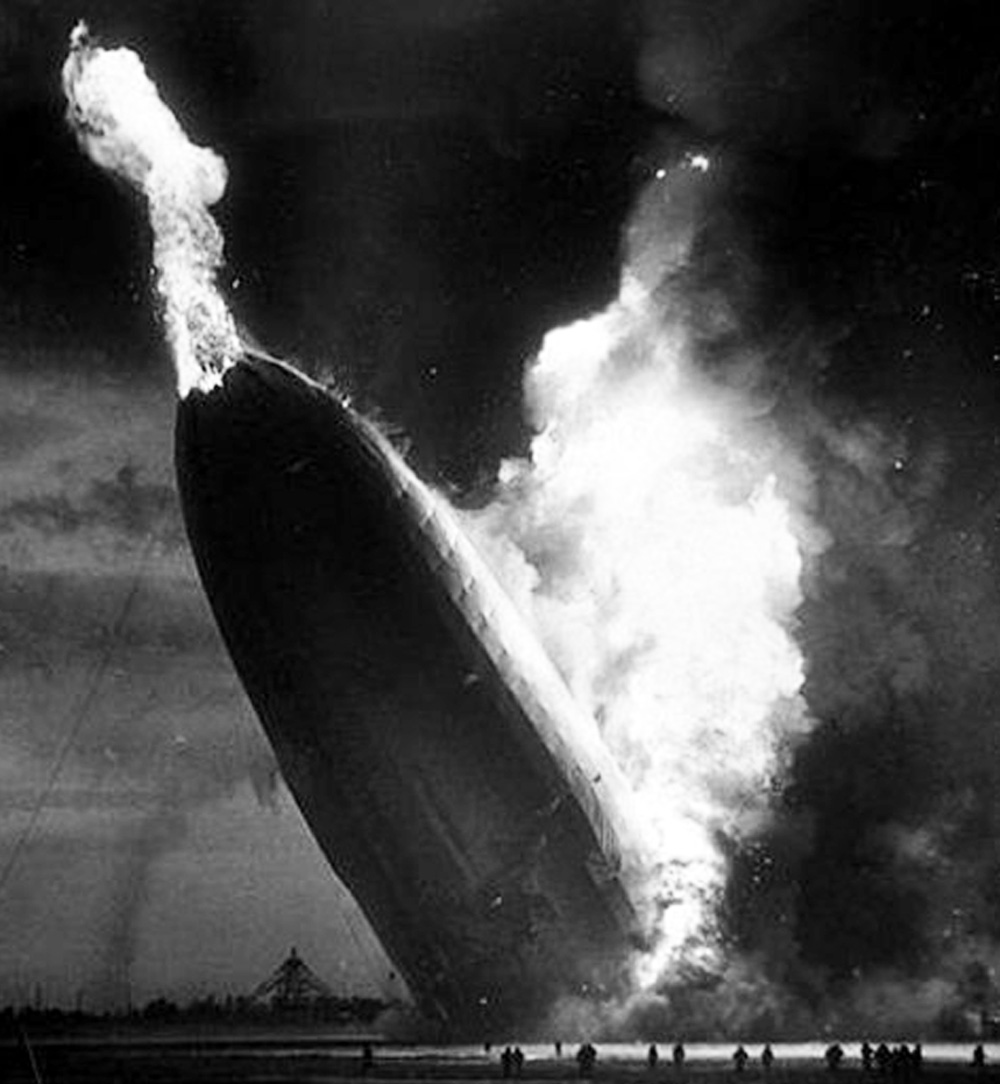
(click to enlarge)
The following photograph demonstrates that the fire was fueled by the Hindenburg’s hydrogen gas cells and not by its fabric covering. As you can see, the fire progressed from gas cell to gas cell; if it had been the covering which was burning, rather than the gas cells, the fire would have spread evenly from one end of the ship to the other without the momentary pause between gas cells that we see in this photo:
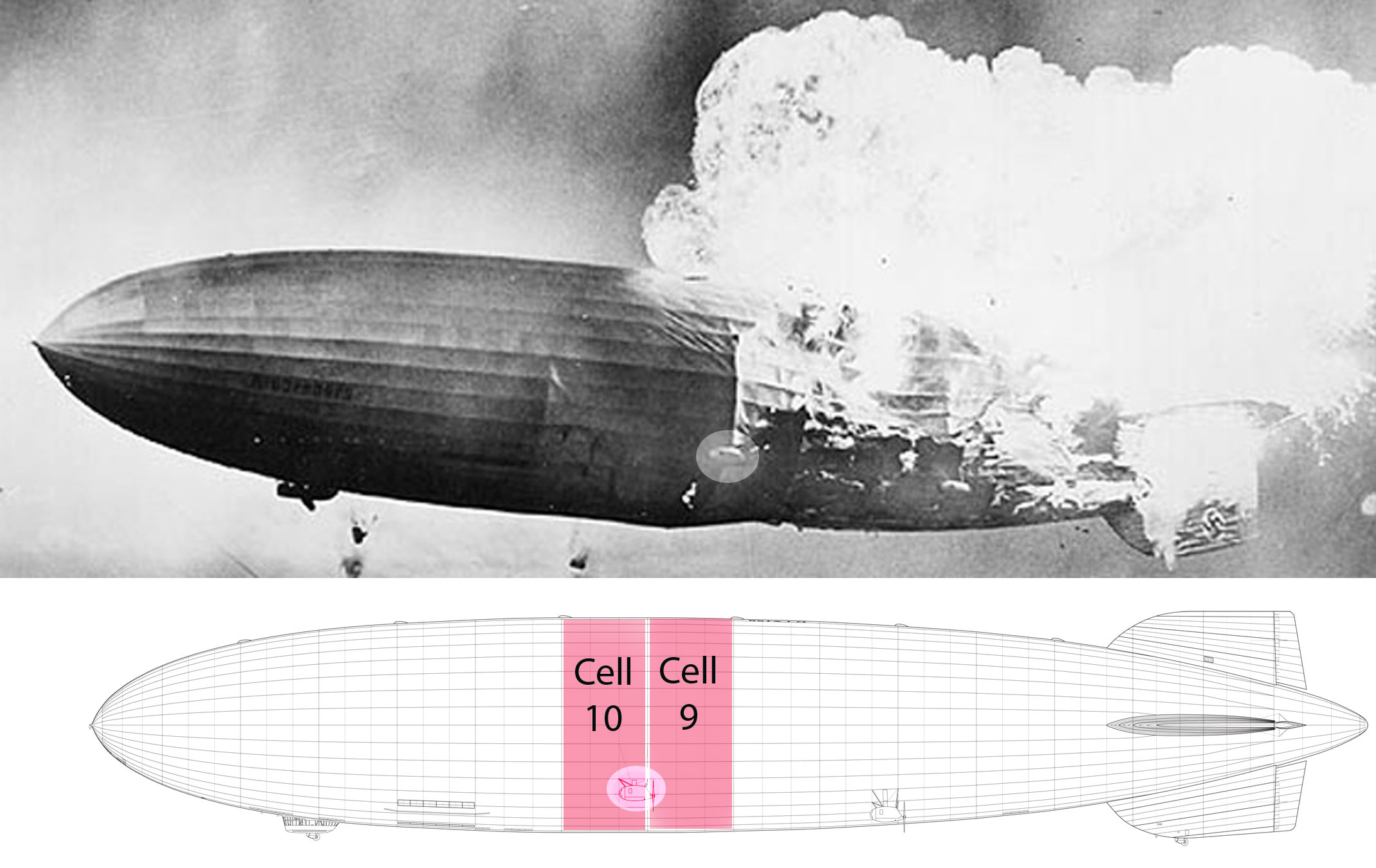
Gas Cells 9 and 10. (The light circle in each image highlights the forward engine car to show the alignment of the two images, and the line separating Cell 9 from Cell 10.)
Airship historian Patrick Russell has suggested that readers pay especially close attention to the following two portions of the film.
From the 12-second mark to the 16-second mark, you can see a tear in the outer covering kicked open by crew members trying to escape the burning ship. Through the tear, you see light from the fire which was blazing in the hydrogen gas cells long before the outer covering finally ignited:
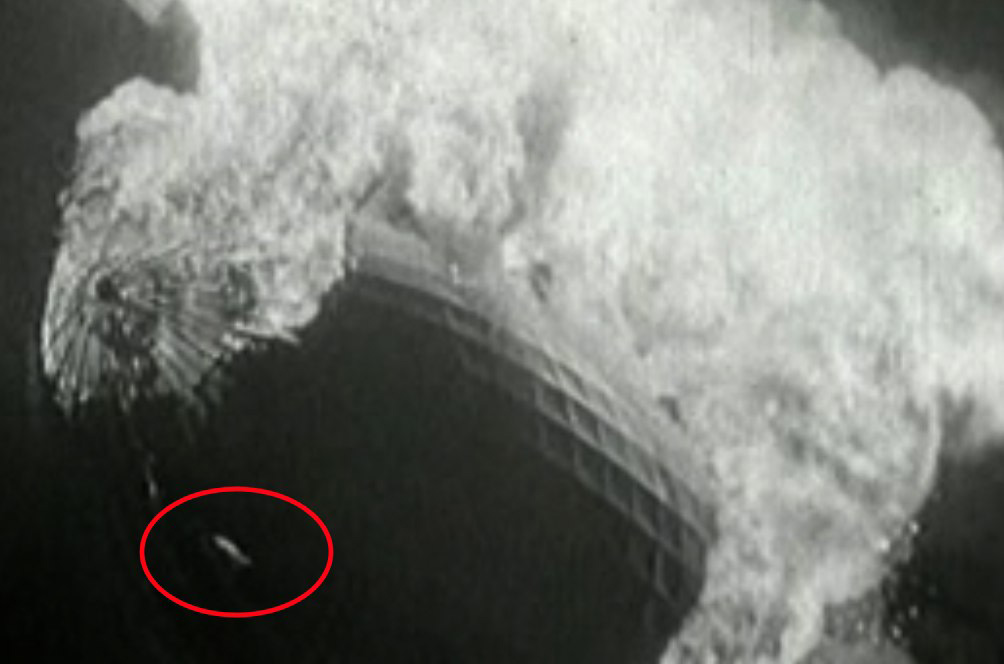
(click to enlarge)
And between the 23-second mark and the 32-second mark, you can see the fabric covering below the passenger compartment, which had still not ignited, even as the rest of the ship was consumed by fire:
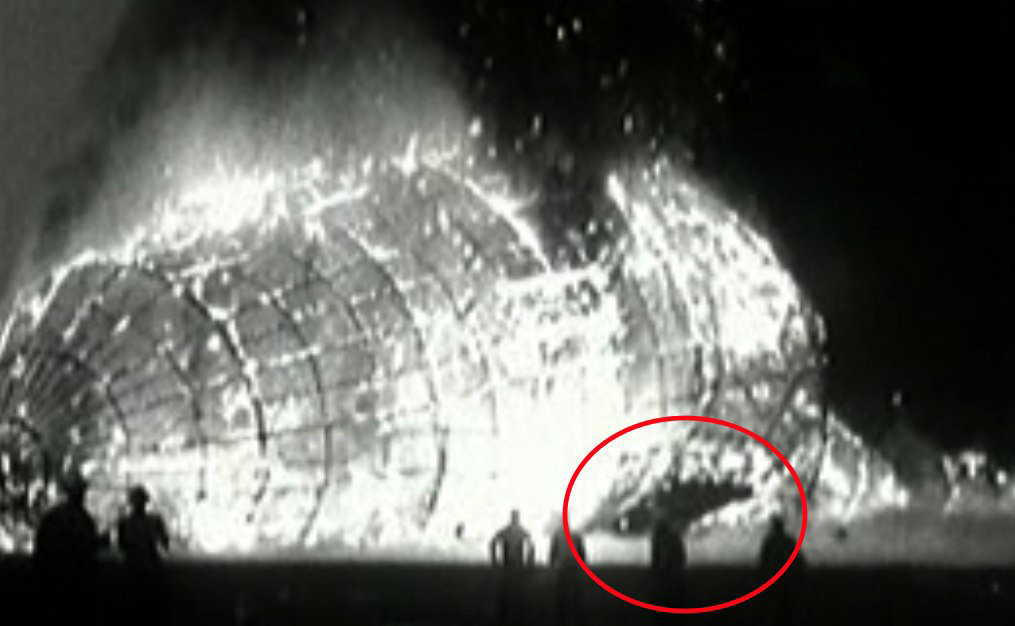
(click to enlarge)
The Final Proof
The final proof may be this: Even after a fire so intense that it took less than a minute to destroy an airship the size of almost three football fields, some sections of the covering never burned at all.
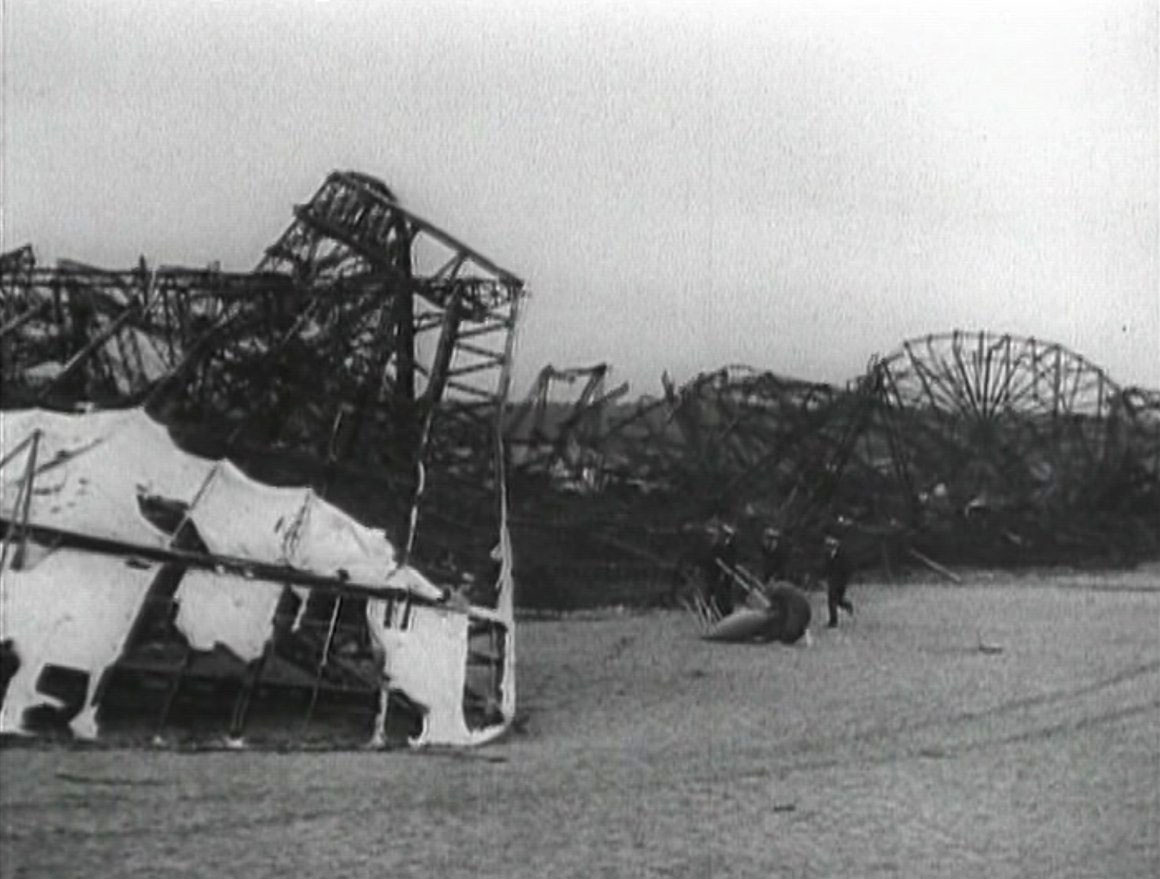
Some sections of the Hindenburg’s covering never burned at all. (click to enlarge)
Summary
Whether the Hindeburg’s covering was sufficiently flammable to have been the initial source of ignition may be open to reasonable debate. It is possible (although not likely, given the rainy and wet conditions) that the covering was the cause of the initial ignition, but if the Hindenburg had been inflated with helium instead of hydrogen, even a small fire on the outer covering would not have resulted in a major catastrophe.
Hydrogen is a highly volatile, flammable gas under all conditions, and when mixed in certain ratios with air it is even explosive. Claims by hydrogen fuel cell advocates that hydrogen was not responsible for the Hindenburg’s ultimate destruction are nothing less than silly.
For a detailed analysis of Hindenburg’s covering, visit: Rocket Fuel, Thermite, and Hydrogen: Myths about the Hindenburg Crash. And for detailed background about the accident in general, visit: The Hindenburg Disaster.
But for a basic understanding of the “rocket fuel” argument (sometimes called the Incendiary Paint Theory), you just need to look at the films of the crash: If the Hindenburg had been painted with anything as flammable as rocket fuel, its covering would have burned rapidly during the fire, but that simply did not happen.



Last hydrogen airship fire, the Hindenburg? What about the V-6 Osoaviakhim from the USSR, which crashed into an unmarked mountain and burned in 1938? Wasn’t that fire hydrogen-fueled? I only know about that one via the Airships book that had its own entry on here (great book, still enjoy reading it), and I only know what the book said about V-6 Osoaviakhim. But if that’s the case, then clearly the Hindenburg was NOT the last hydrogen airship disaster.
The Hindenburg WAS painted with a flammable component of rocket fuel.
This article is unbalanced in trying to place the blame entirely on the gas filled envelopes/bags. There is a slight attempt at rebalancing the argument in the summary, indicating that the covering MAY have been the original site of combustion (static discharges have a habit of doing unexpected things, like making wet stuff catch fire unexpectedly.
The Pro-Hydrogen lobby may be unbalanced in their take, that the Hydrogen was NOT a problem AT ALL.. However both sides taking extreme stances helps no one.
This article showed things like a small patch of fabric on the UNDERSIDE of the envelope non combusted, and some sections that weren’t burning. The tail surface which had unburnt sections of fabric after the fire.
Does the author have any experience at all on combustion, thermodynamics or heat transfer? (Probably not) Note that it is exceedingly difficult to attain perfect combustion of any large piece of material, even if it is composed of fairly combustible products (see burning newspaper for a quick example, it will even extinguish before being fully burnt) also note that a large piece of combusting anything, is much more likely to burn from the outside in (around the periphery), rather than simultaneously bursting into flame uniformly. (the yes crowd obviously didn’t think their responses too carefully)
HAS the Author ever burned butyrate doped fabric, to note that while less combustible than Nitrate doped fabric, it does burn well with thick black rubber-like smoke. Now add powdered aluminium to that dope and see if it burns better or worse.
The real point the hydrogen lobby are trying to make (and partly fail due to hyperbole) is that the Hindenburg did not EXPLODE…. (as opponents of hydrogen claim that any significant conflagration of hydrogen will lead to an intense deflagration) rather the venting hydrogen flared off in a spectacular internal and external flare stack.
It is likely that the flammability of the covering (which DID contain powdered aluminium, which is flammable, self sustaining though it needs a relatively high initial energy input to begin combustion) did play a significant role in the disaster.
If the ship had been filled with helium, the inert gas MAY have extinguished, or partly attenuated the blaze, then again maybe not. Helium would NOT have added to the fire (as the hydrogen undoubtedly did, both within the envelope and externally to great visual effect). However a lot of the effects of the hydrogen on the fire was well away from the cabins and majority of the crew areas. (I Pity the few crew members trapped out at the end of a gangway when a wall of fire headed their way.)
Hydrogen opponents always want to make the hydrogen appear the single initiating and final cause of the disaster and don’t want to allow people to know that more crew and passengers were directly affected by burning diesel fuel than were affected by the fire caused by the combusting lift gas.
As Hydrogen is a common and readily available element, it is not out of order to study means to make it useful in whatever ways it can be used. Studies into effecting fast dumping of the lift gas, (turning the descending ship into a large parachute) or safe jettisoning passenger and crew pods, may be better than banning all uses of hydrogen in whatever future airships are used (manned and unmanned. Helium has much less lifting power than hydrogen and it is a severely non renewable resource (50% difference in lift may make a difference in some applications “you think” )
Postscript: We have learned a lot about better electrical connections of an aircraft components to a single ground plane over the last 80 years (composite craft are prone to suffering significant damage if not electrically connected/grounded and statically discharged)
With better electrostatic management this disaster need not happen to any modern craft using hydrogen as a lifting gas.
Take home Message: Don’t fly a kite in a thunderstorm with a conductor attached to the string. (Unless you are Benjamin)
That’s like saying that modern automobiles are painted with a flammable component of rocket fuel. It’s literally true, but misleading and irrelevant.
Actually, yes. While my own academic training is in history I have discussed these topics with numerous qualified chemists, physicists, and engineers (including at the Southwest Research Institute and elsewhere) and I have been an observer or participant in experiments by qualified scientists exploring the mechanics of the Hindenburg fire.
And that is the whole point; without the presence of hydrogen the fabric would have burned more like the newsprint you describe in your example.
Actually, yes.
The relevant point isn’t that helium might have attenuated the blaze. The point is that if the ship had been inflated with helium there probably would not have been a blaze in the first place. But even if you won’t concede that fact and want to assume that the fabric independantly caught fire, if the ship had been inflated with helium it would not have crashed to the ground and been destroyed in half-a-minute with the consequent loss of life.
Your comment that “more crew and passengers were directly affected by burning diesel fuel” is simply false.
Your ideas about “turning the descending ship into a large parachute or safe jettisoning passenger and crew pods” are simply not feasible or consistent with the physics of LTA flight.
Hello Dan, have you read Addison Bain’s book released last year?
I haven’t read it but there is a review suggesting he does make a rebuttal against his critics, pointing out their flaws etc. And he claims he never denied hydrogen didn’t contribute to the fire blahblah.
I think the most important thing is that the outer covering likely couldn’t have been ignited by an electrical spark as some of the IPT critics have asserted. From the documentaries I’ve seen Bain has only ignited it using a continuous current or simply an open flame.
I was born in 1921. There was no TV etc so I was listenig to a battery operated radio during the landing. I recall the announcer saying, Oh my god and crying and repeatedly saying how horable it was. I felt sorry for those killed.
I am also a veteran of WWII, Vietnam and Korea. I was also aboard a ship on my way to the Phillipines Islands in January 1941 but we were recalled to the US when Pearl Harbor was attacked. I left again and after 21 days aboard the ship we docked in Melborne, Australia. I survivrd 187 bombings, 4 years in the jungles of New Guniea and Morati Island. I do have proof of this. At 91+ years old, I am still active and have a strong mind. Respectfully, USAF M/Sgt Retired Lester Rio DeGennaro. I have GREAT resprect for those Men & Women in uniform protecting
our country.
I worked at Goodyear aircraft(later aerospace) from 1952 to 1980 I was told by older engineers that sparks at large dia trim valve surfaces opening and closing started the hydrogen fire. Ballasting methods were tricky.
That’s an interesting take on the spark theory that I hadn’t heard before.
The only problem with it is that no gas had been valved for at least five minutes before the fire broke out. Therefore, even if there was an issue with the valve covers rubbing against some part of the valve structure and generating sparks when opening and closing (and I’ve not heard that the Germans actually experienced such a problem) there is no way that those sparks could have started a fire several minutes after the fact.
With all that Hydrogen in there only ignorants can claim that anything else was burning so quickly. But even with non-flammable Helium, the time of Zeppelins was at its end. Airplanes are much faster and smaller. Wind have to be much stronger to blow them away.
But there’s one thing that someone might find interesting: to browse the list of passengers and see what role in history (politics, economy…) some of them might have at the time. 🙂
i think this is completely true although i think its a shame that the world totally wrote off any kind of airship after that, the helium ones are actually quite reliable athough slightly more expensive….
I was wondering what the two large objects were that appeared to fall from the Hindenburg during the initial stages of the fire. I am guessing that they were ballast tanks. Please let me know.
Tom M.
Both were storage tanks that were positioned alongside the keel walkway. The forward-most one was a 2500 liter waste water tank (it’s clearly missing in the overhead photos of the wreckage from the next day.)
However, I’m not 100% sure if the one further aft is a water tank, or a fuel/lube oil tank, as the wreckage was so compacted at that spot that I can’t spot which tank is missing in the subsequent wreck photos. I honestly don’t think it was a fuel oil tank, though, because both tanks ruptured and spread their contents over quite a wide radius when they hit the ground. If either had been full of fuel oil there would probably have been fire on the ground outboard of the wreckage that burned for awhile after the ship came down, and I don’t believe that this occurred.
My guess is that both were probably water tanks.
The claim that at least some of the fabric did NOT burn is absolutely correct! How do I know? My now deceased grandfather was ACTUALLY THERE and told me the exact same thing. When he arrived the fire was already under way.When I was a teenager I remember him telling me he examined a section of the silvery colored skin with no sign of combustion on it at all.
I think the rationale of the hydrogen supporting the overall conflagration, as well as the source of the fire in the first place is valid. One can argue quite reasonably that the outer covering, as well as the cells themselves, also supported combustion which is amply shown in the bright flames and smoke. Hydrogen burns cleanly, and without smoke or odor. What caused the hydrogen to explode is really the mystery. Was it that last “S” turn in response to a wind shift?
thanks so much for this information. have you seen the mythbuster episode where they figured out what made it crash.