The Hindenburg’s Interior

The interior spaces on the Hindenburg were divided into three main areas:

hindenburg-cutaway-web

Passenger accommodations on Hindenburg. ("A" Deck)

The passenger decks aboard Hindenburg were contained within the hull of the airship, unlike Graf Zeppelin, in which the passenger space was located in the ship’s gondola.

“A” Deck on Hindenburg

Hindenburg’s “A Deck” contained the ship’s Dining Room, Lounge, Writing Room, Port and Starboard Promenades, and 25 double-berth inside cabins.

Deckplan of LZ-129 Hindenburg - "A" Deck

Deck plan of LZ-129 Hindenburg showing "A" Deck, from 1936 DZR brochure. (click all photos to enlarge)

The passenger accommodations were decorated in the clean, modern design of principal architect Professor Fritz August Breuhaus, and in a major improvement over the unheated Graf Zeppelin, passenger areas on Hindenburg were heated, using forced-air warmed by water from the cooling systems of the forward engines.

Dining Room

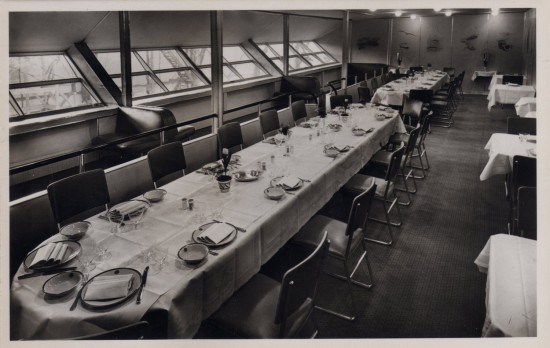
Hindenburg’s Dining Room occupied the entire length of the port side of A Deck. It measured approximately 47 feet in length by 13 feet in width, and was decorated with paintings on silk wallpaper by Professor Otto Arpke, depicting scenes from Graf Zeppelin’s flights to South America.

Dining Room of Airship Hindenburg. (click all photos to enlarge)

Dining Room of Airship Hindenburg. (click all photos to enlarge)

The tables and chairs were designed by Professor Fritz August Breuhaus using lightweight tubular aluminum, with the chairs upholstered in red.
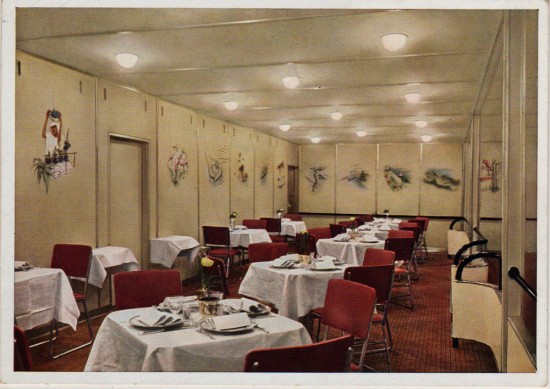
Port Promenade of Zeppelin Hindenburg, showing Dining Room

Port Promenade and Dining Room

Dining Room of Zeppelin Hindenburg

Dining Room of Airship Hindenburg

Dinner on the Hindenburg

Dining on the Hindenburg

Dining Room of Hindenburg, showing Promenade

Dining Room of Hindenburg, with Port Promenade

Lounge

On the starboard side of A Deck were the Passenger Lounge and Writing Room.

Passenger Lounge

Passenger Lounge

The Lounge was approximately 34 feet in length, and was decorated with a mural by Professor Arpke depicting the routes and ships of the explorers Ferdinand Magellan, Captain Cook, Vasco de Gama, and Christopher Columbus, the transatlantic crossing of LZ-126 (USS Los Angeles), the Round-the-World flight and South American crossings of LZ-127 Graf Zeppelin, and the North Atlantic tracks of the great German ocean liners Bremen and Europa.  The furniture, like that in the dining room, was designed in lightweight aluminum by Professor Breuhaus, but the chairs were upholstered in brown.

During the 1936 season the Lounge contained a 356-pound Blüthner baby grand piano, made of Duralumin and covered with yellow pigskin.

Two views of the Lounge, showing portrait of Hitler and the ship's duralumin piano.  (The stewardess is Emilie Imhof, who was killed at Lakehurst in 1937.)

Two views of the Lounge, showing portrait of Hitler and the ship's duralumin piano. (The stewardess is Emilie Imhoff, who was killed at Lakehurst in 1937.)

The piano was removed before the 1937 season and was not aboard Hindenburg during it’s last flight.  [Read more about the piano aboard the Hindenburg.]

Passenger Lounge

Passenger Lounge

Passenger Lounge

Passenger Lounge

Passenger Lounge on the Airship Hindenburg

Passenger Lounge on the Airship Hindenburg, showing promenade windows.

Writing Room

Next to the lounge was a small Writing Room.

Writing and Reading Room of LZ-129 Hindenburg

Writing Room

The walls of the Writing Room were decorated with paintings by Otto Arpke depicting scenes from around the world:

Some of the Otto Arpke paintings aboard Hindenburg

Some of the Otto Arpke paintings aboard Hindenburg

Passenger Cabins on Hindenburg

Passenger Cabin aboard Hindenburg

Passenger Cabin aboard Hindenburg

Hindenburg was originally built with 25 double-berthed cabins at the center of A Deck, accommodating 50 passengers.  After the ship’s inaugural 1936 season, 9 more cabins were added to B Deck, accommodating an additional 20 passengers.

The A Deck cabins were small, but were comparable to railroad sleeper compartments of the day.  The cabins measured approximately 78″ x 66″, and the walls and doors were made of a thin layer of lightweight foam covered by fabric.  Cabins were decorated in one of three color schemes — either light blue, grey, or beige — and each A Deck cabin had one lower berth which was fixed in place, and one upper berth which could be folded against the wall during the day.

Passenger Cabin aboard Hindenburg

Passenger Cabin aboard Hindenburg

Each cabin had call buttons to summon a steward or stewardess, a small fold-down desk, a wash basin made of lightweight white plastic with taps for hot and cold running water, and a small closet covered with a curtain in which a limited number of suits or dresses could be hung; other clothes had to be kept in their suitcases, which could be stowed under the lower berth.

None of the cabins had toilet facilities; male and female toilets were available on B Deck below, as was a single shower, which provided a weak stream of water “more like that from a seltzer bottle” than a shower, according to Charles Rosendahl.

Because the A Deck cabins were located in the center of the ship they had no windows, which was a feature missed by passengers who had traveled on Graf Zeppelin and had enjoyed the view of the passing scenery from their berths.

Cutaway

Cutaway Views Of Hindenburg Passenger Area (click to enlarge)

passenger-decks-profile

Passenger Decks (profile view). Drawing courtesy of David Fowler (click to enlarge)

Promenades

On either side of A Deck were promenades, featuring seating areas and large windows which could be opened in flight.

The Promenade aboard LZ-129 Hindenburg

Starboard Promenade aboard LZ-129 Hindenburg, next to the Lounge. (click all photos to enlarge)

Passenger decks of Hindenburg

Passenger decks of Hindenburg, showing promenade windows

“B” Deck on Hindenburg

B Deck on Hindenburg, located directly below A Deck, contained the ship’s kitchen, passenger toilet and shower facilities, the crew and officers’ mess, and a cabin occupied by Chief Steward Heinrich Kubis (containing a door to the keel corridor, which was the only connection between passenger and crew spaces).

Passenger Decks (before 1936-1937 refit).  Drawing courtesy of David Fowler.

Passenger Decks (before 1936-1937 refit). Drawing courtesy of David Fowler (click to enlarge)

During the winter of 1936-1937, while the ship was laid up in Frankfurt, additional passenger cabins were also added in Bay 11, just aft of ring 173.  The new cabins had windows offering an outside view, and were slightly larger than the cabins on A Deck.  The additional weight of these new cabins was made possible by the unexpected (and unwelcome) need to operate the ship with hydrogen, which has greater lifting power than the helium for which Hindenburg had been designed.

1937 B Deck cabins.  (Drawing courtesy Patrick Russell, "Faces of the Hindenburg" blog.)

B Deck, showing 1937 cabins. (Drawing courtesy Patrick Russell, "Faces of the Hindenburg" blog, based on 1937 DZR brocure.)

The Smoking Room

Pressurized Smoking Room aboard LZ-129 Hindenburg

Smoking Room aboard LZ-129 Hindenburg

Perhaps most surprising, aboard a hydrogen airship, there was also a smoking room on the Hindenburg.

The smoking room was kept at higher than ambient pressure, so that no leaking hydrogen could enter the room, and the smoking room and its associated bar were separated from the rest of the ship by a double-door airlock.  One electric lighter was provided, as no open flames were allowed aboard the ship.

The smoking room was painted blue, with dark blue-grey leather furniture, and the walls were decorated with yellow pigskin and illustrations by Otto Arpke depicting the history of lighter-than-air flight from the Montgolfiers’s balloon to the Graf Zeppelin.  Along one side of the room was a railing above sealed windows, through which passengers could look down on the ocean or landscape passing below.

Pressurized Smoking Room aboard LZ-129 Hindenburg

Smoking Room aboard LZ-129 Hindenburg

The smoking room was perhaps the most popular public room on the ship, which is not surprising in an era in which so many people smoked.

Smoking Room

Pressurized Smoking Room aboard LZ-129 Hindenburg, showing door to the bar, with the air lock doors beyond.

The Bar

Hindenburg Bar

Hindenburg Bar

The Hindenburg’s bar was a small ante-room between the smoking room and the air-lock door leading to the corridor on B-Deck.  This is where Hindenburg bartender Max Schulze served up LZ-129 Frosted Cocktails (gin and orange juice) and Maybach 12 cocktails (recipe lost to history), but more importantly, it is where Schulze monitored the air-lock to ensure that no-one left the smoking room with burning cigarattes, cigars, or pipes.

Schulze had been a steward and bartender aboard the ocean liners of the Hamburg-Amerika Line and was well liked by Hindenburg passengers, even if he was surprisingly unfamiliar with basic American cocktails such as the Manhattan.

The bar and smoking room were also the scene of a raucous party on the Hindenburg’s maiden voyage to America, where passenger Pauline Charteris improvised a kirschwasser cocktail after the ship ran out of gin for martinis.

Cocktails aboard the Hindenburg

Cocktails aboard the Hindenburg

For the interior of Hindenburg’s hull, where crew spaces were located, and the inside of the ship’s control car, visit:

SHARE THIS PAGE

on StumbleUpon, del.icio.us, Facebook, Digg, Reddit, Twitter.

  • StumbleUpon
  • del.icio.us
  • Facebook
  • Digg
  • Reddit
  • Twitter

{ 56 comments… read them below or add one }

Wilfred Dugas March 5, 2010 at 7:49 am

I wish they still had airships like that. I love them, or any air ships.

[Reply]

Malcolm Gunstone March 2, 2010 at 9:21 am

I am a P.C. Pilot and have some great aircraft in my hanger, including 1930’s types. Now I MUST get an airship from somewhere.
Thanks lots for your work in collating so much info.

[Reply]

James February 25, 2010 at 3:10 am

Hello there are dozens of web articles and videos of the “disaster” i was delighted to find one about the actual life on board floor plans pictures and such. I always wonderd about toilet and sanitary conditions for i noticed no toilets or showers in cabin can you tell me if waste was jettisoned or were there holding tanks? any info would be appriciated thank you……James

[Reply]

Dan (Airships.net) Reply:

Everything was conserved as ballast, since anything that lightened the ship increased the amount of lifting gas that had to be valved to maintain static equilibrium.

[Reply]

Kaelin February 17, 2010 at 12:58 pm

Isnt the hindenburg place haunted

[Reply]

John Lewis February 12, 2010 at 4:49 pm

Königsberger Klopse. That brings back memories of my German Grandmother.

I’m afraid that my reaction to this dish was the same as the American passengers on the Zeppelins–I HATED it.

JL

[Reply]

biggles February 6, 2010 at 8:18 am

Its remarkable how modern and contemporary the interior design and furniture is in most of these interior shots!

If some put forward they were from some trendy cafe or bar today, you could quite well believe it to be true!?

[Reply]

Wayne Masters February 5, 2010 at 2:48 pm

I have pictures of the 45 ft Hindenburg model i designed and constructed in 1986. i’m looking at them now as i embark on construction of the Eiffel tower model and wish to build both at @ 100ft. I have special light effects to add to the Tower.
i remember the Hindenburg project as overwhelming.

[Reply]

Rhodger Smith February 2, 2010 at 12:10 pm

Very interesting, thanks for putting this together!

[Reply]

Jason Wallace January 27, 2010 at 11:26 pm

Hi Dan i thought you might be interested in this in realtion to my detailed info and questions

http://www.aerosml.com/

its about the russian airships the one i think you will find most interesting is the aeroscraft

let me know what you think

cheers jason wallace

[Reply]

Jason Wallace January 27, 2010 at 12:02 am

HI Dan

As you know i am an Airship fanatic and given the chance i would do anything to be involved with them in anyway i would love to promote the use of them as doctor Eckener did in Glory days of the passenger Zep what i dont get if he was so close to being succsesful with the hindenburg that if it didnt crash and the second season would have been a success i think airships as a viable means of travel would have been here to stay my mates think im talking rubbish as i said before there not for everyone but i think the reasons it seases to exist are

1. the nazis came to power and messed up Dr eckeners plans as they were obsessed with power the americans did not what to supply helium as they were in fear of Remilitirisation of the Rhine land and that he may use them for war.

In wich case had the nazis not have come to power the Hindenburg would have been inflated with Helium and the whole disaster could have been avoided.

2.and the same thing happend with the LZ-130 with hitler in power and ww2 on the verge of breaking loose eckener succsesfully persuaded the americans to supply helium but when they were just about to supply it hitler and the NAZIS invaded austria wich i think was a nuetral countrie at the time and with that the second world war started and the americans stopped the helium export and the LZ-130 had a short life with hydrogen on spying missions and so forth when i 1940 hitlers propaganda minister joseph goebbels orded the Graf Zeppelin and its name sake to be broken up and the metal to be melted to make bombers for the Luftwaffe (German Airforce) so then in order to bring Zeps back they would have to build giant hangars and rebuild Zeps and fill them with helium hence it being very very expensive.

so thats part of the poltical reason of the destruction of a viable Airship passenger service

There is also the technological reasons aswell first the airplane was getting bigger and better though i think if the airships and there means of storage were retained and Eckener persuveared hard enough they would have survived but there wasnt so the Airplanes had the skies to themselves and they progressed to the piont of the jet engine wich provided quick travel no were near the safty and comfort of zeps but it was fast and thus in a sense technologically destroyed the revival of passenger Zeps.

But what surprises me with the quest of a more economical means of travel they dont bring them back they are currently building one in russia and it looks allright so if they are doing it why cant the zep company do it and bring them back to there former glory as passenger Travel

tanks
your sincerely Jason wallace

[Reply]

Jason Wallace January 22, 2010 at 8:05 pm

OH and could you please inlcude beverages and wines and deserts please as i would be much obliged and any cocktail recipes if possible i have the one from your site allready i was not sure if it that stuff would have been seperate from the menu it self

P.S if its in german how i would i go about converting it to English so i can under stand it and have it prepared to the letter i will be very gratefull as to your findings
thank you very much much obliged

keep up the great work your site is astounding i read it daily and always pick up little bits of info i mightve missed and is thorough first class research and i look forward to reading your comments and findings in the near future

yours sincerely Jason Wallace

[Reply]

Dan (Airships.net) Reply:

I just sent you an email with information about food on the Hindenburg and a scan of a sample menu.

In general, food on the Hindenburg was German, and very heavy, and American passengers sometimes complained that it was not to their liking. Königsberger Klopse was a typical dinner about which some of the non-German passengers raised doubts; the dish consists of meatballs made with beef, pork, and anchovies, served in a caper sauce:

http://www.recipezaar.com/Koumlnigsberg-Dumplings-Koumlnigsberger-Klopse-166395

There were two original “Specialty cocktails” served on Hindenburg. The “LZ-129 Frosted Cocktail” was just gin and orange juice (not very exciting!) and the recipe for the other cocktail (the Maybach 12) has been lost to history.

I can also tell you what was served on the famous “Millionaires Flight“: Swallow Nest Soup, cold Rhine salmon, tenderloin steak, Chateau Potatoes, Beans a la Princesse, Carmen salad, and iced melon, accompanied by beer and wines including a 1934 Piesporter Goldtröpfchen and a 1928 Feist Brut. The meal was followed by Turkish coffee, pastries, and fine liqueurs.

[Reply]

Jason Wallace January 22, 2010 at 7:54 pm

HI Dan i was wondering if it would be at all possible to get a copy of the dinner menu of the hindenburg cuisine as my cousine had a TITANIC dinner and she said it was great and i would very much like to do the same with the hindenburg and if possible could you get one for the graf zeppelin as well i would be very gratefull and very much obliged to your response on any thing you find.

p.s the questions about the LZ-128 and LZ-131 i made was a mistake i typed the first one and it didnt show up so i typed the second one and submitted it and they both showed up im not shore as to why? so im sorry if you thought i was being demanding and impatient as i was not it was just a simple mistake on my behalf

you have a great site and i look forward to reading your discoveries and if u find dinner menu for Hindenburg and graf Zeppelin i will let you know how the evening goes thank you very much

cheers jason

[Reply]

Dan (Airships.net) Reply:

Don’t worry, I did not think you were being demanding! I see technical things like that all the time. You comments were so friendly and polite I was glad to receive them. :-)

I do have menu information. Obviously there were many different menus, since the Hindenburg served dozens of dinners (unlike the Titanic, which served only four, I believe). I will try to get some menu information for you!!

[Reply]

Jeff Puha December 21, 2009 at 7:11 am

Hello Dan,
Thanks very much for an outstanding website concerning the Hindenburg and other airships. The pictures are superb and the commentary is extremely well-written and comprehensive.
In one of the books I have about the Hindenburg-RELIVING THE ERA OF THE GREAT AIRSHIPS: HINDENBURG by Rick Archibold and Ken Marschall-it is stated that there were curtains that could be drawn between the dining saloon and lounge and their respective promenades at night to block the glare of the incandescent lights from interfering with the view out the windows. Yet I have never read this anywhere else. Do you know if this was true? Thanks.
Sincerely,
Jeff

P.S. Does anyone else have any information on this subject?

[Reply]

Jim Richards December 17, 2009 at 1:03 pm

The tragedy is generally considered to be the death knell of the derigible liner. What I want to know is, why? Build one and actually PUT helium in it, as it was supposed to be in the first place, and you would have an airliner I think people would line up for. If I could afford it, I’d be on it like a shot! Only, this time lets leave off the swastikas.

[Reply]

Richard Waryn Reply:

I agree with your comment. Helium seems to be the the answer. And in this age of cattle car travel wouldn’t it be great to have the grand airships back?! Who’s ready to invest??

[Reply]

wayyne b December 13, 2009 at 8:11 am

are there any interior photos of hindenburg’s sister ship?(lz130?)

[Reply]

Dan (Airships.net) Reply:

You can find some interior photos of LZ-130 here:

LZ-130 “Graf Zeppelin” Photographs

[Reply]

JP Muthelet December 7, 2009 at 5:12 pm

I am wondering: did they have to refill the gas somehow during normal operation? I guess it is impossible to have perfectly sealed balloons?
Thanks for this beautiful website
JP

[Reply]

Dan (Airships.net) Reply:

Hydrogen was routinely valved during normal operations and then replenished on the ground. The procedure is discussed in detail on the page about Hindenburg Flight Operations, and in particular here: http://www.airships.net/hindenburg/flight-operations-procedures#static

Thanks for you kind comments about the website!

[Reply]

Paul van Daalen November 27, 2009 at 3:27 pm

Hi Dan,

At last I now have the time to read airship websites and the List again,
being retired after working for 5 years at the EASA.

Thanks for compiling such a great website!

Paul

[Reply]

kelly Reply:

it was so tragic that it crashed i feel so bad about this crash i am 15 and single

[Reply]

Stu November 13, 2009 at 10:22 am

Could passenger airships like the LZ-127 grace the skies again?

Most certainly!

The flight would be a niche market affair, much like flying the Concorde was. It wasn’t the time getting there, it was riding the machine to get there! The cost of a three or five day airship journey today would be equivalent to a ticket on the QM-2, or perhaps more! There would have to be several airships plying regular service routes in order to see a profit in a five year time line. The initial costs for infrastructure, air routes, ships and a network of ground support bases would be substantial.

Flights would be based on a alternate way of vacationing. Flights would have to have some contact with the ground for excursions and activities not available on the airship. The older, more patient crowd would enjoy a long day of idly watching the scenery roll by. The people who still like to ride first class trains to destinations just for the experience of it, the folks who like luxury cruises on smaller ships to exotic and out-of-reach destinations are the kind of people who would appreciate what the airship experience would bring. The biggest hurdle is water capacity to allow for our love of showers and things. That’s why the daily shore excursions would be a smart idea, in order to fill up the water tanks / and drain the waste water daily rather than carry tons of water for a long haul.

Long term safe use of the ships would net a good return if the notion of “nostalgic” flight takes hold. I believe that such a niche is entirely possible as passenger commercial flight today has become an experience akin to riding the subway to work. The flights should be based on coastal routes which give the ship the ability to operate over more stable atmospheric conditions (and provide sea room to evade weather). Coastal flights offer more vistas and scenery as well as public exposure. Possible routes could include:
1. A New England / Nova Scotia run with jaunts inland to view the fall colors.
2. Summer tours along the coastline of Italy and the islands to the East, including the French Riviera.
3. A coastal tour of the Greek archipelago.
4. A northern California / West coast cruise up to Seattle and north into the Western Canadian coastline featuring wines from the Napa valley as a theme.
5. Flights through the islands of the Far East near Java, Philippines, and the Vietnam coast.
6. Flights along Mexico’s eastern coastline with the Caribbean Sea.
7. Depending on seasonal conditions, special flights along the Great Lakes, follow the mighty Mississippi north from the delta to the headwaters up north, see the fall foliage at it’s peak flying down the Shenandoah Valley, Explore the scenic countrysides of France, Ireland, Holland and Belgium, venture into the fjords of Norway in midsummer.
8. In light of the upcoming Olympics, flights to Rio de Janero and along the Brazilian coastline.

The opportunities are endless. All places are within a days flight of a major hub or city where facilities to land and support airship operations can occur.

And on a green frame of mind, nothing is more green, more eco-friendly, and more unobtrusive in terms of noise and air pollution than a lighter than air vehicle with a stall speed of zero miles an hour.

Can it be done, certainly. All that’s needed are visionaries like Dr. Hugo Eckener who had the passion and the drive to make the dream a reality.

[Reply]

Jim Richards Reply:

Sir, for whatever my humble opinion is worth, I like the way you think. I’ve wondered about pretty much the same thing for some time now. I didn’t think about it in as much detail as you did, I’m sorry to say, but I agree whole-heartedly.

[Reply]

Paul November 11, 2009 at 5:09 pm

The Germans were so far ahead of thier time. Even the design of the passengers interior could be mistaken for a trendy restaurant/bar in London, New York, Paris or Berlin in 2009.

[Reply]

Herbie Jahr October 18, 2009 at 5:55 pm

Could a person have walked around in the helium compartment of the air craft?

[Reply]

Dan (Airships.net) Reply:

Almost all areas of the inside of the hull were accessible to the riggers (but of course, the gas cells were inflated with hydrogen rather than helium).

[Reply]

Kevin C. October 15, 2009 at 6:48 pm

Hi,

Absolutely wonderful website. So many details of the “Titanic of the Air” as I would call it. My story of how I found this website involves a certain musical group from the 1970s. I actually was looking at Led Zeppein IV (album from previous century, pretty well documented!) and just had to allow myself the luxury of checking out “other” Zeppelins! Sad, but true. But my interest is not momentary. I have been fascinated by the Titanic and the Hindenburg (both luxury and horrid fate) for many years. The myths surrounding the disasters are incredible. I have an interest in history and photography and am always trying to figure out the truth of an event. These two mysteries of the 20th century are among the best kept secrets of the world. How did they happen? I doubt anyone will really know the actual truth in either case of all the minor details which led to the disasters. Lots of interesting stories/films/myths have sprung up in both cases. I believe humans love situations such as this more than those whose exact details and causes are known and well-documented through written and visual evidence. This is the fun of history and historical discovery. Trying to prove exactly what transpired given a myriad of inaccuracies and human accounts.

Anyway, thanks very much for the great details and obvious tremendous work involved on this project.

Kevin

[Reply]

Joel October 9, 2009 at 6:59 pm

Thank you! I would LOVE to be able to travel in grand style like the passengers of the Hindenburg and Graf Zeppelin did.

[Reply]

Roland Stimpson October 4, 2009 at 6:10 pm

I was going to parachute school at Lakehurst in 1950. Made my graduating jump 30 March that year. The mast that was supposed to have been for docking the Hindenburg was still there then. Albeit quite rusty ! It’s probably still there. If not, it should be. Off duty time going to Philly was fun. I found & was allowed into the ‘Che Vouz (wrong spelling) 2nd floor dance hall in Upper Darby. Kept my nose clean & had a great time ! Sold some property here , on the Coast Of Maine, to some people from PA. who had been there ! ! One of the air-ship hangars held 5 diriigibles. Took 2 train engines to operate them. Created it’s own humidity. Thanks.

[Reply]

Dennis Zermeno September 26, 2009 at 4:31 pm

Is there any specific plans on-going to construct a real passenger airship capable of carrying over 70 passengers for one day travel providing transportation between cities? I reside in the San Francisco bay area and watching the Zeppelin NT “Eureka” fly is really nothing more than an overpriced excursion flight. Charging $500 for an hour-long flight in an airship that can only hold 12 passengers is not going to spark huge interest in airship travel. Are there any plans to construct a real large size Zeppelin for inter-city travel?

Dennis Zermeno

[Reply]

Bernard Berrie September 6, 2009 at 8:29 am

Being an avid collector of postal items relating to the airship Hindenburg and requiring as many items relating to the airship, for display and exhibition purposes, I recently came across a model of the LZ 129. It is manufactured in Germany by the Schreiber-Bogen kartonmodellbau. The model is produced in cardboard, pre-coloured and is 44ins. long. Besides the main airship there is also a seperate detailed construction of the diningroom and lounge, very detailed and in full colour. This a superb model in every detail and the inner structural detail is quite outstanding. For anyone with a love for these giants of the airways I would recommend the model as well worth assembling. It takes some time as there are many parts to cut out and glue but the result is quite phenominal!! When finished, it will take centre stage at any talks or exhibitions that I may be involved in, in the future. Thank you for an excellent website.

[Reply]

Erich Breckoff September 2, 2009 at 8:16 am

Costs for airships split down in building them, keeping them in workig condition and the needed ground installations.

Building an airship today would be easier and lighter than the originals, and will be probably much cheaper as soon monofibers from carbon can be manufactured (that would mean cloth a few molecules thick you can stress like steel)

The big hurdle is not flying them or building them but how to easily land them and then keep them in place.

Picture it, you have an airship the size of an big building, lighter than air and you want to keep it in one place.

You can build hangars offcourse, like the old airships had but driving them in an out of them is an challenge, one good gust of wind sideways and you have wreakage.

The new projects for freight airships all so faar did not solve the question how to transfer several tons of freight safely to the ground.

An airship able to lift 100 tons would have to reduce its lift quite quickly to do it safely, simply venting gas would be even using hydrogen costly, not to mention helium, and i have doubt that hydrogen would be anything people wouldlike to use today.

The very big problem is not about flying them, it is about landing them and keep them where you want them on ground.

The small passenger airships flying today are not as easy to board as an modern heavier than air flyer, it is something like an flying start where you send people one after the other to jump on a moving walkway as long there is absolutly no wind, the airship sways and moves all the time.

Loading 300 people on it under such conditions would take some day.

You could solve it with hollow masts and people entering through the nose of the airship through an tunnel who follows the airships motions but to use them as freighter you would still have to overcome the problem of balancing lift an weight while loading of offloading if you want to do it as quick as an airplane can do.

with the costs for fuels they may come back, you can pretty much use the whole surface to generate electricity and use diesel electric engines to drive it so they would be very cheap to move around.

So, solve the problem with loading and unloading freight and you may have an deal.

[Reply]

mani mohan August 25, 2009 at 4:55 am

the pictures were amazing. i would like to know why zeppeline is not still in use? the only threat was usage of hydrogen but we can use helium which is much safer. what would be the cost for a kilometer travel in zeppeline?. can you say something about modern day zeppeline?

[Reply]

manimohankrishnan Reply:

thank you Mr.Erich Breckoff. i am convienced. but if it happens we can save a lot of energy is it not?

[Reply]

Erich Breckoff Reply:

Certainly, with solar cell film now made you could use the surface of the airship to produce electricity, for the night you would still need some generators using probably hydrogen (power cells using up hydrogen, light using light fuel) with todays techology and an not burning skin (the skin of the airships back used paints and materials making them burn of easily) storing some hydrogen in an bag would be of no trouble.

Given that humans want water and produce waste keeping the weight balance with hydrogen used up would be no trouble either.

[Reply]

mani mohan August 25, 2009 at 4:52 am

the pictures were amazing. i would like to know why zeppeline is not still in use? the only threat was usage of hydrogen but we can use helium which is much safer. what would be the cost for a kilometer travel in zeppeline?

[Reply]

Robert August 23, 2009 at 5:48 am

Amazing! To think, that almost 80 years ago people could travel by air in a far more spacious and luxurious way than is even possible today. Great pictures.

[Reply]

Keith August 14, 2009 at 11:16 am

Great website with teriffic interior pictures. Would love to see interior shots of the GZII.

[Reply]

Jim Irwin August 2, 2009 at 7:09 pm

Thank-you for your great website. I hope that airship travel makes a comeback. With the higher cost of jet fuel, perhaps there is a need for heavy cargo lifters and cruise ships of the sky. It takes about 10 days to 3 weeks for cargo to get from China & Korea to the West coast of N. America and since most everything we have made is manufactured in Asia, it would help market prediction in ordering various manufactured goods and the transportation cost would be greatly reduced from traditional heavier-than-air airfreight. The time from Asia to the US might be three days instead of twelve hours, but the cost would be lower and it is easier to predict market demand for 3 to 4 days instead of three weeks. Thanks for the work you have done on your site.

[Reply]

Connie August 1, 2009 at 7:46 pm

Having read many books, that of Harold Dick been the best, and visited many internet sites, I thought I had seen everything about the ‘golden era of airship travel’. Until I found this site…

Warmest congratulations for your beautiful work here and your love towards this largely unknown part of history!

[Reply]

Todd July 10, 2009 at 2:25 pm

I am hoping you can help me with a question regarding some plates which I have come across. They are the pattern used on the Hindenburg by Heinrich and Co. Where I am at a loss is they are monogrammed on the opposite side from the monogram. The monogram was executed in the same blue and gold tones and was fired at the same time. Are you aware of china being monogrammed for VIP guests?

Thank you,
Todd

[Reply]

Dan (Airships.net) Reply:

@ Todd:

I haven’t seen or read about plates like those, but I am far from an expert on china patterns! :-)

Perhaps the Zeppelin Museum in Friedrichshafen can help you? (If you get more information, perhaps you could post a follow-up to let us know what you learned.)

[Reply]

Todd Reply:

Thank you, I have contacted them as well.

Best Wishes

[Reply]

Pam July 2, 2009 at 5:17 pm

I recently came across a portfolio of 16″ x 12″ black and white amazing photos of the HIndenburg and Zeppelin and also in there are increbile pictures on I think what they call rice paper ? On the outside of the portfolio It is printed all in German . Does anyone know how to tell if they are orginials. I have never seen anything so amazing ?

[Reply]

William Kane July 1, 2009 at 7:20 pm

I was in the 2nd grade in 1937 and I remember walking home for lunch on the day the Hindinburg crashed and burned. The huge airship flew right over me (I lived in Marlborough MA) and I remember how low it appeared to me. I have retained that view for the rest of my life as if it was yesterday.
Bill Kane

[Reply]

Bev June 18, 2009 at 9:42 pm

Hi Dan, thanks for the reply. How did I find your fascinating site? This is a ridiculous answer, but actually, I was playing a computer game (I am at the age when games keep the old brain sharp!), and it had a scene including the Hindenburg. Being the curious person that I am, I started doing a bit of internet research to learn more, and found your site, clearly the best source I located. So…there you have it! It really is a wonderful site, and I look forward to more info as you include it. I especially like the photographs. (I like ’30’s movies, too!) Thanks again for such a great site. Bev

[Reply]

bev June 18, 2009 at 4:31 pm

This is amazing. I am not a history student, just someone who is fascinagted by a time when seconds weren’t counted (as in road rage today!), and the ones who could afford them, indulged in such opulence. Awesome. Thanks so much for all your work. I just “happened” on this site, and am totally captivated.

[Reply]

Dan (Airships.net) June 10, 2009 at 8:08 am

The Zeppelin Museum in Friedrichshafen has a wonderful full-size recreation of the starboard public rooms and some passenger cabins. I remember reading about the disposition of the piano but I don’t recall where I saw the information and unfortunately I did not record it in my notes at the time.

[Reply]

Morgan Johnson May 31, 2009 at 12:41 am

Dan,
Thank you so very much for gathering these materials into one place for people who love the idea, the romance and the fact of this wonderful form of travel. The elegance of the engineering details and artwork that captures the ideal of this most elegant form of people going from place to place is all here.
Such a great pleasure …

[Reply]

Dan (Airships.net) Reply:

Thanks for your kind comments!

[Reply]

Ralph Wagner May 29, 2009 at 5:00 pm

What was the seating capacity of the dining room? From the illustrations, it doesn’t seem that 50 passengers could be served at once.

[Reply]

Dan (Airships.net) Reply:

That’s a good question. Actually, sources disagree. Some say the dining room seated 34, which is consistent with the photographs and deck plans, but other reliable sources indicate that 50 passengers could be served at one sitting. Since the lightweight tables and chairs could be easily rearranged into different configurations, it is possible that both answers are correct.

[Reply]

Kurstwhile Evinoffq May 21, 2009 at 7:07 am

Amazing. To think, 80 years ago almost, people were leisurely smoking in a smoking room in the sky, and dining with silver service… and we think the a380 is amazing for the interior space it has, we are fooling ourselves… this would have been a golden age to be alive (and rich). The colour photos are just amazing, I’ve never seen colour photos of the interiors before. I would love hollywood to make a golden age of airships movie in the next few years… I’d love to watch in HD, people interact and relax on a huge deck/cabin thing… to think there was a grand piano… just amazing. Simply blows my mind. We too often think of the first part of the 20th century as not having much progress, man, we had plenty of progress.

[Reply]

Ed Reply:

I find the absence of such an airship industry “questionable.” I’m surprised no one has produced a work that discusses this specific issue. Ever since I first read about these wonderful airships and that industry, I simply cannot quit puzzling over their (commercial) non-existence. The sinking of many ocean vessels has not discontinued the operation of ocean vessels. How many souls? How much asset value? And heavier-than-air craft! OMG! Hardly a year passes that hundreds of souls DON’T perish. -Not to mention related money losses/settlements. Over the years I have decided the “C” (conspiracy) word applies.. exemplified by the thinking of Edward Bernays that society requires “responsible” mind managers to tell them what to want, not want, like, not like… and so on. Have you not watched those commercial jet crosswind, etc. landings, and the MANY (spectacular, deadly, expensive) crashes on youtube..? So, in keeping with what I mentioned on Edward Bernays, technology (or lack of) is not the problem. The problem with the NON-existence of an LTA industry is that it not only lacks any “public relations,” but has for many decades suffered from a “public relations” against it.

[Reply]

Ed Reply:

I have suggested that there may be certain ‘mechanisms’ that account for the non-existence of LTA industry. We know that the evolving process, history, of LTA was a phenomenon that occurred not just in Germany. However, thanks to Von Zeppelin, he made sure that his country picked up that ball and ran with it.
Germany was not the only country to attempt developement of rocketry. Nazi’s ran with that one, big time. Yet the US space program is not much compromised by NAZI origins, or, at least, significant NAZI component of origins of US space & rocketry program, etc. It is not my intention, here, to beat the drum for Germany’s sake. God forbid! But, in pursuing my interest of LTA history, it rather occurs to me that Germany succeeded where others did not, could not, etc., for whatever reason. (And if you think I’m puffing my ancestry, I’m not German. I’m an American with mostly Brit and French ancestry or nationality background.) Consider for a moment how the beginnings of German LTA industry might have proceeded had Germany, in fact, had helium from the get-go…
As for the “C” word, it is certainly not Boeing or anyone else’s job to promote a LTA industry. I think The HTA manufacturers make great products. Nor do I think that HTA involves itself in any public relations activity (or scheming) to keep LTA ostracized. In fact, I think a few decades back Boeing had some people involved with R&D for LTA.
So the mind of the public wants maximum speed, minimum time.

[Reply]

Miguel Krebs May 19, 2009 at 9:40 pm

I need all the photographic to publish and documentary material possible related to the sector of restoration of the ship, including the menus, personnel of kitchen, food provision, conservation, etc.

[Reply]

Miguel Krebs May 19, 2009 at 9:39 pm

I need all possible photographic and documentary material related to the sector restoration of the ship, including the menus, personnel of kitchen, food provision, conservation, etc.

[Reply]

Miguel Krebs May 16, 2009 at 11:52 am

I am historian of the world-wide gastronomy and wanted to publish photographies and commentaries about the kitchen of the Hindemburg in our Web.¿ Could you facilitate some material to me?
Thank you very much.
Miguel Krebs

[Reply]

Dan (Airships.net) Reply:

What would you like to know? I will help if I can.

[Reply]

JOE Reply:

Hey i’m doing a Nat’l History Day project and I want to know what know what ever you have

[Reply]

Mike April 20, 2009 at 11:49 am

Wonderful site full of detail and superb pictures.
Do we know where the Duralumin grand piano is? I believe it was a Blüthner.

Mike

[Reply]

Dan (Airships.net) Reply:

The piano was in fact a Blüthner. I did come across a reference about where the piano wound up after it was removed from LZ-129, but I don’t want to pass the information along just from memory; let me find my source again, and I will let you know. (I try to be as accurate as possible on this website, cross-referencing facts from more than one source where possible, so I would hate to give incorrect information.)

[Reply]

Peter April 11, 2009 at 3:33 am

The Zeppelin museum in Friedrichshafen does indeed have a mockup pf the Hindenburg’s interior, one side only plus a mirror giving the size of the accommodation.

The Zeppelin NT is manufactured about three miles away and offers flights around Bodensee.

http://www.zeppelinflug.de/

Finally, there is another Zeppelin museum close by in Meersburg, which together with Lindau and Mainau is well worth a visit in any case.

http://www.zeppelin-kurier.de/

I had an unforgettable week in the area in early September two years ago and am looking forward to a return trip.

[Reply]

Stu April 7, 2009 at 7:19 pm

I response to Lars comment concerning a recreation of the Hindenburg – I believe the Maybach – Zeppelin museum in Friedrichshafen, Germany has a full sized mock up of the Hindenburg’s passenger accommodations. Museum guests can walk around the mock up and inside as well I believe. I am not sure what restrictions there are and if the walks are guided tours or not. It is only one side of the hull and has passenger sleeping cabins and I believe the lounge / writing room. If one doesn’t mind vacationing for a week in that lovely part of southern Germany, it’s certainly a “must see” on your travels there.

[Reply]

Faleiros April 7, 2009 at 3:16 pm

muito massa!!!
PARABÉNS pelas fotos!!!

[Reply]

Dan (Airships.net) Reply:

obrigado muito

[Reply]

George Timcke April 7, 2009 at 8:23 am

I am glad to have stumbled on this site in the last few minutes, and have been reading the comments with interest. The object on the wall of the reading and writing room looks a little strange to be a bookcase. Books there certainly are, but if memory serves it was also a small stationery store and the point from which telegrams were sent via pneumatic tube to the radio room. One wonders whether the typewriter visible in the same photograph was that of Lady Hay-Drummond-Hay.

[Reply]

Ned Carlson March 31, 2009 at 10:58 pm

Do you have anything that could show the layout of the cabins on B-deck. I don’t think I’ve ever actually seen a plan or photo of them (not really surprising given the timing I suppose).

Also, do you have anything reliable about the Graf IIs passenger accomodations? I saw a grainy isometric view of A deck some time ago and it seemed to be quite a bit different from Hindenburg.

[Reply]

Dan (Airships.net) Reply:

I do have a diagram of B-Deck and information on LZ-130; I will try to post them as soon as I can.

[Reply]

lars nordqvist March 28, 2009 at 12:22 pm

I wish i could be there.Hopefully it would be possibel to create computerized i mean virtual reality journey .

[Reply]

Tael Neilan March 14, 2009 at 11:09 pm

Those pictures are fantastic! I’ve never seen a color photograph of the Zeppelin before! By the bye, are those photographs Photochroms? They look like them.

[Reply]

Dan (Airships.net) Reply:

@ Tael:

They are not colorized B&W images (”photochroms”) but based on color photographs.

[Reply]

Graf Jeffelin March 14, 2009 at 11:09 am

Two questions:

1. What were the officers’ (not crew’s) quarters like on the Hindenburg? Did each officer have his own cabin? Was the captain’s housing different than the other officers’?

2. In the 1975 movie Captain Pruss is portrayed as a sarcastic jerk. Was he? All of the reading I have done seems to indicate that he was a reasonably well-liked member of the Zeppelin family. What do you know about him?

Just stumbled on the website. It’s absolutely fascinating!

Thanks in advance for the answers!

[Reply]

Dan (Airships.net) Reply:

@ Graf Jeffelin:

The officers shared a compartment with twelve bunks, located at in Bay 14 just forward of the control car; the commander had a private cabin in the same area. There was another crew area with 22 bunks located in Bay 11, just aft of the passenger accommodations, and there were twelve additional bunks located closer to the stern in Bay 5.

With regard to the character portrayals in the 1975 movie The Hindenburg, these should not be taken as reliable. Most notably, the film portrays Ernst Lehmann as opposed to the Nazis, when in fact he was noted (and criticized by Hugo Eckener) for his willingness to cooperate with the Nazi regime.

[Reply]

Count von Z March 14, 2009 at 2:36 am

These pictures are fantastic. Are they originals or are they from the 1970s film?

Recalling the film it really did look exactly like this. Maybe some pictures from it would also be useful if these above are originals, if they’re marked as sets from the film.

Are there any plans or interiors of the Graf Zeppelin II? It didn’t fly as a passenger ship but there must be at least blueprints and architectural shots.

[Reply]

Dan (Airships.net) Reply:

The images on this website are all of the actual ship; none are from the 1975 Robert Wise movie The Hindenburg.

While the 1975 movie was historically inaccurate and even absurd in many regards, I agree that the recreation of the interiors was remarkably faithful.

I do have photographs of the interior spaces of LZ-130 (sometimes called “Graf Zeppelin II”):

LZ-130 Photographs

Thank you for your kind comments about the site!

[Reply]

Jake Steven Rutigliano Reply:

if there is anyone that has seen the 1975 film The Hindenburg, post to me if the original theatrical print of the film has the studio shot footage of the climax and aftermath scenes in color.

[Reply]

Arthur Reply:

no color shots exist as far as i know.

[Reply]

carl zimmerman March 1, 2009 at 11:52 am

awesome airships great site

[Reply]

david February 6, 2009 at 1:23 am

what is that hanging on the wall of the Writing and Reading Room?

[Reply]

Dan (Airships.net) Reply:

I think you are referring to the bookshelf.

[Reply]

Leave a Comment

* Your e-mail address will not be made public.