Hindenburg (LZ-129)

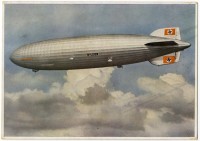
2-days-to-europe-cop-webThe Hindenburg was the first airliner to provide regularly scheduled service between Europe and North America.

While the airship is better remembered for the fiery Hindenburg disaster of 1937 than for its many technological achievements, it was the fastest and most comfortable way to cross the Atlantic in its day.
Hindenburg Directory

Hindenburg: A Detailed History

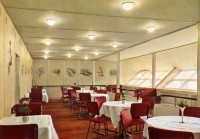
Dining Room of Airship Hindenburg. (click all photos to enlarge)

Click to learn more about Hindenburg's Passenger Decks

Origins of the LZ-129 Hindenburg

The astounding success of the Graf Zeppelin had proved the viability of long range passenger transportation by airship, and by the late 1920′s, Hugo Eckener and the Zeppelin Company  were enthusiastic about building a fleet of ships specifically designed for intercontinental passenger transportation.

Hindenburg under construction

Airship Hindenburg under construction.

The ship originally planned for this role was LZ-128, which it would have been 761 feet long and lifted by 5,307,000 cubic feet of hydrogen.  But the fiery crash of the British airship R-101 in October, 1930 (in which passengers and crew were killed by the hydrogen fire that followed the crash, rather then by the impact itself) convinced the Zeppelin Company to alter its plans and develop a ship capable of being lifted by helium.

Helium is heavier than hydrogen, and therefore provides less lift, so a helium airship must be larger than a hydrogen airship to carry the same payload. The plans for the 5.3 million cubic feet LZ-128, therefore, were abandoned in favor of a design for a much larger ship, the 7 million cubic feet LZ-129, later to be named Hindenburg.

Eerily — in light of later events — the Zeppelin Company purchased 5,000 kg of Duralumin from the wreckage of the British R-101 and used the metal to fabricate components for the Hindenburg.

Airship Hindenburg under construction

Airship Hindenburg under construction.

When completed, LZ-129 was 803.8 feet long, with a diameter of 135.1 feet, and a total gas capacity of 7,062,000 cubic feet of hydrogen.

Size comparison between LZ-129 Hindenburg and Boeing 747

Hindenburg and Boeing 707

LZ-129 and its sister ship, LZ-130, are still the largest objects ever to fly.

The Hindenburg and the Nazis

Nazi Financing

Actual construction of LZ-129 began in the Fall of 1931, but progress lagged due to a severe lack of funds during the Depression. At first, the Nazi Party’s assumption of power in January, 1933 had little effect on the fortunes of the Zeppelin Company, partly due to Air Minister Hermann Göring’s dislike of lighter-than-air flight. But Propaganda Minister Joseph Goebbels was aware of the potential symbolic value of LZ-129 as a showcase for German strength and technology, and in 1934 Goebbels offered Hugo Eckener 2 million marks toward the completion of LZ-129.

Creation of the Deutsche Zeppelin-Reederei

Flag of the Deutsche Zeppelin-Reederei

Flag of the Deutsche Zeppelin-Reederei

Determined to overshadow his rival Goebbels, Hermann Göring offered an additional 9 million marks from the Air Ministry, but the offer came with conditions: In March, 1935, the Air Ministry split the Zeppelin Company into two firms; the original Luftschiffbau Zeppelin, which would be responsible solely for the construction of airships, and the newly created Deutsche Zeppelin-Reederei (DZR), half-owned by the German national airline Lufthansa, which would be responsible for airship operations.

The establishment of the DZR also served the interest of the Nazis by effectively removing Hugo Eckener from the leadership of German zeppelin operations. Ernst Lehmann, who was much more amenable to the National Socialist government than Hugo Eckner, was put in charge of the DZR, and Eckener became mostly a figurehead.

Deutsche Zeppelin-Reederei office in Frankfurt

Deutsche Zeppelin-Reederei office in Frankfurt

[For more information, visit this short history of the Deutsche Zeppelin-Reederei.]

The Hindenburg as Nazi Symbol

The Hindeburg with Swastikas

The Hindenburg

Nazi officials were very much aware of the symbolic value of the huge and impressive airship, and frequently called on Hindenburg for propaganda flights, often in company with the Graf Zeppelin.  Hindenburg made appearances at public events such as the 1936 Berlin Games and the Nuremberg Party rally, and Hindenburg’s first major flight, after test flights were completed, was a 74-hour propaganda flight in support of Hitler’s remilitarization of the Rhineland.

Max Schmeling

Max Schmeling

When boxer Max Schmeling defeated black American boxer Joe Louis, the Nazi government arranged for Schmeling to return to Germany on Hindenburg.

Schmeling’s victory in the boxing ring had made him a national hero; Propaganda Minister Joseph Goebbels wanted to maximize publicity for Schmeling’s homecoming, and to associate the victorious boxer with this symbol of technological achievement, to demonstrate German supremacy in all fields from sport to aviation.

Hindenburg’s First Flights

Hindenburg was completed with the financial support of the Nazi government, and the ship’s first flight took place on March 4, 1936, lasting 3 hours and 6 minutes. Over the next two weeks the ship made several additional test flights, performing well in all ways, and on March 23, 1936 Hindenburg carried passengers for the first time when she took approximately 80 reporters on the short flight from Friedrichshafen to Lowenthal.

hindenb-gondola050web

Control gondola and ground crew of Hindenburg. (click all photos to enlarge)

Hindenburg Propaganda Flight

After its basic test flights in early March, 1936, Hindenburg was scheduled to make a series of endurance trials in preparation for its first transatlantic crossing on March 31, 1936.

Damage to fin during March, 1936 propaganda flight

Damage to fin during March, 1936 propaganda flight

In place of the much-needed endurance trials, however, the Nazi government’s Ministry of Propaganda requested that Hindenburg and Graf Zeppelin undertake a joint three day flight in support of the upcoming March 29 plebiscite on Hitler’s remilitarization of the Rhineland.

Beholden to the Nazi government, which had put him in charge of the DZR, Ernst Lehmann agreed to cancel the test flights and make the propaganda flight instead, and Lehmann even went forward with the planned flight despite unfavorable gusty conditions on the day of departure. Hindenburg’s ground crew lost control of the ship while preparing it for the takeoff, and the stern slammed into the ground damaging the lower fin.

Hugo Eckener was furious at Lehmann for jeopardizing not only the brand new ship, but the entire zeppelin program, and his outburst at Lehmann — and at Propaganda Minister Goebbels — for risking the airship to make a “scheissfahrt” (shit flight) for the Nazis represented Eckener’s most dramatic break with the Nazi government.

29-march-vote-web

Despite the damage, the fin was quickly repaired, and Hindenburg and Graf Zeppelin spent the next few days broadcasting music and pro-Hitler announcements from specially-installed loudspeakers, and dropping swastikas attached to tiny parachutes and propaganda leaflets encouraging Germans to vote “Yes!” for the Fuhrer in the Rhineland referendum. According to the official results of the election, 98.8% of the voters approved Hitler’s policies.

Propaganda leaflet dropped from Hindenburg

The cancellation of Hindenburg’s endurance trials, however, put the ship at risk, as Hugo Eckener had predicted. Hindenburg had engine trouble on its first transatlantic crossing, just two days after the propaganda flight, and the ship suffered multiple engine failures on its return flight across the ocean. The engine failures were traced to problems with the Daimler diesels which undoubtedly would have been discovered during the test flights canceled by Lehmann.

1936 Berlin Olympics

Hindenburg over 1936 Berlin Olympic Games

Hindenburg also demonstrated its propaganda value on August 1, 1936, when the ship flew over the 1936 Berlin Olympic Games. Spectators in the Olympic stadium and crowds of up to 3 million Germans and visitors in the streets of Berlin watched Hindenburg cruise above the city for more than an hour at an altitude of approximately 750 feet.

Under the command of Max Pruss, Hindenburg carried 65 passengers, and also 778 kg of mail (which was dropped by parachute over Berlin’s Tempelhof airfield), and the flight was a financial success for the DZR as well as a propaganda triumph for the Nazi government.

Nuremberg Nazi Party Rally

Hindenburg was again enlisted as a propaganda vehicle on September 14, 1936, when the ship, following 17 aircraft flying in a Swastika formation, flew over the final day of Der Parteitag der Ehre (the 8th NSDAP Congress) in Nuremberg.

hindenb-flight051web

Hindenburg’s Transatlantic Service to North America

On May 6, 1936, LZ-129 began the service it was built for; regular transatlantic crossings between Germany and the United States, carrying up to 50 passengers with both comfort and speed.

Father Paul Schulte saying mass aboard the Hindenburg

Father Paul Schulte saying mass aboard the Hindenburg

The passengers on Hindenburg’s maiden voyage to America included celebrities, wealthy travelers, journalists, and members of the Nazi elite.  (See complete passenger list with photos and biographies.)

The flight featured the first Catholic mass ever said in the air, and a broadcast over the NBC radio network including a recital on Hindenburg’s specially-made lightweight duralumin piano.

[Read an account of Hindenburg's maiden voyage to North America by United Press reporter Webb Miller, who was a passenger on the flight.]

Hindenburg’s Arrival in America after Maiden Voyage to USA

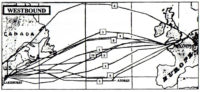
Hindenburg’s 2-1/2 day crossing of the North Atlantic was an astounding accomplishment at a time when even the fastest transatlantic ocean liners (such as the Blue Riband-winning Queen Mary, Normandie, and Bremen) made the trip in five days, and slower ships took as long as 10 days.

hindenburg-brochure-full

Hindenburg brochure (click to enlarge)

1936 Transatlantic schedule, showing the Hindenburg crossing in 2-1/2 days, the Blue Riband winning Queen Mary, Normandie, and Bremen crossing in 5 days, and slower ships taking as long as 10 days.

1936 Transatlantic schedule (click to enlarge)

Hindenburg’s fastest crossing of the North Atlantic took place in August, 1936; the ship lifted off from Lakehurst, New Jersey at 2:34 AM on August 10th and landed in Frankfurt the next day, after a flight of just 43 hours and 2 minutes.

Ticket for Hindenburg's maiden voyage to the United States

Ticket for Hindenburg's maiden voyage to the United States

Of course, Hindenburg’s speed came at a price; passage between Europe and America via Hindenburg cost $400 one way in 1936, and $450 in 1937, while first class passage on a German ocean liner could be had for as little as $157. The best German liners of the day, Bremen and Europa, charged $240 (HAPAG/NDL rate brochure), and rates on Cunard’s Queen Mary were similar (Cunard rate brochure). And a passenger could cross the Atlantic in third class for just $82.00 (see complete 1936 transatlantic rates; view jpg or download .pdf).

(Converting these prices to current values is a theoretically complicated exercise, since different economists approach this topic with different assumptions, but those who are interested in converting these fares to current prices might look at http://eh.net/hmit or http://www.measuringworth.com/uscompare/.)

In addition to revenue from passengers and freight, Hindenburg derived income from the large quantities of mail it carried. (See examples of Hindenburg mail.) Because of Hindenburg’s irregular sailing dates during its maiden season, coupled with the high price of postage for zeppelin mail, most of the letters carried in 1936 were philatelic (items designed especially for stamp collectors or those seeking a souvenir of the zeppelin service) rather than commercial, but plans to introduce a more regular schedule in 1937 and possibly lower the cost of postage left the DZR hopeful that significant income could be earned by carrying business mail.

Registered mail carried on Hindenburg's first flight from Europe to America (Sieger 406D)

Registered mail carried on Hindenburg’s first flight from Europe to North America (Sieger 406D)

By the end of 1936, Hindenburg had crossed the Atlantic 34 times, carrying over 3,500 passengers and more than 66,000 pounds of mail and freight, and the ship’s highly successful 1936 season seemed to indicate that regular transatlantic air service had arrived.

hindenb0491

On October 9, 1936, just before Hindenburg’s last flight from the United States to Germany, 72 wealthy and influential passengers were invited on what became known as the Millionaires Flight; a 10-1/2 hour cruise over New England to generate support for a German-American transatlantic zeppelin service. The passengers were awestruck by the ship, the Hindenburg received wide coverage in the press, and the future of the passenger zeppelin seemed brighter than ever.

Hindenburg’s 1937 Season

With the success of Hindenburg’s 1936 season, eighteen round-trip flights between Germany and the United States were scheduled for 1937, and a companion ship, LZ-130, was nearing completion at the Zeppelin Company construction shed in Friedrichshafen.

1937 DZR schedule for Hindenburg and Graf Zeppelin

1937 DZR schedule for Hindenburg and Graf Zeppelin

During the winter between the 1936 and 1937 seasons Hindenburg underwent maintenance and renovations at Frankfurt. Since the ship was being operated with hydrogen — rather than the helium for which it had been designed — it had a greater lifting capacity, and additional passenger cabins were added to take advantage of the additional lift.

Hindenburg made six successful flights in 1937, including a round-trip from Germany to Brazil, and test flights in which World War I ace and Luftwaffe leader Ernst Udet attempted to fly a small airplane onto a trapeze-hook mounted on the airship.

On Hindenburg’s first North American flight of the 1937 season, under the command of Captain Max Pruss, the Hindenburg crashed at Lakehurst, New Jersey, killing 13 of the 36 passengers, 22 of the 61 crew, and a civilian member of the ground handling team, and the era of transcontinental passenger zeppelin travel came to an end.

The Hindenburg Disaster

For complete information about the crash of the Hindenburg at Lakehurst, New Jersey, on May 6, 1937, visit the Hindenburg Disaster.

Tragedy at Lakehurst

Tragedy at Lakehurst

More Information about the Hindenburg

For other pages about the Hindenburg, also visit:

Tragedy at Lakehurst

Tragedy at Lakehurst

Dining Room of Airship Hindenburg. (click all photos to enlarge)

Dining Room of the Hindenburg

SHARE THIS PAGE

on StumbleUpon, del.icio.us, Facebook, Digg, Reddit, Twitter.

  • StumbleUpon
  • del.icio.us
  • Facebook
  • Digg
  • Reddit
  • Twitter

{ 22 comments }

Kevin Olson January 15, 2010 at 2:00 pm

I had no idea that Hindenburg used duraluminum from R-101. That is pretty spooky. Great website!

John Borrego July 3, 2009 at 9:08 am

Dan,
Any idea what happened to the remains of the Hindenburg after the crash? It would be interesting to imagine all that aluminum eventually being made into B-17s and sent back to Germany, so to speak.
John

Colin McLeod June 30, 2009 at 7:28 am

I have a printed list of travellers (crew + passengers) on the Hindenburg’s journey from Rio de Janeiro on 2 December 1936. I’m happy to send a scan of it to anyone who would find this information of interest.
Colin

Andreas Horn June 28, 2009 at 12:05 pm

Hi Dan!

A few weeks ago I had to make an offer for a huge (1/5 scale), flying “Hindenburg” model for a movie project and I finally got asked if it would be possible to recreate the “Hindenburg” in 1/1 scale…!!!
My rather superficial research resulted in a devastating answer. First, as there is almost no know-how on how to build large rigid airships anymore, the total cost for engineering, construction and flight tests would add up to more than 1 billion dollars.
Second, for an exact replica of the “Hindenburg” it would be almost impossible to get a certificate of airworthiness according to modern standards, even if the airship will be equipped with modern avionics and a fly-by-wire system.

When the the 9 million-dollar partial replica in the Zeppelin Museum Friedrichshafen was designed, the engineers encountered all the problems associated with recreating an advanced old Zeppelin airship.
Though a complete set of drawings was available (but few assembly drawings), it took them months to find out how the pieces must be put together. By employing cardboard models they found the one and only way in which the different pieces can be riveted together. This only gives a slight impression on how it would be to rebuild the complete “Hindenburg”.

Andreas

Dan (Airships.net) June 10, 2009 at 7:56 am

Please see the discussion in the comments above.

Rubens Martins Borges Filho May 13, 2009 at 9:57 pm

Dear Dan,

Thanks for the photo from the Daimler-Benz
diesel engine, 890 kW (1,200 hp) of the Hindenburg.
Rubens Borges.

Eliot May 10, 2009 at 3:15 pm

hi, great web-site. just one quick question, by todays standards how much would it cost to build the Hindenberg???

Dan (Airships.net) Reply:

@ Eliot:

Thanks for the compliment!

As to the cost of building the Hindenburg in today’s currency… that would be quite a task even for a highly qualified cost accountant.

Even determining how much it cost to build Hindenburg in the 1930′s is a challenge; which expenses do you include? And do you take the expenses in 1930′s Reichsmarks and just try to convert those figures into a modern currency?

Or are you asking how much it would cost to build the Hindenburg today? And if so, do you mean an exact reproduction — using obsolete technology despite the passage of time? Or do you mean a modern-day functional equivalent, where the Echolot is replaced by a Radar Altimeter?

But to simplify — Charles Rosendahl wrote that the Hindenburg cost $2,600,000 to build. (See, Rosendahl, What About the Airship?, p 154.)

Of course, converting that figure to current dollars is itself tricky, since different economists use different approaches to inflating prices; you can visit http://eh.net/hmit or http://www.measuringworth.com/uscompare/ to learn more about the various approaches. But using Rosendah’s figure of $2.6 million, and the various calculators at measuringworth.com, that yields a range from $43 million to $657 million in 2009 dollars.

Eliot Reply:

i did a bit more resurch and estemated a cost of
$43,193,503.09 to build the hindenberg today!!!

Dan (Airships.net) Reply:

Can you let us know how you calculated that estimate?

Eliot Reply:

sure, take the $2,600,000 put it through measuringworth and then pick the top one on the list…

Rubens Martins Borges Filho May 6, 2009 at 7:27 pm

Hi dan,

I would like to know if you have a photo from the Daimler-Benz diesel engines, 890 kW (1,200 hp) of the Hindenburg ,and the name of the propeller.

Zack April 22, 2009 at 10:33 am

Hey Dan,

I am doing a social studies project about the Hindenburg Disaster. I have a question about what the skin of the zeppelin was covered in. Any ideas?

Best Regards,
Zack

Dan (Airships.net) Reply:

@ Zack:

Yes, I think I can help. :-)

Hindenburg’s covering was made of cotton canvas which had been doped (painted) with a solution of cellulose acetate butyrate (sold under the trade name “Cellon”) to which aluminum powder had been added. Iron oxide was also added to the dope applied to the upper portion of the hull as protection from UV radiation.

The flammability of this solution has been the subject of vigorous debate between those on either side of Addison Bain’s “incendiary-paint theory,” which argues that the ship’s paint was the primary cause of the fire at Lakehurst.

Many supporters of the Addison Bain theory like to say that the dope used on Hindenburg was basically the same substance as “rocket fuel,” but that comparison is inappropriate in several ways, perhaps most importantly because “rocket fuel” contains an oxidizing agent (which produces its own oxygen during combustion), and there has never been any suggestion that the doping compound used on Hindenburg contained an oxidizer.

I hope this is helpful, and best of luck with your project!

jon knight April 18, 2009 at 1:59 am

i saw the

I SAW THE AIRSHIP WHEN IT RETURNED FROM THE USA IN 1938 OR 39 IT TRAVELLED ALONG THE SOUTH COAST OF ENGLAND IN THE LATE AFTERNOON IT TAAVELLED JUST OUT SIDE THE 3 MILE INTERNATIONAL BOUNDRY AND WAS CLEARLY FROM THE SHORE AT LITTLEHAMPTON WEST SUSSEX JK

Iairs

Evan April 9, 2009 at 6:46 pm

I am taking an aviation history class and have been learning quite a bit about airships and their importance to aviation. I came to your site looking for stats on the Graf and the Hindenburg and stayed and enjoyed the articles and photographs! Thanks for your work on this.

Ben March 29, 2009 at 8:50 pm

Thanks Daniel for all of your great info. I did a reasearch paper on the Hindenburg and your website was a great help. Don’t worry I cited everything. Thanks Ben

Dan (Airships.net) Reply:

Thanks, Ben!

Tael Neilan March 14, 2009 at 10:46 pm

@ Wille Gerhardt:
The Hindenburg was originally designed to lift with helium gas, but when Dr. Eckener went to the U.S. (largest supplier of helium) they would not make any exeptions to the Helium Control Act of 1927. Any other means to get helium was out of the question because it was so expensive. Zeppelin Reederi figured since the Graf had made so many successful flights with hydrogen, why not use it in the Hindenburg instead of helium. I bet the guys who denied Eckener the use of helium were kicking themselves once it blew up…

Dan (Airships.net) Reply:

Yes, Tael is correct, Hindenburg was designed for helium. Thanks for contributing to the discussion! (The plans for LZ-128 were for a hydrogen ship, which was replaced by the LZ-129 after the R-101 crash and fire.) Some of the design innovations made necessary by the planned use of helium are discussed on the page regarding Hindenburg’s Technology.

Erica March 12, 2009 at 3:02 pm

What was the MAIN, immediate and remote causes of this accident??

Dan (Airships.net) Reply:

Thank you for your question. Unfortunately, it is not a question which can be answered quickly, simply, or even definitively. Hundreds of pages can be written — and have been written — analyzing the various theories that have been advanced, from sabotage, to structural failure due to maneuvering, to static discharge, to Addison Bain’s compelling theory regarding the flammability of the covering material, and various combinations of these factors.

At some point I may prepare a summary and analysis of the various theories, but at the moment I am working on biographies of various airship designers, officers, and crew members, and expanding the section on the US Navy’s rigid airship program.

Phil March 4, 2009 at 4:55 pm

Hi Dan,
I’m looking for a list of dates for the 34 Atlantic crossings the Hindenburg completed during the 1936 season? Do you know of a website or a book that contains such a list? Thanks in advance and thank you for your work on this informative site!
Phil

Dan (Airships.net) Reply:

I response to your request, I have just added a page with Hindenburg’s complete flight schedule. I will be adding further information about particular flights (such as the propaganda Plebiscite flight, and the Millionaire’s Flight) in future. I hope this is helpful!

Fred Baker March 4, 2009 at 9:55 am

Where was the Hindenburg built? Is that the same location as for other airships? Thanks FB

Dan (Airships.net) Reply:

Hindenburg and Graf Zeppelin were both built at the Luftschiffbau Zeppelin construction sheds at Friedrichshafen, but repair and maintenance work was sometimes performed at the hangars in nearby Löwenthal, or in Frankfurt. (For example, when additional passenger cabins were added to Hindenburg during the winter refit of 1937, the work was performed at Frankfurt.)

J.T. March 2, 2009 at 9:57 pm

What an awesome site, whoever put it together! I love the color pictures of the interior. I’ve just recently acquired this interest in the Hindenburg, and wish to learn a lot more about it. I’ve scoured the internet looking for any dedicated forums for it, but I’ve found none. What are the best 2 or 3 forums for internet discussion on the Hindenburg? Thanks!

Kurt February 12, 2009 at 10:42 pm

What was the Hindenburg’s top speed?

Mark February 5, 2009 at 2:16 pm

Anyone know what a perfectly preserved letter and envelope would be worth that was shipped over on the Hindenburg?

Dan (admin) Reply:

The value of a piece of zeppelin mail depends mostly on which flight the letter was carried on, as well as the country of origin and stamps used. Commercial mail is sometimes considered more valuable than philatelic mail, and if the letter has particular historical significance, that would affect its value as well.

Wille Gerhardt February 2, 2009 at 5:44 am

Have just watched two (different) TV documentaries about Hindenburg. In one, an experienced American flight accident investigator provides a convincing theory of the cause of the horrible accident. Sabotage was ruled out because the fire started about 10m above the internal passagewalk, and a sabotur would rather have just dropped his bomb below the walk. The investigator finally concluded that the accident was caused by a combination of pilot error and electric charge. Before the accident, Hindenburg had flown below a thunderstorm and became delayed having to circle at Lakehurst. Just before reaching the landing mast a gust of wind caused the ship to drift. The impatient captain decided to make a sharp course correction, a maneuver for which the ship was not designed. The load from the steering fins apparently caused a steel cable to rupture, ripping through a gas sack and upwards through the covering in front af the uppermost steering fin. A rippling of the skin at this spot is clearly visible on the old film and described by several eyewitnesses. This in itself would not have ignited the hydrogen, but the ship was electrically charged from the thunderstorm. Lowering of the steel anchor cable grounded the electrical charge of the steel skeleton but the isolating skin – unfortunately painted with inflammable cellulose nitrate – was still highly charged. The ripping steel cable from the grounded steel skeleton through the charged skin caused an intense spark starting the fire just in front of the uppermost fin as witnessed and filmed. The fire spread primarily along the highly flammable skin – 34 secs from tail to nose, faste than hydrogen alone would have burned. This explains that the flames were yellow – pure hydrogen flames are colorless.
I am bit confused by your description that Hindenburg had been built for helium. Obviously it was lifted by hydrogen. A sister ship was indeed planned for helium, but the tragedy caused all plans of more Zeppelins to be given up.
Thanks for your interesting site with the excellent photos.
With kind regards, Willie Gerhardt

Arthur Brown January 25, 2009 at 1:34 pm

congratulations on a truly elegant and informative site. I especially like the fact you can enlarge the images so easily. excellent job!! it kept me engrossed for hours.

adam clark January 21, 2009 at 8:05 am

thank you very much for this for brilliant information!

best regards,

Adam Clark age: 9

Dan (admin) Reply:

Thank you, Adam! I am so glad you enjoyed it!!!

Comments on this entry are closed.