Graf Zeppelin History
Christening of LZ-127 on July 8, 1928 by Countess Helene von Brandenstein-Zeppelin. (click all photos to enlarge)
Certainly the most successful zeppelin ever built, LZ-127 was christened “Graf Zeppelin” by the daughter of Ferdinand Graf von Zeppelin on July 8, 1928, which would have been the late count’s 90th birthday.
By the time of Graf Zeppelin’s last flight, nine years later, the ship had flown over a million miles, on 590 flights, carrying thousands of passengers and hundreds of thousands of pounds of frreight and mail, with safety and speed. Graf Zeppelin circled the globe and was famous throughout the world, and inspired an international zeppelin fever in the late 1920s and early 1930s.
Graf Zeppelin Test Flights
Graf Zeppelin made its first flight on September 18, 1928, under the command of Hugo Eckener. The ship lifted off at 3:32 PM and flew a little over three hours before returning to its base in Friedrichshafen.
A series of successful test flights followed, including a 34-1/2 hour endurance flight during which the new German ship was shown off to the residents of Ulm, Nuremberg, Wurzburg, Frankfurt, Wiesbaden, Cologne, Dusseldorf, Bremen, Hugo Eckener’s hometown of Flensburg, Hamburg, Berlin, Leipzig, and Dresden.
Graf Zeppelin being led from its hangar for its first flight on September 18, 1928. (click all photos to enlarge)
Graf Zeppelin’s First Flight Across the Atlantic
Graf Zeppelin made the very first commercial passenger flight across the Atlantic, departing Friedrichshafen at 7:54 AM on October 11, 1928, and landing at Lakehurst, New Jersey on October 15, 1928, after a flight of 111 hours and 44 minutes. The ship carried 40 crew members under the command of Hugo Eckener, and 20 passengers including American naval officer Charles E. Rosendahl and Hearst newspaper reporter Lady Grace Drummond-Hay.
The ship’s first transatlantic crossing almost ended in disaster when it encountered a strong squall line on the morning of October 13th. Captain Eckener had uncharacteristically entered the storm at full power — he was known to reduce speed in bad weather — and the ship pitched up violently in the hands of an inexperienced elevatorman; the airships R-38 and USS Shenandoah had broken up under similar circumstances.
In-flight repair of Graf Zeppelin's fin, showing the extensive damage suffered in the squall and the dangerous conditions faced by the repair party.
Eckener and his officers re-established control, but soon learned that the lower covering of the port fin had been torn away, threatening further damage which would have rendered the ship uncontrollable. Eckener sent a repair team of four men — including his son, Knut Eckener; senior elevatorman and future zeppelin commander Albert Sammt; and Ludwig Knorr, who would become chief rigger on LZ-129 Hindenburg — to repair the covering in flight. Eckener also made the difficult decision to send out a distress call, knowing that he was risking the reputation of his brand new ship, and perhaps the entire zeppelin enterprise. The distress signal was soon picked up by the press, and newspapers around the world ran sensational stories about the looming destruction of the overdue Graf Zeppelin on its maiden voyage.
The emergency repairs were successful, but the ship encountered a second squall front near Bermuda. Graf Zeppelin made it through the second storm, even with the temporary repairs to the damaged fin, and reached the American coast on the morning of October 15th. After a detour over Washington, Baltimore, Philadelphia, and New York, to show Graf Zeppelin off to the wildly enthusiastic American public, Eckener brought his damaged ship to a safe landing at the United States naval base at Lakehurst, New Jersey on the evening of October 15, 1928. Graf Zeppelin was overdue, damaged, and had run out of food and water, but Eckener, his crew, and his passengers were greeted like heroes with a ticker-tape parade along New York City’s Broadway.
After two weeks of repairs to the damaged fin, Graf Zeppelin departed Lakehurst on October 29, 1928 for its return to Germany. The return flight took 71 hours and 49 minutes, or just under three days; the ocean liners of the day took twice as long to carry passengers across the Atlantic.
Graf Zeppelin Round-the-World Flight (“Weltfahrt”)
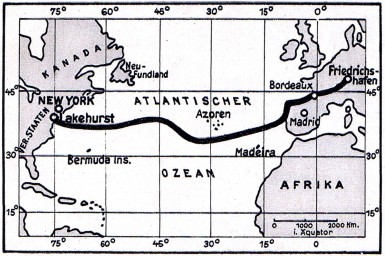
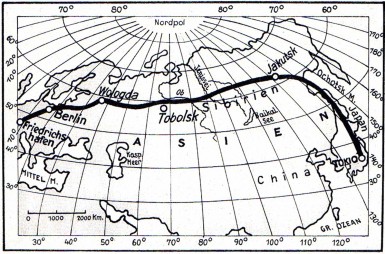
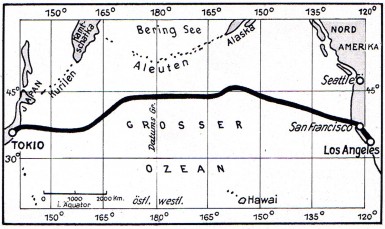
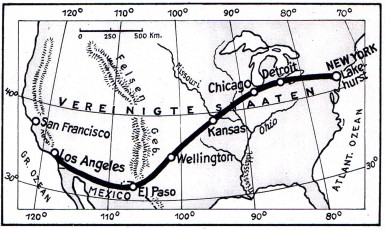
In 1929, Graf Zeppelin made perhaps its most famous flight; a round-the-world voyage covering 21,2500 miles in five legs from Lakehurst to Friedrichshafen, Friedrichshafen to Tokyo, Tokyo to Los Angeles, Los Angeles to Lakehurst, and then Lakehurt to Friedrichshafen again.
[See maps, dates, and flight times for each of the five legs of the flight.]
It was the first passenger-carrying flight around the world [see a complete list of passengers and crew aboard the flight], and received massive coverage in the world’s press.
The flight was partly sponsored by American newspaper publisher William Randolph Hearst, who paid for about half the cost of the flight in return for exclusive media rights in the United States and Britain.
Hearst had insisted that the flight begin and end in America, while the Germans naturally thought the Round-the-World flight of a German ship should begin and end in Germany. As a compromise, there were two official flights; the “American” flight began and ended at Lakehurst, while the “German” flight began and ended at Friedrichshafen.

The Round-the-World flight carried 60 men and one woman, Hearst newspaper reporter Lady Grace Hay-Drummond-Hay, whose presence and reporting greatly increased the public’s interest in the journey. Other passengers included journalists from several countries, American naval officers Charles Rosendahl and Jack C. Richardson, polar explorer and pilot Sir Hubert Wilkins, young American millionaire Bill Leeds, and representatives of Japan and the Soviet Union.
Graf Zeppelin left Friedrichshafen on July 27, 1929 and crossed the Atlantic to Lakehurst, New Jersey, and the “American” flight began on August 7, 1929 with an eastbound crossing back to Germany.
The longest leg of the journey was the 11,247 km, 101 hour 49 minute flight from Friedrichshafen to Tokyo, which crossed thousands of miles of emptiness over Siberia. A planned flight over Moscow had to be canceled due to adverse winds, prompting an official complaint from the government of Soviet dicatator Joseph Stalin, which felt slighted by the change in plan. The passage over Russia’s Stanovoy mountain range in eastern Siberia brought Graf Zeppelin to an altitude of 6,000 feet. The ship landed to a tumultuous welcome and massive press coverage in Japan, where a crowd estimated at 250,000 people greeted the ship’s arrival and Emperor Hirohito entertained Eckener and guests at tea.
The next leg of the flight crossed the Pacific ocean enroute to Los Angeles; Eckener deliberately timed his flight down the American coast to make a dramatic entrance through San Francisco’s Golden Gate with the sun setting behind the ship. According to F.W. “Willy” von Meister (later New York representative of the Deutsche Zeppelin-Reederei), Eckener explained: “When for the first time in world history an airship flies across the Pacific, should it not arrive at sunset over the Golden Gate?”
After slowly cruising down the California coast to land in daylight the next morning, Graf Zeppelin made a difficult landing at Los Angeles on August 26th, through a temperature inversion which made it difficult to bring the ship down, requiring the valving of large quantities of hydrogen. The lost hydrogen could not be replaced at Los Angeles, and the takeoff, with the ship unusually heavy, was even more challenging; Graf Zeppelin only narrowly missed hitting power lines at the edge of the field.
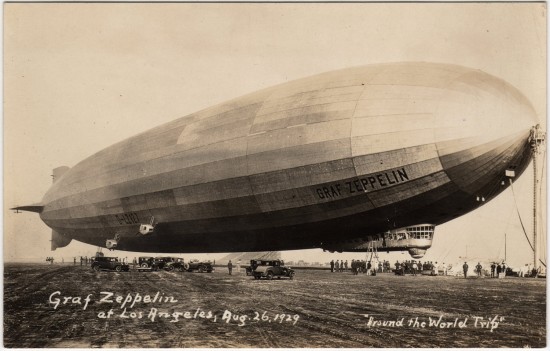
After a difficult summertime passage over the deserts of Arizona and Texas, Graf Zeppelin flew east across America. The ship was greeted with wild enthusiasm by the people of Chicago, and ended its record breaking flight with a landing at Lakehurst the morning of August 29, 1929. The Lakehurst to Lakehurst voyage had taken just 12 days and 11 minutes of flying time, and brought worldwide attention and fame to Graf Zeppelin and its commander, Hugo Eckener.
The flight is the subject of the largely fictional Dutch film Farewell.
Graf Zeppelin Polar Flight
In July, 1931, Graf Zeppelin carried a team of scientists from Germany, the United States, the Soviet Union, and Sweden on an exploration of the Arctic, making meteorological observations, measuring variations in the earth’s magnetic field in the latitudes near the North Pole, and making a photographic survey of unmapped regions using a panoramic camera that automatically took several pictures per minute. The size, payload, and stability of the zeppelin allowed heavy scientific instruments to be carried and used with an accuracy that would not have been possible with the airplanes of the day.
The polar journey, like other zeppelin flights, was largely financed by stamp collectors; Graf Zeppelin carried approximately 50,000 letters sent by philatelists, and made a water-landing to exchange mail with the Soviet icebreaker Malygin, which itself carried a large quantity of mail sent by stamp collectors.
After the three-day Arctic flight, which included a landing in Leningrad, Graf Zeppelin returned to Berlin to a hero’s welcome at Tempelhof airfield, where the ship was met by celebrities including famed polar explorer Admiral Richard Byrd.
[Read a detailed account of the Graf Zeppelin's Polar Flight.]
The Century of Progress Flight to 1933 Chicago World’s Fair
By late 1933, Graf Zeppelin had not been to the United States in over four years, since the Round-the-World flight of 1929. When the Zeppelin Company was asked to fly the ship to the 1933 Chicago World’s Fair, officially dubbed the “Century of Progress International Exposition,” Eckener agreed on condition that the United States issue a special commemorative stamp and share the postal revenue with the Zeppelin Company. After initial opposition by the United States Post Office (and President Franklin Roosevelt’s initial rejection of the idea of a fourth zeppelin stamp), the Post Office eventually agreed to issue the stamp, and so at the end of Graf Zeppelin’s last flight to South America in October, 1933, instead of returning directly to Germany from Brazil, Graf Zeppelin flew to the United States for stops in Miami, Akron, and Chicago.
While Graf Zeppelin’s appearance was one of the highlights of the Chicago Fair, the swastika-emblazoned ship, which was viewed as a symbol of the new government in Berlin, triggered strong political responses from both supporters and opponents of Hitler’s regime, especially among German-Americans. The political controversy muted the enthusiasm that Americans had previously displayed toward the German ship during its earlier visits, and when Eckener took Graf Zeppelin on a aerial circuit around Chicago to show his ship to the residents of the city, he was careful to to fly a clockwise pattern so that Chicagoans would see only the tricolor German flag on the starboard fin, and not the swastika flag painted on the port fin under the new regulations issued by the German Air Ministry.
Graf Zeppelin and the Nazis
The Graf Zeppelin was recruited as a tool of Nazi propaganda remarkably soon after the National Socialist takeover of power in early 1933. Only three months after Adolf Hitler’s appointment as chancellor, the Propaganda Ministry ordered Graf Zeppelin to fly over Berlin as part of the government’s May 1, 1933 celebration of the “Tag de Nationalen Arbeit,” the Nazi version of the May Day celebration of labor.
Later in May, 1933, Graf Zeppelin flew to Rome in connection with Propaganda Minister Joseph Goebbels’ first official meeting with the fascist government of Italy; Goebbels invited Italian Air Minister Italo Balbo to join him on a flight over Rome.
In September, 1933, Graf Zeppelin flew over the Reichsparteitag congress at Nuremberg (the “1933 Nuremberg Rally’) to dramatically herald Hitler’s appearance before the crowd.
Throughout the remainder of its career Graf Zeppelin was ordered to make numerous propaganda flights, occasionally in concert with LZ-129 Hindenburg after that ship was launched in 1936.
South American Service
By the summer of 1931, after many pioneering flights which demonstrated the airship’s impressive capabilities and captured the enthusiasm of the world, Graf Zeppelin began regularly scheduled commercial service on the route between Germany and South America.
The passage to South American was an almost ideal route for a German airship; Brazil and Argentina had a considerable German population, and there were strong business and trade connections between these countries and Germany, yet the transportation of mail, passengers, and freight by ship took weeks. In addition, the ships to South America were far less comfortable than the luxury liners which crossed the North Atlantic to New York. Graf Zeppelin reduced the travel time between Germany and South America from weeks to days, and was therefore hugely popular.
Graf Zeppelin crossed the South Atlantic 18 times in 1932, and made a similar number of flights in 1933. By 1934, the Zeppelin Company was advertising a regular service to South America, departing Germany almost every other Saturday to Brazil, with connecting airplane flights to Argentina. In 1935 and 1936, Graf Zeppelin’s schedule was almost exclusively devoted to passenger and mail service between Germany and Brazil, with crossings back and forth almost every two weeks between April and December. Over its career, Graf Zeppelin crossed the South Atlantic 136 times; it was first regularly scheduled, nonstop, intercontinental airline service in the history of the world.
Graf Zeppelin’s Last Flight
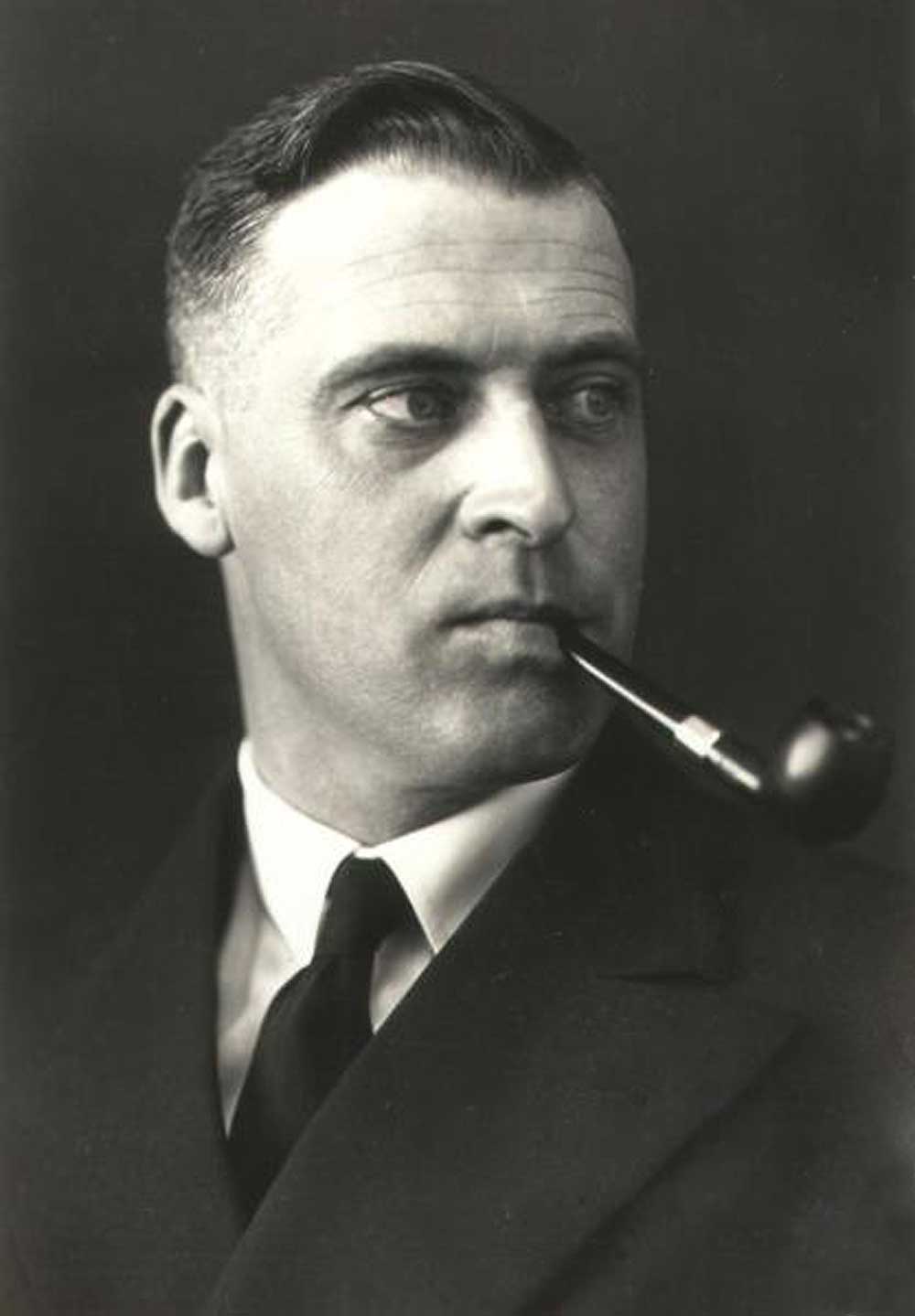
Graf Zeppelin was over the Canary Islands on the last day of a South American flight from Brazil to Germany when it received news of the Hindenburg disaster in Lakehurst, New Jersey. Captain Hans von Schiller withheld the news from his passengers, and told them of the disaster only after the ship’s safe landing in Germany.
Graf Zeppelin landed in Friedrichshafen on May 8, 1937, and never carried a paying passenger again. The ship made only one additional flight, on June 18, 1937, from Friedrichshafen to Frankfurt, where she remained on display — all her hydrogen removed — until she was broken up on the orders of Hermann Goering’s Luftwaffe in March, 1940.


{ 70 comments… read them below or add one }
Dan,
I am a zeppelin enthusiast, and am overjoyed to have access to your detailed, and exciting website. Thank you.
[Reply]
We were amazed to find this site. My Dad who was born in 1923 was just telling me that when he was about 5(ish) he saw an airship over Bristol. Can you tell me which one it is likely to be plase. Dad thinks it was the Graf Zeppelin.
[Reply]
Linda B Reply:
August 28th, 2010 at 12:25 pm
Hi Jan,
I remember watching a slide show at my local photo club in Keynsham about 12 years ago and we were shown a slide of an airship over Bristol near Castle Park in the 1930s I have also been searching for which airship it was. All I remember was the swazstika on the tail fin. I will keep researching it as I found it fascinating. Even though what happened over 70 years ago was not nice I still think the Zeppelin and Hindenburg are beautiful creations.
Linda
[Reply]
I recently acquired a reel of 16mm film documenting the transatlantic flight of the Graf Zeppelin. I haven’t been able to find any information about this film and am Guessing it might be quite rare. Here is a picture of the box it came in. I’m planning to have it digitized soon so that the images will be preserved.
[Reply]
I was born in 1930 and was impressed by an Airship I saw cruising slowly near my grandparents’ home on the outskirts of St.Helens, Lancashire. My guess is that it was sometime in the period 1935 to 1937. I have assumed the craft was the Hindenburg or could it have been the Graf Zeppelin?
Thank you for the excellent articles on this site.
[Reply]
In 1929 I was about 5 years old and early one August morning my father got me out of bed and in my pajamas he held me up to see the Graf Zepplin hanging overhead with its engines idling in a low rumble. I would guess that it was only about 2 or 3 hundred feet overhead and I recall it extended for about 3 of our city blocks in Independence, Kansas, where I lived at the time. Our local paper in Southeast Kansas had been following its round the world flight and predicted its arrival.
I will never forget this experience and I’ve wondered if there are any pictures in the German Zepplin Museum where perhaps pictures of a US town named “Independence” might have been taken that morning.
[Reply]
Do you have any idea what the 3 interconnecting circles are on the markings of the early zeppelins? They are later turned into the olympic rings on the LZ129 at the 1936 Berlin Olympics where Hitler had Nazi propaganda dropped on the crowd as the Hindenberg flew over. I would appreciate any info you could share ewith me, i am writing a book about Led Zeppelin. Thanks! S. Jordan
[Reply]
Sometime between 1934 and 1938 I was on the flat playground roof of my school (St.James) which was next to Liverpool Cathedral. A Zeppelin Luftschiffe flew very low over the cathedral and school so that we kids could see the people in the gondola looking out.
My father said that he suspected that the aircrew would have been taking photographs for military purposes. Can you tell me the exact date and which aircraft it was ?
[Reply]
Would anyone know the the route taken by the Graf Zeppelin during the U.S. leg of the world tours? More specifically the route taken from Chicago eastward. My father lived in southwest Michigan in the late 1920′s and 30′s and witnessed the fly over of the zeppelin. I am try to figure whereabouts he might have seen it. He often mentioned that when it passed over the zeppelin played a tune over speakers to those on the ground for Pheiffer Beer: “drink Pfeiffer…make mine Pfeiffer…”. Is there any infromation about the ship being used to advertise? I’ve read on the internet that Pfeiffer Beer was brewed in Detroit at that time so the advertizing would make sense. Any reply is appreciated. A.N.
[Reply]
G.E Jones asked about swastikas on the hindenbur/zeppelins tails. I have a postcard that is not part of book zeppelin weltfahrten but was just pasted in the back and with a jewellers magnifier showed both air ships having swastikas on the tail. There is no writing or dates to put it in context but I would guess from my moms stories of nazi germany it was no doubt added during hitler’s reign of terror. If I find any more I’ll let you know
[Reply]
jenb comment 1905 asked about a collectors book called zeppelin-weltfahrten which I also have a copy. wonderful collection of photos, drawings, maps etc. My mother who is also german, swiss tells me her parents who were heavy smokers collected cigarette coupons from a particular brand (still not sure which but probably out of business long time ago like the zeppelins) and would cash the coupons in for the pictures to fill the album which was also provided by the cigarrette company. At least 2 of your pictures are dead matches for the ones in my book, control car LZ127 and the one on lake costance/bonashee. my mom still is helping translate the book which covers the world trips(south america etc) and has many pictures taken from the airships. I don’t have tons of time to spend on line, but feel free to reply.
[Reply]
Dan (Airships.net) Reply:
March 30th, 2010 at 9:27 am
You are correct! Many images on this site are taken from the three volumes of the Zeppelin-Weltfahten book series.
[Reply]
I visit your site often and always find something interesting. This time I noticed
what I believe is an error of omission. That is, you have skipped the Europe-
Pan America flight by LZ-127: Freidrichshafen, Seville, Pernambuco, Lakehurst,
Seville, Freidrichshafen (May 18-June 6, 1930).
Cheers,
Bob
[Reply]
Dan (Airships.net) Reply:
March 24th, 2010 at 6:34 pm
Thanks for your comment. Unfortunately there are dozens of flights I have not yet described in detail, but I try to add new information as often as time allows.
Thanks again!
[Reply]
Robert E. Mattingly Reply:
April 21st, 2010 at 7:15 pm
Hi Dan,
To clarify my earlier comment, I was referring to your line in a narrative which describes the Chicago flight: “By late 1933, GZ had not been in the United States, since the Round-the-World flight of 1929.”
The Europe-Pan America flight of 1930, the first
to both South and North America, also resulted in
the first U. S. Air Mail stamps to picture the
Graf Zeppelin. In short, this was a major intercontinental trip several years before the
Century of Progress flight and it did stop in the United States.
Cheers,
Bob
[Reply]
Dan (Airships.net) Reply:
April 24th, 2010 at 5:27 pm
Ah, great point, thanks! I will correct the text as soon as I can.
[Reply]
Dan,
My grandfather, Wylie G. Logue, was the Commercial Manager of Radiomarine Corporation of America (RCA) from 1928 – 1937. There is a photograph of him
guiding the Graf Zeppelin over the Atlantic that appeared in the November 1928
RCA Wireless Magazine. This item appeared on Ebay of all places and identified my grandfather by name. It sold or was not a completed transaction. At any rate, do you have any idea how I might get a copy of the RCA magazine?
Thank you.
Fay Evans
[Reply]
Dan (Airships.net) Reply:
March 21st, 2010 at 7:47 pm
Unfortunately I don’t have a copy of that magazine.
[Reply]
I am 88 years old,but clearly remember Graf Zeppelin over Hull.i wasin Mersey Street school playground, i think the year was 1929, but it could have been 1930.
The zeppelin was over Wembley on 28th April 1930 and I believe made a flight up the east coast and would have included Hull. There is a photo in Hull Daily Mail archives showing the Zeppelin over the Beverly Road, it’s number is 260829.jpg.
I wasonly 7 or 8 at that time.
[Reply]
My Mother was born in Bournemouth in 1924 and remembers her father picking her up in his arms and pointing to a huge airship passing over head. She thinks she must have been about 5 years old and she seems to remember her father saying it was it’s last flight.
Having watched the wonderful program on BBC 4 last night I’ve googled my way to this great site to find out more about airships. For me, the program showed the wonder, romance and excitement of a past age. Perhaps the Hindenburg disaster has blurred what a wonderful experience floating along in an airship must have been.
[Reply]
I too was fascinated by the round the world film of Grace Drummond-Hay which has just been shown on British TV. I would like to follow up on a question raised by two of your commentators, but not answered. What happened over the Pacific? The sound track clearly stated that the airship ran into a storm, was tossed around, was nearly lost, and came down in a bay beside “an uninhabited island” to make emergency repairs. Could this have been Middleton Island in the Bering Sea? (It’s an island I have visited myself; it is uninhabited, and it sits by itself a long way from the Aleutians). Yet the “speeds” given for the crossing don’t allow for a stop. Was it all made up by Hay for journalistic effect? Or was it suppressed by Eckener so as not to put off passengers? The commentary speaks of US and Japanese air searches. There must be some record of this. Best regards and congratulations on your website, Peter Wadhams
[Reply]
Having Watched the GRAF ZEPPELIN round the world voyage on BBC4 last night prompted me to “Google”.
I have, somewhere, a postcard of Graf Zeppelin at Lakehurst which I shall “dig out” and share with this site.
[Reply]
Hi,
Congratulations on a truly interesting site. Is there any chance you could tell me which of the Airships I would have seen flying North above Weston-Super-Mare Somerset in 1933-35, It was in the afternoon about 3-4 oclock. I have always thought it was the R101 but now realise this is incorrect. I was born in 1932 and I must have been 3-4 years old at the time. After a long time searching I would much very appreciate a reply. Incidentally I went on to join the RAF and spent 26 years as an aircraft engineer.
Regards Brian Hunt
[Reply]
Dan (Airships.net) Reply:
February 9th, 2010 at 10:55 pm
Assuming it was a rigid airship, and not a blimp: If you were born in 1932, and were four years old at the time, it could have been Hindenburg, which was launched in 1936. LZ-127 Graf Zeppelin did not visit the UK in 1934 or 1935, so if you were at least three, it could not have been LZ-127. If you were older, it might have been LZ-130 Graf Zeppelin, which flew over the UK in 1939.
[Reply]
D Jones Reply:
June 14th, 2010 at 6:08 pm
I came to your site whilst reseaching after my father told me of the time he was called out of his home in the forest of Dean by my grandfather to see a massive airship flying overhead. He remembers this being around 1935 so I’m guessing that he also witnessed the Hindenburgh. Thank you for helping me find out the information and for a facinating website.
[Reply]
Hello,
About 20 years ago I purchased a small private photo album with 15 various 3.5×2.5 inch photographs of the Graf Zeppelin some of it airbourne and also when on the ground. There is is a pencil date mark of 1932/33 and I believe that they were taken somewhere in England as some buildings of a shop and Town Hall are in one of the pictures.
Do you know if there are any collectors who would be interested in buying them ?
[Reply]
As a Ford dealership owner up till 1941, my father received a sample of Veedol Oil drained from the tanks of Graf Zeppelin,dated October 15, 1928. This was courtesy of Tide Water Oil Company.
I was born on Oct 6, 1926, and have an image in my mind of a large lighter than air ship flying over Redondo Beach, CA. Could this have been the Graf Zeppelin?
Homer Meek
[Reply]
Dan (Airships.net) Reply:
January 18th, 2010 at 4:04 pm
Graf Zeppelin landed at Mines Field in Los Angeles on August 26, 1929, so depending on the date (and how well you remember things from age 2 or 3!) it could have been LZ-127.
[Reply]
Why does the skin of the airship look like it’s tighter in some photos?
[Reply]
I recently obtained a small pocket knife from my 87 yo. father it appears to be alluminum and has a picture of Graf Zeppelin on the front and the words “Der Erfinder des lenkbaren Luft-schiffes” and on the large blade is MACUPA SOLINGGEN. on the other side of the knife is the Graf Zeppelin flying over a body of water with a mountain scene with a tugboat and people standing and watching from the shore. Can you tell me what the words on the knife say? and anything else about it?
[Reply]
Dan (Airships.net) Reply:
December 20th, 2009 at 3:22 pm
Thanks for you message, and for the photo of your fascinating knife. Perhaps the following might help.
The knife does, of course, depict Graf Zeppelin the man, but it does not depict Graf Zeppelin the airship (LZ-127). Graf Zeppelin (the man) is described as “Der Erfinder des lenkbaren Luft-schiffes,” or “The inventor of the dirigible air-ship.” The ship is one of Zeppelin’s early airships (identifiable by the shape of the hull, the two gondolas, and the shape of the tail fin, among other things). The body of water is almost certainly the Bodensee (Lake Constance), on the border between Germany and Switzerland. And Solingen, of course, refers to the famous knife-making town near the Ruhn (home of Wusthof, Henckels, and dozens of others). The knife could have been manufactured at any time during the Zeppelin era, but there is a good chance it was likely made around the time of the first airships (1900-1914).
Thanks for sharing this item!
Dan
[Reply]
Artie Reply:
December 20th, 2009 at 4:29 pm
That looks like LZ 4. But I guess it could be any early zepp. Definitely not LZ 127.
[Reply]
Kevin Reply:
March 11th, 2010 at 1:53 am
“Der Erfinder des lenkbaren Luft-schiffes” means “The inventor of the dirigible airship” in german.
[Reply]
Manning Harvey Reply:
March 11th, 2010 at 12:42 pm
Kevin, Thank you I have really enjoyed the input I have gotten about my knife. I find it facinating. Manning sends…
[Reply]
I seem to recall the Graf Zeppelin flying over Kansas City on the 1933 trip (not the 1929 voyage) from Miami to Chicago/ Akron, possibly to avoid the Eastern US storm mentioned above. Does anyone have details about the route taken in October 1933?
[Reply]
I was born in 1925 in Argentina. My father corresponded with german factories
in Mulheim Ruhr, and I have the original enveloves of those letters that came ” Mit
Luftschiff Graf Zeppelin” The oldest, the ” triangular” flight left Friedrichshafen on
10-14-33 and arrived in B.A. Argentina on 10-19-33 (by plane bw.Brazil and Argen
tina. The next letter is dated 6-23-34 at Friedrichhafen and 6-28-34 arriving at
Buenos Aires Argentina, this is the only flight of the G.Z. unknown to most, I
remember driving to the airport where it was going to land and seeing it.
In 1936 our family got on german passenger ship ” Monte Sarmiento” bound to
Europe(march/april)and after leaving last brazilian port Salvador, at sea we met the
LZ 29 “Hindenburg” first trip to S.A. she circle low over the ship, could see the
side windows, ships photographer took a picture when she was passing over the
ships twin funnels , I don’t know the exact date , she left Friedrichshafen on for
South America on 3-31-36 this is another unknown voyage of the LZ-29
[Reply]
Jag har ett mynt med Graf Zeppelin daterad 1928, på baksidan av myntet står det Shell. Är det någon reklam eller är det ett mynt man ska vara rädd om?
[Reply]
Watching Ditteke Mensink’s film « Farewell » last night about the Graf Zeppellin’s Round-the-World flight prompted me to google the subject and so find your website.
I’d be grateful for your comments on the following. In the film, Grace Drummond-Hay refers to serious problems on the Japan-USA leg of the trip. This apparently cut radio contact and forced the airship down onto the sea for repairs. Your website makes no reference to these problems which would appear to be inspired by those encountered on the flight from Germany to the USA preceding the start of the Round-the-World trip. Furthermore, the footage which illustrates this event appears to be of the Graf on the Bodensee as shown in the photo on your website.
My father saw LZ-127 over Liverpool, England and he often referred to the thrill of seeing her though even by then, she was suspected of carrying out air recce missions to photograph possible future Luftwaffe targets. The July 8th 1932 edition of “Flight” on flightglobal.com. says that she flew over Liverpool on 3rd July 1932 on a flight that also took in Edinburgh, Glasgow and Bristol.
40 years later, my father was still kicking himself for not having his camera with him that day!
Very many congratulations on your really impressive website!
Best wishes,
John Salter
[Reply]
Dan (Airships.net) Reply:
December 16th, 2009 at 3:08 pm
Thank you for your comments. Some of your questions are addressed here:
New Movie about “Lady Hay” and the Graf Zeppelin: “Farewell”
[Reply]
JohnSalter Reply:
December 17th, 2009 at 2:57 pm
Thank you very much indeed for your reply.
I greatly enjoyed the film and the inaccuracies I suspected at the time in no way detracted from my pleasure. In fact it was because of them that I found your website.
I did not record the TV showing of the film so I can’t check back but there was also reference to serious problems encountered when crossing a mountain range in Eastern Siberia. Was this also perhaps an example of poetic license?
I’m afraid two errors crept into my original query when I misspelled Zeppelin and also implied that the Graf ran into trouble on the flight out to the USA for the start of her round-the-world trip. Sorry about that!
[Reply]
I have an old photgraph of the Graf Zepplin at Lakehust, N.J., date unknown. It has an inset picture of Dr. Hugo Eckener in the top left corner. I found this picture in my great aunts house when I was a teenager, almost forty years ago. It had been folded up, but is still a great photo.
[Reply]
Hi,
My wife has a postcard that was sent from the US to Germany on the return of the first transatlantic Graf Zeppelin flight in 1928. The card is signed by Ludwig Neugass and it sent to his father Julius in Mannheim, Germany. It is written in German but the translation indicates that he was on the outbound leg of the flight i.e. the first Graf Zeppelin flight from Germany to Lakehurst. Does anyone have a passenger list for that flight and if so can they please see if Herr Neugass is listed as it would add to the story.
[Reply]
I have a piece of metal left from my grandmother. I was told that it was part of the Hindenberg. There was writing but I never checked it out. I just looked it up and I believe it is part of the Graff Zeppiin. Someone wrote 1928 Graff and on the back Lakehurst NJ.. I believe it was a piece of the ship that was removed during it’s repair there. Any ideas on how this can be confirmed?
[Reply]
Dan (Airships.net) Reply:
November 28th, 2009 at 10:12 am
Rick Zitarosa of the Navy Lakehurst Historical Society is the authority on all things Lakehurst with regard to LTA.
[Reply]
Michael asks about the use of the song known as “Deutschland uber Alles”. This was the national anthem of Germany at the time. The words were written in the middle 1800′s to the tune “Austria” by Josef Haydn (this was the Austrian national hymn).
The new words with the well-known tune were titled “Das Lied der Deutschen” and was popular in the German states. In 1921 or ’22 the Weimar Republic made it the official national anthem. The Nazis kept it, but it was not a Nazi composition.
I don’t know anything about Zeppelin protocol, but that song being played at take-off would be quite usual, just as US ships departing might have a band play “America” or “The Star Spangled Banner”.
The song is still the German national anthem, with the original third verse beginning “Einigheit und Recht und Freiheit” (Unity and Justice and Peace) replacing the words that had become associated with Nazi rule.
[Reply]
I too stumbled upon this informative site whilst search for info on a book that my father has(He’s German). I believe it is the 1933 Zeppelin-Weltfahrten collector book. Dad had it as a child in Germany and added collector photographs to it. Any information about these books would be of value. Thanks.
[Reply]
I have a postcard that flew on the Lakehurst – Los Angeles leg of Graf Zeppelin’s round the world flight in 1929. I would like to sell this item and was wondering if you might connect me with a collector.
[Reply]
Hi! I am writing a detective drama radioplay to be set on a blimp, and I am leaning towards using the Graf Zeppelin.
Could you please tell me a list or range of years in which there were transatlantic flights? I’d like to have a flight from America to Germany be the setting of the story, if possible. Which years were there such flights?
Also, were all 20 berths always filled or would the Zeppelin operate while not at full capacity?
Thanks so much!
Alex
[Reply]
Dan (Airships.net) Reply:
November 28th, 2009 at 10:28 am
LZ-127 Graf Zeppelin never conducted regular passenger service between the USA and Germany, but LZ-129 Hindenburg made ten roundtrip passenger flights between North America and Europe in 1936. Occupancy levels varied greatly; for example, on Hindenburg’s lsat flight, there were only 36 passengers in the ship’s 72 berths; the scheduled return flight, however, was fully booked.
[Reply]
Alex Reply:
November 28th, 2009 at 1:28 pm
Were there any flights that went from Friedrichshafen to Lakehurst at all? I have reason to believe that there may have been such a flight in 1929?
I considered the Hindenburg for my radioplay, but it has been overused in literature, I believe, and I wanted to a smaller scale story if possible, with only a handful of characters. The Graf is much more suited to these purposes, I think…
[Reply]
Dan (Airships.net) Reply:
November 28th, 2009 at 8:28 pm
There was definitely a flight from Friedrichshafen to Lakehurst in 1929! Read more about the Round-the-World Flight at http://www.airships.net/lz127-graf-zeppelin/history#weltfahrt.
[Reply]
Alex Reply:
November 28th, 2009 at 9:25 pm
Ah, thank you! The only trouble is that this particular flight had lots of high profile passengers, and I want to make up my own characters…
Perhaps I could make up a fictitious Friedrichshafen-Lakehurst flight? I also don’t want to try to represent Eckener in the radioplay, because I wanted to have a corrupt captain, and I don’t want to distort his image. I was thinking of having the radioplay start with a monologue by Eckener, explaining how he was bed-ridden with some malady, and another man had to command the Graf in his stead…
Do you think it would be unreasonable to use these pretend details and make up a fictitious flight of the Graf?
[Reply]
Alex Reply:
November 28th, 2009 at 9:32 pm
Ah! But hold on–the Graf crossed from Friedrichshafen to Lakehurst before beginning the Round the World Trip, didn’t it? Maybe I could use this…?
[Reply]
I stumbled across your site while looking for information on the LZ-127 for a 3D model I am making of it. It was interesting to find out that the Graf Zeppelin had the swastika painted on its tail fin, like the Hindenburg. I have yet, to find any pictures on the net of this detail. Most show the tail fins in the same color as the rest of the ship. Is it safe to assume that all of these photos are dated prior to 1933, or do you thing some of them may have been “retouched” in the name of Political Correctness?
[Reply]
I am 86 years old, I was fourteen on my way to church, May 7 1937. it was around noon in Newark New Jersey when the Hindemburg flew over head. I was amazed at its size and I stil remember the markings on its tails, ones that I will never forget.It was only a short time later while docking at the U.S. naval air station that it exploded and burned.
[Reply]
Hello Kansas relatives. I googled Fritz Womack a couple of months ago. My folks took us to Kansas when I was in 4th grade on a vacation. I believe that Great Uncle Ben Horton married Thelma and Doris Jean was her sister. My grandmother Kathryn Robinson, Eggen, Hatch is Thelma and Doris Jeans sister. My mom is Anna and my uncle was Robert Eggen. I met Fritz when he had a Great Scott company. It was a healing salve. We met Scotty who is very tall and Sandy. My mom said that some of the relatives fly the exhibition jets. My dad Ernie Faahs just passed away two weeks ago. Anyone remember us? My mom will be here tomorrow. Ben Horton had a motor rewind company. Was president of a country club and had one of the boxes in the mile high stadium years ago. Scotty played amature ball somewhere. We also had a relative that crop dusted. I remember their phone had a really long phone cord so they could reach the back door. I must sound like a flake. But is there any thing I have wrote that sound familar? I am 48.
Thanks for reading this.
Phyllis.
[Reply]
My family lived in Mt. Sterling, Kentucky, in 1933 and while I was playing in our
side yard I happened to look up and the Graf was passing directly over our house,
flying North. This was mid-afternoon. My father, who worked for Southern Bell
Telephone Co., rushed home to tell my mother that the Graf was on its way to the
Chicago Worlds Fair. I can remember it being hugh, and making a soft humming
sound as it passed over. I was young, but remember it quite well. Very scary to a
young boy.
[Reply]
Hello,
I have two photos of a zeppelin -its either the LZ127 or the LZ129
.One picture is the zeppelin at St Pierre Miquelon ,the other picture has signatures-J.S.Siegel(clearly)Jorgensen(looks like)-dated July 9,1936 and its marked The Hindenburg.Is that possible ?Thanks you for any information you may have.
Norman Labrecque
[Reply]
The Three Way Flight in 1933 was documented by one of the Momsen girls on the flight. Their father worked for the Goodyear Branch of the Zepelin Co in South America anf Mrs Momsen had a contract with the NY Times to send status messages of the flight’s progress from S.A. to the chicago World’s Fair. The document by the daughter had little or no detail of the portion of the flight from Miami to Akron. The brother Billy was too little to remember. Does ANYONE have such details ? I would appreciate such data, Mrs Momsen’s dispatches to the NY Times, entries from the Airship’s Log, etc. Thank you. Burke O’Kelly
[Reply]
I have an unrelated question regarding the launching ceremony of german zeppelins. Like the George C. Scott 1975 hindenburg film, was “deutschland uber alis” regularly played during a zeppelins departure?
I appreciate any help you might be able to give.
Michael
[Reply]
I have a book of the polar flight of the graf zeppelin , it was written for the Aeroarctic union , written by Dr. L. Kohl-Larsen.
released in 1932
I have the dutch translation , The book has some nice pictures in it that aren’t on you’re site yet , also there are some very shots from the scientific gear that was on the ship .
when i have some time i will scan these and send them to you.
[Reply]
The Graf Zeppelin was a very busy airship. I told a friend that I saw it from our school yard in Romulus, New York. That would have be between 1930 and the summer of 1934. I can’t find a record of that. Can you help, or can you point me to a web site that may have that information? Thanks. CKM
[Reply]
Among my earliest recollections is seeing an airship. I was born in 1930 and therefore it would have occurred in about 1933 or 1934. During those years we lived in Quincy, MA. some 20 miles south of Boston. It seems that as sure as I am sitting here I did see it. Did the dirigible drop leaflets over cities from time to time? Would the airship have been returning to Europe from the world’s Fair? Some members of the family suggest that I simply dreamed that I saw it. I did not find any reference to such an event in old Boston newspapers. Do you suppose that I did just dream it up?
[Reply]
Dan (Airships.net) Reply:
August 28th, 2009 at 9:46 pm
The Hindenburg flew over Boston several times during 1936 (although it did not drop leaflets). Perhaps that is what you remember?
[Reply]
I remember my mother taking me out to an open field so we could see the Graf Zeppelin when if flew over Kansas City, Mo in 1929. The event is still very clear in my memory and I am now 90 years old. Thank you for all this interesting information of the Zeppelin.
[Reply]
Another map of the Graf’s ’round the world flight was just posted to:
http://michael5000.blogspot.com/2009/08/1932-sears-world-atlas.html
From the (you guessed it) 1932 Sears World Atlas
[Reply]
Hi Dan,
Am looking for a Graf Zeppelin expert. Want to send you a photo of a Graf Stateroom Key fob to determine if it is from the American flight (wording is in English), and estimate its value for possible sale.
Thanks!
Patricia
[Reply]
Dan (Airships.net) Reply:
August 3rd, 2009 at 9:56 pm
People are always welcome to send me emails; my email address is dan at airships.net (and can also be found on my Contact page).
[Reply]
I came across your page while researching a odd artifact found in my home. A silver ounce with graf zeppelin on the front with a picture and on the back an engraving first europe pan american round trip graf zeppelin 1930. It also has some sort of sort of serial number or casting number. Ever heard of such a thing? Most likely it was from my grandmothers aunt who lived in San Francisco in 1930.
[Reply]
What a wonderful website. My question is how were the airships of the early 20th century navigated over water ? In those days, celestial navigation was the norm, but this would have been difficult/impossible with the hull blocking the view of the sky from the gondola. Thanks.
[Reply]
Dan (Airships.net) Reply:
July 23rd, 2009 at 9:18 pm
Dead reckoning was the primary means of navigation.
It was possible to take star and sun sights by climbing one of the vertical shafts to an observation hatch at the top of the hull, but it was, of course, quite a climb (100 feet in the case of Graf Zeppelin, and 135 feet in the Hindenburg), and German airship officers had justifiable confidence in their ability to rely on dead reckoning.
I will be posting additional details of DZR flight operations, based on the reports written by US Naval observers, which include detailed discussion of navigation.
Thanks for posting a great question.
[Reply]
I’m doing a short blurb on the Graf Zeppelin’s around-the-world flight for my article at nasa.gov. Thank you for some great information and images! Can you contact me at your earliest convenience via e-mail regarding use of one of the images for the article? TY.
[Reply]
We will be celebrating the 80th anniversary of the “fly over” of the LZ127 “Graf Zeppelin in August. A special postal cancellation has been approved by the USPS at the Davenport, IOWA post office and a large concert, story and poetry reading about the age of airships will take place at Davenport’s famous “german playground” Schuetzen Park. Will will be honoring Dr Hugo Eckener at this event as he hails from Flensburg – Schleswig/Holstein as do many of the families in our culturally rich German-American community. Recently, the MetLife blimp flew over our Schuetzen Park, but there was no place big enough for it to land safely…if only! Check out our website: http://www.SchuetzenPark.info.
[Reply]
I found your site today while looking for some information on the Graf Zeppelin. I found an old newspaper article stuck inside some birthday cards given to me by an older, now deceased, relative years ago. The article was about the Graf Zeppelin flying over our hometown in Columbus, Ohio on it’s way to the Chicago World’s Fair. the article stated how clearly could be seen, the Nazi Swastika on the fin of the zeppelin.
Thank you for such a comprehensive web site full of information. I was able to identify the year in which this article was printed because of you site. Thanks so much.
[Reply]
I just got a photo of graf zeppelin flying over davenport iowa on august 28, 1929.
photo by a.e.williams davenport times staff photogragher
[Reply]
Kory Darnall Reply:
July 16th, 2009 at 9:01 pm
We have just republished this photo as a postcard for the 80th anniversary of the event it shows. Great Photo!
[Reply]
Ellis Kell Reply:
July 28th, 2009 at 10:21 am
Where can I get an electronic scan of the Graf photo over Davenport, Iowa? My mom saw the Graf fly over when she was only 8 years old, and I would love to have a copy of it for her.
[Reply]
Kory Darnall Reply:
July 28th, 2009 at 10:38 am
If you provide me with your email, I can send one to you. Kory @ Schuetzen Park Historic Site.
SchuetzenPark@yahoo.com
[Reply]
Dan (Airships.net) Reply:
July 30th, 2009 at 12:28 pm
Thank you for sending this postcard, from the Archives of the Schuetzen Park Historic Site, so people can see the Graf Zeppelin over Davenport, Iowa.
[Reply]
My mother remembered seeing the Graf as a five-year-old child in California during the 1929 round-the-world flight. She recalled being brought out at night wrapped in a blanket by her mother. I suppose this was on the San Francisco to Los Angeles leg of the journey.
Many thanks for this wonderful site! I love these magnificent old giants.
[Reply]
I thought that this might be of interest to you. I am 59, now. I live in Surrey England. While digging in the garden, I came across what I thought was a coin. But, when I cleaned it. It was an aluminium disc. On one side it had stamped, SHELL. On the old Shell Oils, Shell. (Interesting) But, on the other side it has a stamping of an air ship with clouds around it. 1928 stamped below it. And above it, it had, GRAF ZEPPLIN.
What I would like to know is. Who would get one of these. Where they given to workers. Passangers ?. Thank You.
[Reply]
I am sorry to have mislead you. The Siegler Katolog lists two types of First Europe- Pan America Round World Flights, but does not list the dates of these flights, many locations. but dates are lacking.
One cover I have has a May 5, 1930, Varick, N.Y. cancel and a June 6, 1930 Friedrickshafen cancel received. So was this a Latin America flight ? It has the Type 11 Round Flight cancel. However there is also a cancel “Mit Luftpost befordeck Hamburg” which puts a doubt on it’s flight.
[Reply]
Are there records of the actual dates by location of trips by the LZ127 ? Where can I find them, if they exist ?
[Reply]
Dan (Airships.net) Reply:
June 19th, 2009 at 6:01 pm
I do have a complete list of LZ-127′s flights, but with 590 flights, it was just too much work to type up the list, the way I did for the Hindenburg’s flight schedule. If you would like me to look up a specific flight for you, though, I would be very happy to help.
[Reply]
Rudolph W. Wittemann Reply:
June 19th, 2009 at 6:42 pm
Thanks, 590 flights ! Woo !
I am interested presently in the 1930, New York, First Round World Flights, via South America, to Germany.
How many were there and dates at locations ?
I am a collector of Zep covers and these flight dates seem missing from Siegler Katalog.
[Reply]
Dan (Airships.net) Reply:
June 20th, 2009 at 10:00 pm
I am not entirely sure I understand the grammar of your question… I am sorry!
Are you referring only to flights in 1930? LZ-127 did not visit NY in 1930, and there was only one Round-the-World flight, which took place in 1929. As to flights between South America and Germany, Graf Zeppelin crossed the South Atlantic 136 times.
Please excuse me for not understanding exactly what you were asking, but if you have a more specific question, I will do my best to provide the information!
[Reply]
Rudolph W. Wittemann Reply:
June 21st, 2009 at 8:02 am
Wait, I take back that last statement, the cover is addressed to a Hamburg address, so it was forwarded from Friedrichstafen on arrival, June 6th.
[Reply]
I became fascinated about age 7 with flying things and the rigid LTA’a were high on the list. In October 1933 the “Graf” flew to SA, Miami, Akron, Chicago and returned to Germany, the three-sided flight. I was in my yard in Memphis, Tennessee and saw the Graf fly over. The Momsen family were passengers and one of the daughters wrote a story of the flight. It is available on the net. She had no details of the part of the flight from Miami to Akron except to say that Dr. Eckener took a zig-zag course because of the bad weather along the Eastern seaboard. Her brother is still alive but was too young to remember the flight and now does not have the details I’m looking for. Do you have such material or know where it is available, i.e. the ship’s log book pages for that portion of the flight or ? Would appreciate any help you can give me. I’m like the boy from Kansas – did I really see it or was it my imagination ?
[Reply]
Dan (Airships.net) Reply:
May 25th, 2009 at 1:50 pm
Unfortunately I don’t have a detailed log for that flight, but perhaps someone here can provide that information.
[Reply]
Richard A. Grimes Reply:
June 17th, 2009 at 11:56 am
I was a four or five year old when I saw the GZ fly over White Plains(Greene County), Georgia, USA. I think the year was 1933. Can you give me any details on this flight?
[Reply]
Dan (Airships.net) Reply:
June 17th, 2009 at 12:40 pm
It must have been while Graf Zeppelin was flying from Miami, Florida to Akron, Ohio on October 24-25, 1933.
Thanks for your comment!
[Reply]
Truly wonderful reading the history of the Graft Zeppelin. Have pictures of the Graft Zeppelin, radio room, sleeping berth, and passenger cabin in the Lakehurts NJ hanger. Repairs and believe to be new outer-skin is being accomplished to the port side rear wing. If there is any additional information with respect to her visit at Lakehurst, please forward to me. Thank you.
Sincerely,
William Emley
[Reply]
Dan (Airships.net) Reply:
May 19th, 2009 at 12:43 pm
Thank you for your comment.
I have tons of additional information about Graf Zeppelin’s history, including visits to Lakehurst, and I have only just begun my work n the Graf Zeppelin section of this site; I have been concentrating primarily on Hindenburg, since I had to start somewhere, and have only limited time. But you can expect to see additional information about LZ-127 in the future. If you would be willing to share your photos of Graf Zeppelin on this site, email me good quality scans (dan@airships.net) and I will be glad to include them.
Thanks!
[Reply]
lori brown Reply:
December 6th, 2009 at 10:21 am
i think my grandfather was on the graf, can send pixs,but could you try and decifer the time frame…if alive he would be 99 yrs.
[Reply]
Dan (Airships.net) Reply:
December 12th, 2009 at 10:45 am
Dear Ms Brown:
I would be happy to review the photos of your grandfather on LZ-127 Graf Zeppelin, and to help you date the photos if I can. Feel free to email them to me here with as much information about them as possible. And of course, the larger (higher resolution) the scans, the better, so I can examine small details.
Very best!
Dan
[Reply]
Outstanding. We just read the story about the Hindenburg disaster. We were curious about what happened to the Graf Zeppelin. Now we know. Thank you.
[Reply]
Dan (Airships.net) Reply:
April 24th, 2009 at 12:36 pm
To Mrs Pressley’s class:
Thank you so much for taking the time to post a comment!
[Reply]
From your flight schedules of Hindenburg, I’ve been able to pinpoint the date of a sighting of this ship as she went past Eastbourne in 1936. Thank you for that excellent resource.
Do you have the same kind of info for GZ? The town of Eastbourne lies just to the east of the significant landmark, Beachy Head. I’m sure the latter would appear in a flight log.
An elderly man reports seeing the GZ going from east to west “in about 1938″. He saw the name and also the swastikas … the latter may be helpful to fix a date. I’m wondering whether this could have been the spy flight of LZ130 between 2 and 4 August 1939. I’ve read that she went up the east coast; but did she come along the south coast, too? There was an important chain home radar station at Pevensey, a few miles to the east of the town. Furthermore the high headland of Beachy Head was an obvious site for radar and wireless intercept stations. When the war started, many of the these were set up.
Your assistance would be greatly appreciated.
Mike
Eastbourne Local History Society
[Reply]
Peter Butler Reply:
June 30th, 2009 at 3:57 pm
I was a schoolboy at Eastbourne in the 1930′s and vividly remember an airship which appeared to be hovering directly over the town one Summer afternoon. At the time we were told that this was a ‘friendly visit’ down the entire East coast! From this website I have now been able to establish that this must have been the Hindenburg and that the year was 1936. I wonder whether the British authorities were ever asked for permission for this intrusion into our coastal airspace and were naive enough not to guess its real purpose? A most useful photographic map of the entire coastal area of Eastern England must have thereby been obtained from ‘right under their noses’!
[Reply]
Dan (Airships.net) Reply:
June 30th, 2009 at 4:10 pm
Thank you for sharing you memories.
The Hindenburg’s flights over the UK were, actually, the subject of questions raised in the House of Commons.
[Reply]
Mike Reply:
June 30th, 2009 at 4:54 pm
Further to my initial post about a sighting of the GZ over Eastbourne, I’ve since found out that she flew along the shore from east to west on 19 August 1931 and was seen by thousands of residents and visitors. There is a report in the local papers and there will be an article with further details in the autumn issue of Eastbourne Local History Society’s newsletter. Thank you for this interesting site.
Mike
[Reply]
The newspaper report in my previous post verifies Mr. Earl E. Treloggen’s post that the Graf flew over Chanute, Kansas as Chanute is located just South of Iola, Kansas, and would have been under the flight path of the Graf. Independence, Kansas, is located just to the South-South West of Chanute. A heading of 23 degrees would take the Graf over Independence, Chanute, Iola, Lone Elm, and finally to Kansas City. See http://www.lincolnkings.com/fritz/img/Grafpathoverkansas.jpg
[Reply]
Keith Potter Reply:
October 28th, 2009 at 3:41 pm
I was born Aug 27, 1929, in Independence KS. My mother recalled that all the nurses rushed to the roof of the hospital to see the Graf, leaving her in distress. I saw a photo in a dentist’s office in the Denver area showing the Graf over Independence, and have often contemplated going back to ask for it — but I can’t remember which dentist or his office location.
[Reply]
My grandfather, Fritz Womack, caught up with the Graf Zeppelin on August 28, 1929 as it flew over Iola, Kansas. Fritz and his flying buddy Ross Arbuckle flew their airplanes very close to the airship. There’s a newspaper account of the event at http://www.lincolnkings.com/fritz/pdf/graf.pdf
Is there an official account of this in a publication other than this reference?
Thanks.
[Reply]
I’ve always had a fascination with airships since I was a child in the 1970s, the Graf Zeppelin was my favorite. My Mom helped me make a 3 foot paper model about 25 years ago from a German kit with English instructions and it now hangs above my bed in my Seattle home.
[Reply]
My father, Raymond b.1924, was relaxing in a “tub?” of water in the backyard of his home in the Manyunk section of Philadelphia (158 East Street) and saw the Hindenburg, at reduced altitude and speed flying at angle 2:00 along, he reckons, the banks of the Schulkyl River. It was before the fateful 1937 season. I read that when passenger airship arrive early, they kill time by touring along rivers. Groundcrews at Lakehurst, I believe, assemble at 12 hr. intervals. Also, someone I once worked with had a singed, postage-stamp sized fragment of its skin, which he kept in a saftey deposit box. After coaxing him into retrieving it, he came to work in a bad humour, as one of his family members apparently removed it from the box to an uncertain fate.
[Reply]
In 1929 the Graf Zeppelin flew over Chanute, Kansas. For years I would see a vision of the “ship” overhead. I would be wide awake at these times. Finally, in possibly 2004, I asked my sis-in-law, who was 15 in 1929 if she remembered seeing it. She first said no and then said yes and told where she was at the time. Having verified my vision, I have never had another. I was born in June 1925, so was four years old on August 28, 1929, when the Graf Zeppelin passed over my home town.
[Reply]
juanita alloway Reply:
May 22nd, 2009 at 12:46 pm
In re graf zepplin over Chanute, KS. I too remember this, vividly. I was a child but I recall the huge airship hovered over Chanute in the late afternoon one day. My dad was a Santa Fe engineer and had gone to work but my mother and I were in the barnyard doing the evening chores. Suddenly my mother started screaming that the world was coming to an end….and she told us to run to the house. Then I saw this huge cigar shaped blimp, quietly floating at what seemed jut above the barn roof. I didn’t know what was going on but we all stood transfixed nearly. None of my brothers or sister remembered the incident, but I can still recall it.
I’m sure the CHANUTE TRIBUNE probably carried a story about this.
[Reply]
juanita alloway Reply:
May 22nd, 2009 at 1:27 pm
After thinking about this awhile, the time of day I saw the graf zepplin may have been early morning instead of early evening. I remember we were outside doing some chores and it could have been morning instead of evening.
[Reply]
James Blanton Reply:
April 29th, 2010 at 2:02 am
Juanita: My mother (Marjorie Jean DeBolt) related to me seeing the Graff Zeppelin on that day in 1929. She said that her father loaded up the car with the family and they drove out on the highway following the airship.
[Reply]
juanita alloway Reply:
April 29th, 2010 at 11:33 am
Yes, your mother and I, no doubt, saw the airship the same time. She and I graduated high school together; I remember your father Bill.
[Reply]
I saw the Hindenburg’s crash in Lakehurst on May 7, 1937. from my back yard me and my friend.
[Reply]
Mr Daniel Grossman, I am enchanted and lifted one of your pictures tonight in the following, to link your website together with some YouTube Zeppelin footage I had previously put together in a tentative outline:
http://bodwyn.wordpress.com/2009/02/03/the-graf-zeppelin-1928-1939/
I hope you won’t mind. The posting is part of a Bodwyn Wook category called Trains, Planes & “Getting There,” in which I try to let the old images speak for themselves to us, of a former age:
http://bodwyn.wordpress.com/category/trains-planes-and-getting-there/
Thank you for your Zeppelin web site!
[Reply]
Dan (admin) Reply:
February 4th, 2009 at 9:57 pm
@Emmett Smith: I am flattered you included me in your blog! Thank you
[Reply]
I recently purchased a Steinbach nutcracker at an auction. It is stamped “made in West Germany”, and in its hands are construction plans (KONSTRUKTIONEN) and a dirigible with LZ 127 GRAF ZEPPELIN printed on it. I was trying to date the nutcracker and ran across your website. Very interesting!
[Reply]
humm this was my relative very interesting! thank you!!
[Reply]
I decided to explored the keyword of “airship”, and found that all your great pictures which I want to see, because of the airship documentary showing on TV of Thailand now.
Very great…
[Reply]
your photos are great. years ago i saw and tried to purchase a picture of the graf flying over ny with the swatika flying from its mast. it was so unique that the owner would not consider selling it. have you ever seen it and would you have any ideas on whether it might be available as a reprint or something?
[Reply]
admin Reply:
December 18th, 2008 at 8:00 am
Thanks for your comment about the photos; much appreciated. As for the photo you saw, it would probably have been Hindenburg, and not Graf Zeppelin, which did not visit New York after the Swastika was painted on its tail in 1933. (In 1933, in accordance with Air Ministry regulations, the Swastika was painted on one fin, and the German red-white-black tricolor was applied to the other; in 1934 the Swastika was painted on both fins.) Graf Zeppelin’s only visit to the United States in 1933 was a circuit that included Miami, Akron, a visit to the Chicago World’s Fair, and a pass over Washington, DC. Graf Zeppelin never visited the United States in 1934-1937, as it was exclusively devoted to the South America service, with Hindenburg on the service to the United States.
[Reply]
Werner Zarnikow Reply:
April 5th, 2010 at 6:49 pm
I was living in Buffalo N.Y. in 1933. My recollection is that the Graf came over buffalo after visiting the Chicago Worlds Fair.Do you have any information about that? Thank you.
[Reply]