LZ-129 Hindenburg was the first airliner to provide regularly-scheduled service between Europe and North America.
While the airship is better remembered for the fiery Hindenburg disaster of 1937 than for its many technological achievements, it was the fastest and most comfortable way to cross the Atlantic in its day.
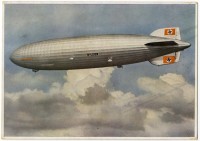
LZ-129 Hindenburg: A Detailed History
Origins of LZ-129 Hindenburg The astounding success of the Graf Zeppelin had proved the viability of long range passenger transportation by airship, and by the...
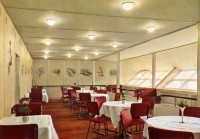
The Hindenburg's Interior: Passenger Decks
The interior spaces on the Hindenburg were divided into three main areas: Passenger Decks Control Car Crew Areas The passenger accommodation aboard Hindenburg was contained within the...

Hindenburg Flight Operations and Procedures
An overview of flight operations and flight procedures of the airship Hindenburg. [To learn about the “hardware” of flight — the flight instruments and controls...
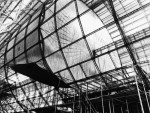
Hindenburg Design and Technology
Hindenburg’s Basic Design The basic design of LZ-129 Hindenburg was conventional, and based on time-tested technology used by chief designer Ludwig Dürr and the Zeppelin...

Hindenburg Statistics
LZ-129 Hindenburg statistics: Length: 245 m / 803.8 feet Diameter: 41.2 m / 135.1 feet Gas capacity: 200,000 cubic meters / 7,062,000 cubic feet Lift:...
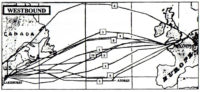
Hindenburg Flight Schedule
A list of all flights of the airship Hindenburg, with dates, departures, and arrivals. For details on particular flights, visit: Hindenburg Disaster: The Last Flight...

The Hindenburg Disaster
The Hindenburg disaster at Lakehurst, New Jersey on May 6, 1937 brought an end to the age of the rigid airship. The disaster killed 35...
Hello!
I am trying to find a manifest list of the penultimate and ante-penultimate eastwards bound flights of the Hindenburg. I am doing research into a family called Davies (possibly Davis) who are said to have been on one of these two flights.
Does anyone have any suggestions as to where I might get access to these manifests?
A Marguerite Hortense Seagraves Davis of Houston Texas (born April 9, 1909) was on Flight 43 from Frankfurt am Main (departed 26 September 1936) to Lakehurst (arrived 29 September 1936). Does this help?
Very kind of you to reply, but not my family I’m afraid. My Davies/Davis was a land estate manager in Patagonia – both Chile and Argentina – they flew back to Europe from Brazil. I only know the son’s name – Richard Middlecott Davies, born in Patagonia (Chile, I think) on 13th July 1934.
I looked at the later Eastbound passenger lists from LZ-129 and I did not see anyone named Davies or Davis. 🙁
Is it possible they flew from South America on LZ-127? That would have actually been more common.
Thanks again for looking. I’m afraid I have only a comment from an elderly relative that “the family flew on the last but one flight of the Hindenburg” – which I suppose can be parsed in several ways!
Oh wait! That phrasing suggests they might have flown in 1937. I looked through the 1936 lists to/from North America.
The ship made one round-trip to South America in 1937 before the final flight to Lakehurst, so perhaps they flew from SA to Germany on that flight.
All accounts say they flew from Brazil – to Europe. I’m sorry I have so little information, but fabrication isn’t going to help!!
Is the a site I can search for my grandfather’s name to confirm his passage on the Hindenburg.
Herbert E Tautz of Milwaukee, WI
I just looked through all printed passenger lists for the ship’s Eastbound flights and did not see the name Herbert E Tautz. I don’t have all the Westbound lists, and since the lists I have were printed in advance, sometimes a passenger who bought a ticket at the last minute is not included.
In the early 1950’s a “BLIMP” flew over the Hamden area of CT… My father said it was only for very rich people… We were quite well- off, BUT, not very rich … I was too young to understand???
Hi Dan,
I want to belatedly extend my congratulations to you for the excellent Nova episode on Mr. Schenck’s film of the Hindenburg crash. At my advanced age it is nice to know I can still be astonished by a piece of Hindenburg film. Like Barbara Weibel I was shocked at the way this film showed the speed of the event, and the utter hopelessness of it all for those who were killed and disfigured. This is the view the assembled “audience” had from the southwest corner of the hangar, a view like Foo Chu’s still shots.
Likewise I was fascinated to see the scenes filmed before the crash, especially the civilian ground crew members trooping out to the field to get their assignments. This leads me to a couple of questions: first, are there more shots like this that the Nova producers chose not to include, and if so what do they show? Since this reel has titles added by Mr. Schenck I assume he might have edited some scenes out himself thinking they would be of no interest. Au contraire! For zeppelin-heads every frame of this film is terra incognita.
Happy Fathers Day and thanks again,
Dennis
It’s an honor to have such kind words from Dennis Kromm.
Thank you for taking the time to post a comment. 🙂
can you check for the name Barbra Selznick please
Check the name for what?
Hi, great site. I’m wondering if you can help me find the route The Hindenburg flew for the propaganda flights when they dropped leaflets. Any ideas? Particularly wondering if there were an propaganda flights over or around Frankfurt. Thanks!
Fahrt Nr. 8 Deutschlandfahrt: Friedrichshafen – Friedrichshafen – 26.-29. 3.1936Fahrtdauer: 74 Stunden 04 MinutenFahrtweg: 6676 km26.3.1936:Vom Mast gelöst (12:08) – Ausfahrt aus der Halle (15:13) – Aufstieg (15:21) – Ravens-burg (15:30) – Ulm (16:05) – Nürnberg (17:26) – Bayreuth (18:10) – Plauen (19:25) Chemnitz (20:18) – Görlitz (22:05) – Landsberg (23:55)27.3.1936:Stolp (02:00) – Leba (02:37) – Rixhöft (03:19) Brüster Ort (04:45) – Cranz (05:12) – Tilsit (06:16 – 06:27) – Stallupönen (Treffen mit dem LZ 127 – 07:25) – Insterburg (07:30) – Wehlau (07:50) – Königsberg (08:15) – Gerdauen (09:04) – Nordenburg (09:15) – Rastenburg (09:55) – Sensburg (10:04) – Nikolaiken (10:19) – Johannisburg (10:34) – Ortelsburg (11:10) – Wartenburg (11:38) – Allenstein (11:42) – Tannenburg Denkmal bei Hohenstein (12:10 – 12:20) – Neudeck (13:05) – Marienwerder (13:18) – Marienburg (13:52) – Elbing (14:14) – Danzig (14:42 – 14:57) – Stolp (16:26) – Stettin (18:10 – 18:21) – Ueckermünde (18:44) – Anklam (18:57) – Greifswald (19:15) – Stralsund (19:28) – Rostock (19:59) – Wismar – Lübeck (20:45) – Neumünster (21:05) – Rendsburg (21:18) – Schleswig (21:30) – Flensburg (21:45) – Eckernförde (22:32) – Kiel (22:45) – Hamburg (23:50)28.3.1936:Abfahrt Hamburg (00:30) – Elbe Feuerschiff (03:00 – 03:16) – Helgoland (03:33 – 03:55) – Husum/St Peter (05:40) – Cuxhaven (07:24) – Bremerhaven (07:50 – 08:07) – Varel (08:54) – Oldenburg (09:15) – Münster (11:55) – Bielefeld (12:45) – Herford (12:53) – Oeynhausen (13:00) – Minden (13:10) – Stadthagen (13:25) – Hannover (13:48 – 13:50) – Braunschweig – Gardelegen – Stendal (15:33) – Rathenow – Berlin (16:40 – 17:32) – Magdeburg (18:29 – 18:35) – Dessau – Bitterfeld (19:14 – 19.23) – Leipzig (19:59 – 20:17) – Berlin (21:35 – 23:00) – Treuenbrietzen (23:33) – Wittenberg (23:50)29.3.1936:Bitterfeld (00:14) – Halle (00:30) – Leuna-Werke (00:42) – Merseburg – Weißenfels (00:51) – Naumburg (00:59) – Apolda (01:14 – 01:15) – Erfurt (01:37) – Gotha (01:50) – Eisenach (02:08) – Paderborn (03:22 – 03:40) – Lippstadt (03:44) – Hamm (04:09) – Bocholt (05:00) – Cleve (05:30 – 05:40) – Duisburg ( 06:13) – Dortmund (06:51) – Düsseldorf (07:40) – Krefeld ( 07:56 – 08:00) – Köln ( 09:30 – 09:46) – Koblenz (10:47 – 10:50) – Trier (11:50) – Merzig (12:14) – Saarbrücken (12:34) – Neunkirchen (12:45) – Saarbrücken (12:50) – Zweibrücken (13:20) – Kaiserslautern (13:30) – Frankfurt am Main (14:06 – 14:13) – Darmstadt (14:30) – Ludwigshafen (14:54 – 14:58) – Heidelberg (15:07) – Stuttgart (15:48) – Landung Friedrichshafen (17:25) – am Mast gesichert (17:44) – Einfahrt in die Halle (18:05)
Dan can you orient people who travel out of the Frankfort airport now where the Hindenburg and Graf Zeppelins hangars were located.
I think I sort of have my answer as I compared the site of Zeppelinheim now on a map to a map of the airfield made in the late 1930’s I think that the hangars were where the new terminal is going to be where the site of the former U.S. air base was or just where the runway closest to it was
I had no idea that Hindenburg used duraluminum from R-101. That is pretty spooky. Great website!
Dan,
Any idea what happened to the remains of the Hindenburg after the crash? It would be interesting to imagine all that aluminum eventually being made into B-17s and sent back to Germany, so to speak.
John
What was left was sent back to Germany for an evaluation of “what went wrong”. The only remaining parts are at a Museum in Friedrichshaften Germany on Lake Constance. What I saw was the docking point of the airship and 1 of the 12 cylinder motors. A very cool place and a must see.
only 11 years late
I have a printed list of travellers (crew + passengers) on the Hindenburg’s journey from Rio de Janeiro on 2 December 1936. I’m happy to send a scan of it to anyone who would find this information of interest.
Colin
Hi Dan!
A few weeks ago I had to make an offer for a huge (1/5 scale), flying “Hindenburg” model for a movie project and I finally got asked if it would be possible to recreate the “Hindenburg” in 1/1 scale…!!!
My rather superficial research resulted in a devastating answer. First, as there is almost no know-how on how to build large rigid airships anymore, the total cost for engineering, construction and flight tests would add up to more than 1 billion dollars.
Second, for an exact replica of the “Hindenburg” it would be almost impossible to get a certificate of airworthiness according to modern standards, even if the airship will be equipped with modern avionics and a fly-by-wire system.
When the the 9 million-dollar partial replica in the Zeppelin Museum Friedrichshafen was designed, the engineers encountered all the problems associated with recreating an advanced old Zeppelin airship.
Though a complete set of drawings was available (but few assembly drawings), it took them months to find out how the pieces must be put together. By employing cardboard models they found the one and only way in which the different pieces can be riveted together. This only gives a slight impression on how it would be to rebuild the complete “Hindenburg”.
Andreas