On this day in 1919, the British airship R34 completed the first round-trip crossing of the Atlantic ocean by air.
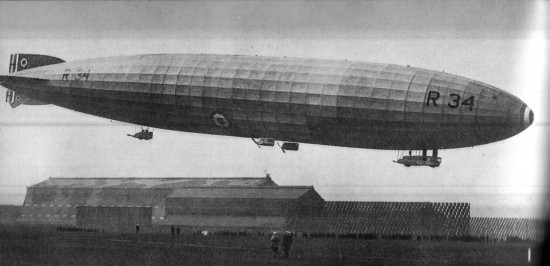
Westbound Crossing
R34’s flight from Scotland to New York was the first nonstop flight across the Atlantic from East to West, against the prevailing westerly winds; a feat that would not be accomplished by airplane until 1928.
The ship left East Fortune, Scotland on July 2, 1919, and landed in Mineola, New York on July 6, 1919, after a flight of 108 hours and 12 minutes.
Eastbound Return
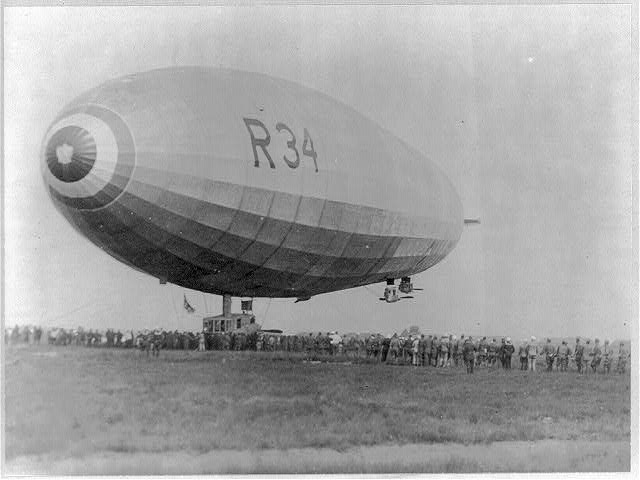
The ship sailed home on July 10, 1919, and arrived in Pulham, England on July 13, 1919 after a flight of 75 hours and 3 minutes. It was the first round-trip crossing of the Atlantic by air.


Stu:
That’s a good point you make there about fuel-efficiency being the answer to the question I posed. It may even be the correct answer. My hesitation is that, as I mentioned in my reply to glenn’s post earlier, a conventional winged aircraft actually beat the airship on the eastbound crossing. Also, I don’t have fuel consumption figures for either craft, the R 34 or Alcock and Brown’s Vickers Vimy, which made the world’s first nonstop transatlantic eastbound crossing, despite its possibly having had poorer fuel economy than the R 34, so I can’t really verify your point.
As for airships being “the Priuses of the air,†that is not so clear, either. Modern fuel-efficient jet aircraft get as many as 96.9 mpg per seat, according to DOT figures, which beats a Prius carrying one passenger. Also, there is a significant disanalogy between Priuses and airships, and that is in the matter of speed. A modern jet aircraft is easily five or six times faster than even the fastest airship, whereas Priuses and conventional, non-hybrid cars can travel at the same speed.
For jet aircraft as the actual Priuses of the air, see:
http://online.wsj.com/news/articles/SB10001424052748704901104575423261677748380
It is sort of amazing that this large, expensive, and comparatively slow aerial vehicle accomplished these crossings before the comparatively light, fast, and relatively inexpensive airplane was able to. Does anyone have a nice, neat and simple explanation of this fact?
The explanation is the following: They offered a “work around” for engine technology, navigation technology, and the limits human endurance to deal with these deficiencies of the day.
Even through the end of WWI engines were still unreliable, limited by fuel consumption (range) and performance when running for long periods. Combined with the limits of navigation of the time, this limited planes performance. A platform which could stay airborne for extended periods with multiple engines, radio communication and a full service crew to deal with all the challenges of the technology, solved these problems.
Case in point: The R34 was essentially a direct copy of German WWI zepp, BUT HAD A WOOD FRAME. The trip was made by the skin of the teeth: Commander Scott had a list of problems, engines included (They were Sunbeam engines I believe. A bad choice) and barely made it to the United States, with about 20 minutes of gasoline left to burn.
I’ve been an airship buff since 1991, and have extensive notes and books on the subject. I just discovered this site. Great job!
Thanks for your answer. I agree about engine unreliability and navigational problems, but I don’t see how the dirigible by itself solved the latter. And despite the challenge of long-endurance engine performance, the British aviators Alcock and Brown nevertheless made it first across the Atlantic Eastbound, nonstop, on 14-15 June 1919, doing so in 16 hours, at an average speed of 115 mph. So it might be just an accident of history that the Westbound crossing was not made first by an airplane as well.
The answer is simple. An airship is an aerostat which means it flies without the need of an engine pushing it through the air creating dynamic lift. An airplane (then as now) is an aerodyne which means it gains flight only by moving through the air using the air movement across it’s wings to create lift. With a stall speed of zero, the airship only needed it’s engines to move it through the air, not to keep it in the air. So the airship, particularly the larger ones, had the ability to haul vast amounts of fuel aloft and use low power to move them through the air. The result was a aircraft that had far greater duration and distance than any fixed wing aerodyne at that time. Today, jet liners can achieve these distances, but burn many times more fuel doing so than the airships of long ago. Airships are still the most economical way to fly in terms of fuel usage. Consider them the “Priuses” of the air.